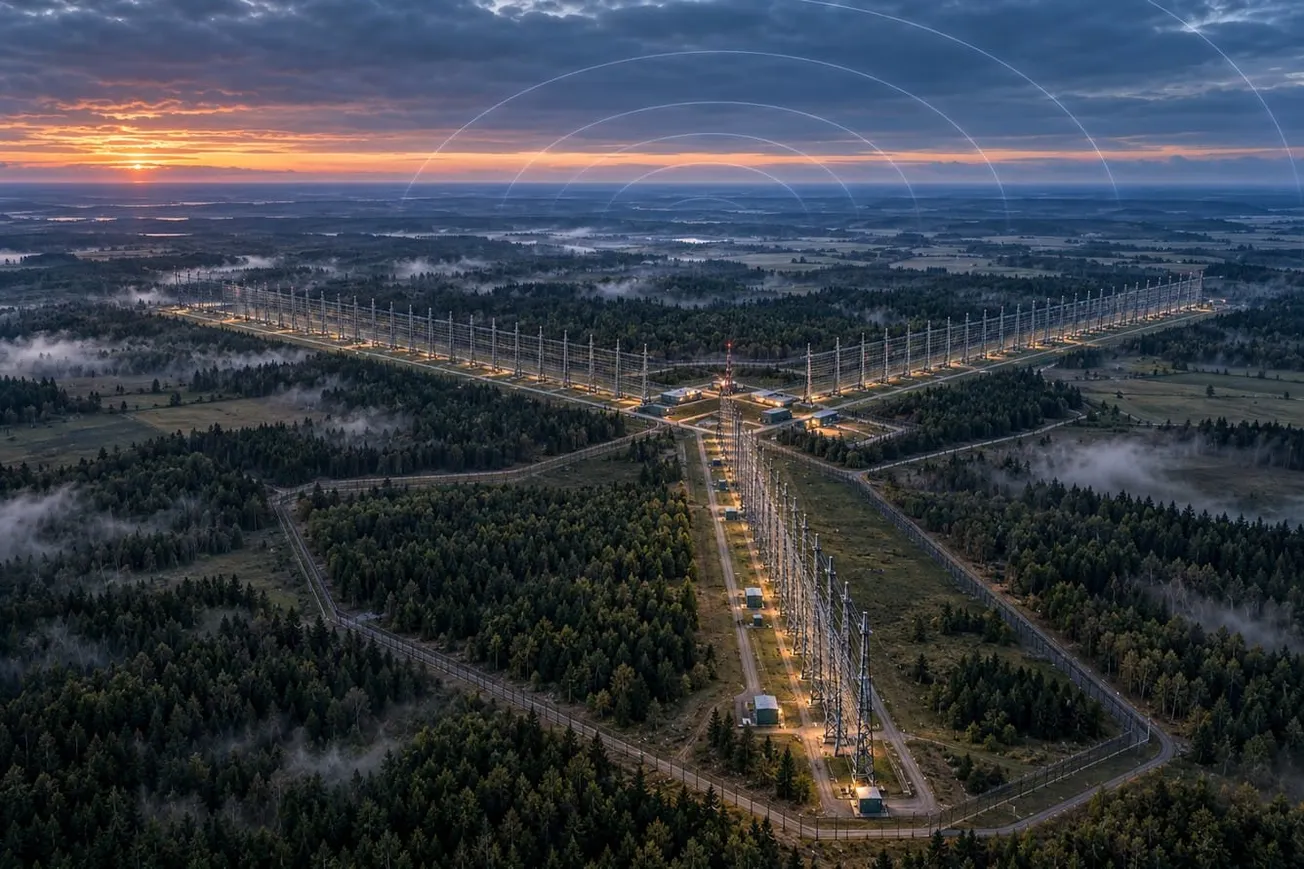
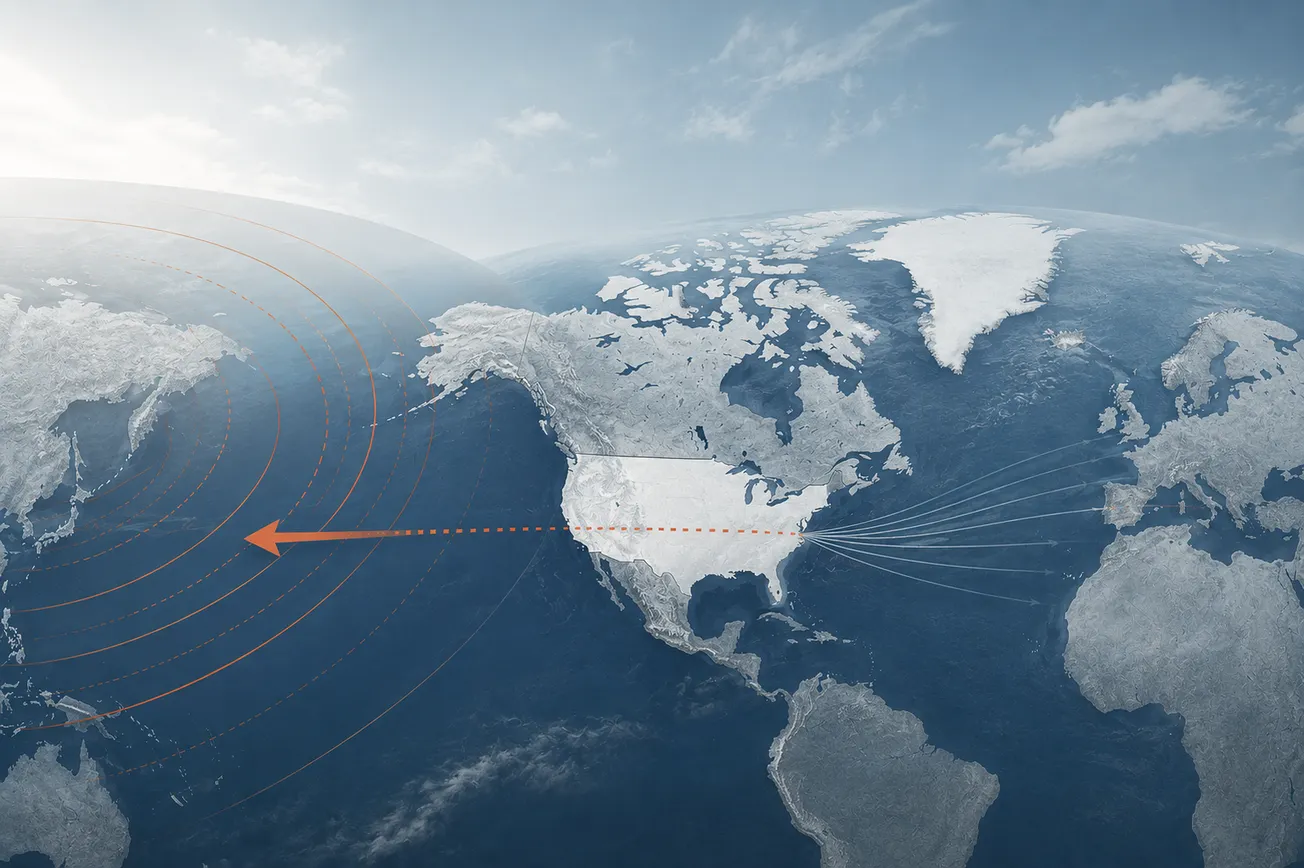
America cannot be strong in every theater at once. For eight decades, it spent as though it could, and Europe was glad to let it. The arrangement began to end on June 12.
That day, the Pentagon notified European allies, in writing, that the United States would sharply reduce the forces it commits to NATO’s collective defense. Washington intends to withdraw about a third of the fighter jets it has earmarked for the alliance, pull the aerial tankers that keep those jets flying, cut its surveillance aircraft, reassign one of its two bomber contingents, and move a missile submarine and a carrier strike group out of the European pool.
The war with Iran owned the headlines through the spring. On Sunday, the White House announced a deal with Tehran to reopen the Strait of Hormuz, with a signing set for Friday in Geneva, and the long fight wound toward its close.
Rewind to January, when the administration published a National Defense Strategy that plainly ranked the country’s priorities: defend the homeland, deter China in the Indo-Pacific, and leave allies elsewhere to take “primary responsibility” for their own security with more limited American help. In May, a senior defense official briefed NATO members in Brussels on the coming reductions. The June notice surprised no one watching closely; it was a scheduled step the Iran war had kept out of public view.
The European members of NATO command a combined economy exceeding $20 trillion and a population larger than America’s. They have possessed the resources to defend themselves for a generation. What they lacked was the will, because Washington provided the muscle while asking little in return. In early June, the commander of U.S. forces in Europe, General Alexus Grynkewich, put the problem plainly: an “unhealthy codependence” in which the alliance relied on American power because its structure encouraged it.
The Iran war exposed how that dependence runs in only one direction. When the United States asked its allies to help keep the Strait of Hormuz open, Europe largely shrank from the task. Germany ruled out a military role, while Britain and France offered little beyond hesitation. The Iranian missile threat reached Europe’s cities and energy supplies far more directly than America’s. Even so, much of the continent treated the conflict as someone else’s problem. We wrote at the time that America’s allies had begun to behave more like China than they cared to admit.
The Pentagon’s own planners now concede what years of overstretch have made undeniable: the U.S. military is built to fight one major war at a time, not two. That reality leaves little room for ambiguity about priorities. The decisive theater is the Pacific, where a single competitor is assembling the first military since the Soviet Union capable of meeting the United States as a near-peer. Beijing’s nuclear arsenal is projected to exceed 1,000 warheads by 2030. Its navy is expanding toward a fleet of nine aircraft carriers; its long-range missiles already reach far enough to threaten American forces across the Indo-Pacific and, increasingly, the U.S. homeland.
Europe is the theater America can responsibly hand off. Russia remains a serious threat, but it is one that a continent with Europe’s wealth and resources is capable of managing. The strategy says as much, describing Moscow as a persistent but containable challenge that Europe is well positioned to lead against. Concentrating resources where the balance of power is genuinely contested means freeing American capacity from regions that no longer need the United States to carry the burden.
The Republican chairmen of the Senate and House Armed Services Committees, Roger Wicker and Mike Rogers, have warned against reducing America’s forward presence while Russia presses NATO’s eastern flank, saying it would send the wrong signal to Vladimir Putin. Their concern is understandable, but waiting is the wrong answer. There will never be a perfectly quiet moment for such a shift, because Russia will always be testing the alliance somewhere. The case for acting now rests not on Russia’s behavior, but on the fact that Europe is finally beginning to shoulder responsibility for its own defense.
A year ago, at the Hague summit, nearly every ally agreed to spend five percent of GDP on defense, a pledge we called the end of the free ride. Germany has committed to fielding the strongest conventional army in Europe, adding 100,000 soldiers, and basing a permanent brigade on NATO’s eastern flank. Europe is rearming in earnest, and that progress is what makes the handoff responsible rather than reckless.
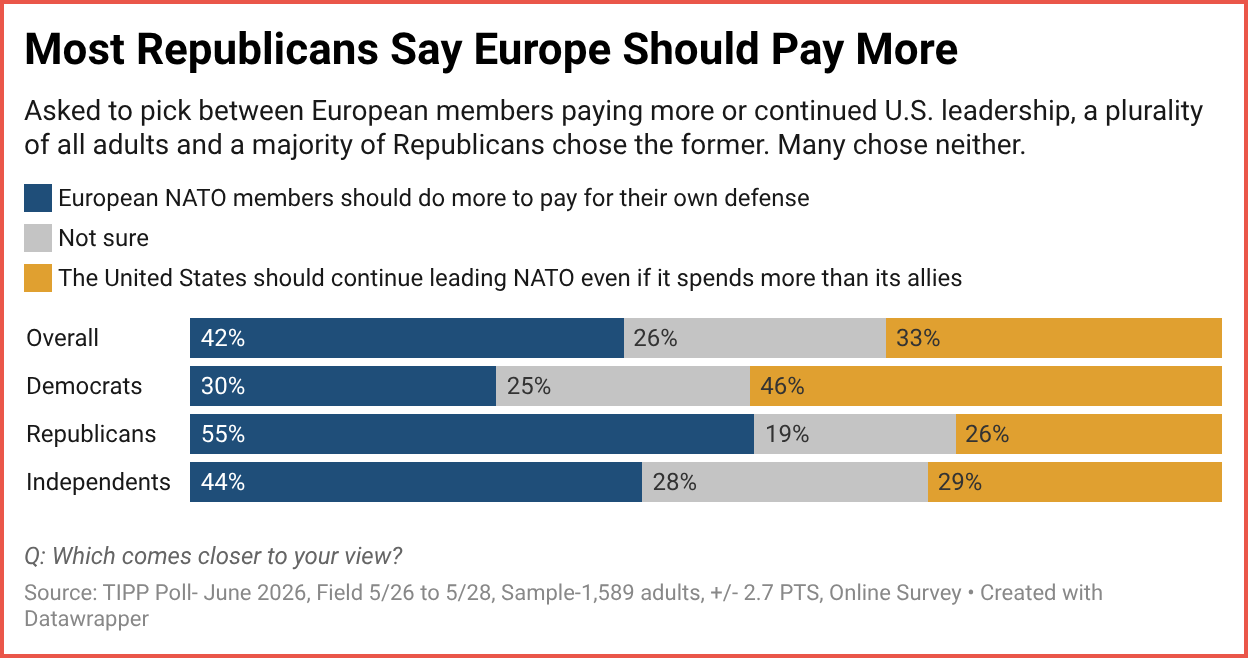
The public, however, sets a clear limit. Our June poll found that, asked to choose, a plurality overall and a majority of Republicans say European members should shoulder more of the cost. But they do not want America to abandon its commitment. Fifty-six percent favor maintaining or strengthening the U.S. commitment to NATO, while only about one in five would scale it back. Even among Republicans and independents, more support keeping or deepening the commitment than scaling it back. The public’s mandate is clear: shift the burden, not abandon the alliance.
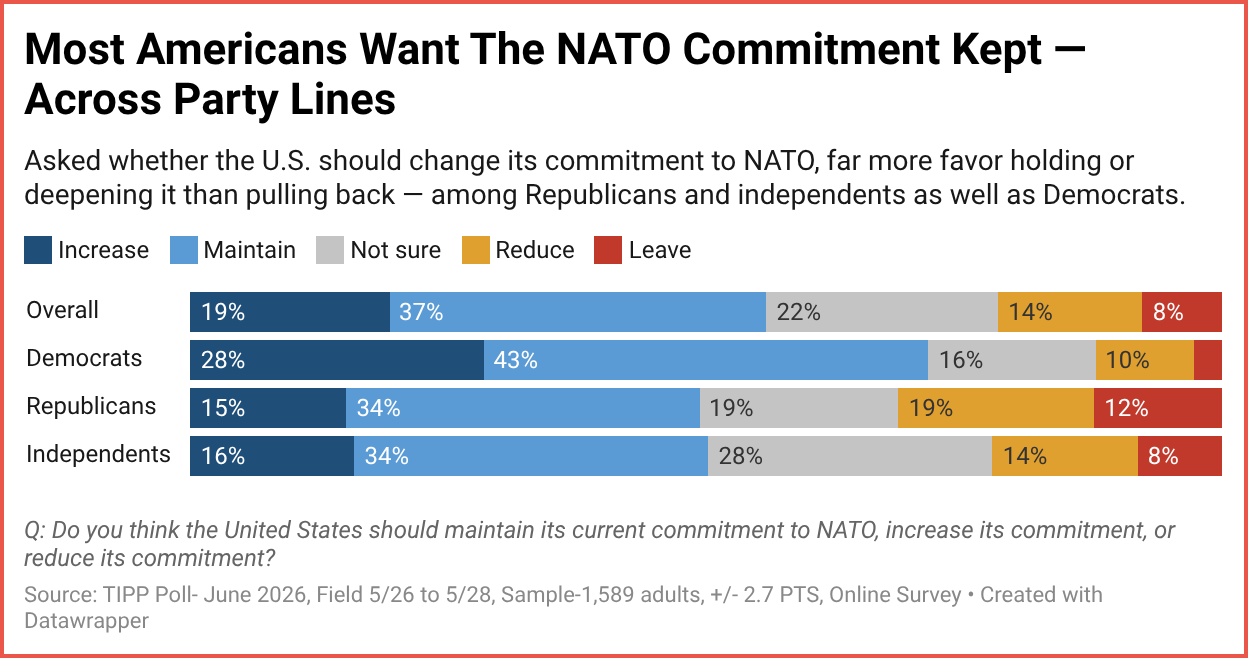
That distinction governs the entire debate. The forces under review are those NATO would rely on in the opening phase of a crisis. Reducing them is not the same as withdrawing from the alliance. By law, a president cannot withdraw the United States from NATO entirely without Senate approval or an Act of Congress, and the minimum U.S. troop presence in Europe remains in place. The challenge is to shift some military resources to the Pacific while leaving no doubt that America will honor its NATO commitments if the alliance is attacked.
For a generation, America watched the wrong ocean. Now it faces the right one.
🌍 Global Affairs
The world's flashpoints, in motion.
🟦 U.S.-Iran Peace Deal Sparks Political Backlash In Israel – TIPP News
🟦 How Open-Source Intelligence Is Defeating Hamas And Hezbollah – Pedro Rodriguez, The Daily Signal
🟦 Protests Erupt Ahead Of Iran’s World Cup Match At SoFi Stadium – TIPP News
🟦 Canadian Envoy Says USMCA Discussions Are Progressing Well – TIPP News
🏛️ National Affairs
The fights shaping America right now.
🟥 ICYMI: The Dems’ Anti-ICE Campaign Was An Epic Fail – Editorial Board, Issues & Insights
🟥 Supreme Court To Review Migrant Detention And Bond Hearing Case – TIPP News
🟥 B-52 Bomber Crashes After Takeoff At Edwards Air Force Base – TIPP News
🟥 White House Releases New Files Showing Mysterious Orb Videos, Accounts Of UFO Sightings – Elizabeth Troutman Mitchell, The Daily Signal
🟥 Why Did JD Vance Convert To Catholicism? – TIPP News
🟥 ‘Gross Misuse Of Federal Funding’: Trump Admin Blocks Payments To ‘Obviously Fraudulent’ Los Angeles Homeless Agency – Joseph Buff, The Daily Signal
🟥 Federal Judge Warned Of ‘Obvious Fraud.’ Karen Bass Still Wants The Status Quo. – Mehek Cooke, The Daily Signal
🟥 Immigration Officer Fires Weapon During Failed Arrest Attempt – TIPP News
🟥 Trump State Department Moves To Deport Trita Parsi – Kurt Nimmo, Ron Paul Institute for Peace and Prosperity
🟥 Spy Power Extension Fails As Conservatives Demand Privacy Reforms – Virginia Grace McKinnon, The Daily Signal
🟥 Lawsuit Exposes Virginia’s Neo-Confederate Approach To Immigration – Tyler O’Neil, The Daily Signal
🟥 Brian Kemp Endorses Burt Jones In Georgia Governor’s Race – TIPP News
🟥 FBI Warns Microsoft 365 Users About Emerging Kali365 Scam – TIPP News
🟥 Data Center Civil War Leaves Virginia On The Verge Of A Shutdown – Virginia Grace McKinnon, The Daily Signal
🟥 Agreement On Data Centers Falters As Ohio Lawmakers Go On Recess – Rebecca Downs, The Daily Signal
🟥 Why Students Walked Away During Google CEO Speech – TIPP News
🟥 Experienced Skydivers Among Victims Of Missouri Plane Crash – TIPP News
🟥 RIP Feminism: Reflections From TPUSA’s Women’s Leadership Conference – Jennifer Galardi, The Daily Signal
🟥 The Academic Achievement Gap Is A Knowledge Gap – Ella Jackson & Jonathan Butcher, The Daily Signal
🟥 An Obama-Era Border Crosser – Terence Jeffrey, Daily Caller News Foundation
🟥 Conservation Was Always A Conservative Value – Mollie Engelhart, The Daily Signal
🟥 A Requiem For Privacy – Andrew P. Napolitano, Ron Paul Institute for Peace and Prosperity
🟥 America The Unfree—Home Of The Policed, Surveilled And Occupied – John W. And Nisha Whitehead, Ron Paul Institute for Peace and Prosperity
🟥 D-Day at 82: An American’s Experience At Normandy – Emily Claire Boulet, The Daily Signal
🟥 Why Eisenhower Believed ‘Under God’ Was Vital To America’s Identity and Victory In The Cold War – Fred Lucas, The Daily Signal
🟥 The Abolitionist Movement In The Antebellum South – Wanjiru Njoya, Mises Wire
🟥 Giving Americans More Choices For Their Retirement Savings – EJ Antoni & Nicole Huyer, The Daily Signal
📊 Market Mood · June 16, 2026
How the trading day is setting up.
🟩 Markets paused after Monday’s rally as investors waited for details of the U.S.-Iran peace framework and assessed how quickly energy markets can return to normal.
🟧 Oil prices continued to fall, with Brent crude dropping toward $80 a barrel as expectations grew that the Strait of Hormuz will reopen and global energy supplies will improve.
🟦 The Federal Reserve takes center stage this week. While rates are expected to remain unchanged, investors are looking for clues from Chair Kevin Warsh on whether easing energy pressures could soften the Fed’s outlook.
🟨 SpaceX remained a market sensation, extending gains after its record-setting IPO and underscoring continued investor appetite for transformative technology and AI-related growth stories.
🗓️ Key Economic Events
On today's U.S. data calendar.
No events scheduled.
Letters to the editor email: editor-tippinsights@technometrica.com
Subscribe Today And Make A Difference. Consider supporting Independent Journalism by upgrading to a paid subscription or making a donation. Your support helps tippinsights thrive as a reader-supported publication. Contact us to discuss your research or polling needs.
Reach our audience. For sponsorship and advertising opportunities, visit our Partner With Us page.