
With October 15 fast approaching, it is hard to believe the first college applications for the Fall 2027 season are due at elite schools such as Stanford (for those submitting portfolios), UT Austin, UNC Chapel Hill, and Georgia Tech (for state residents).
Two weeks later, hundreds of colleges will begin processing applications from their Early Action, Restrictive Early Action, and Early Decision deadlines.
But this year, colleges have gone out of their way to simplify the process. So simplified that, in just 10 short years, the entire college admissions journey has become a real-life example of Dumb and Dumber.
UNC Chapel Hill and Georgia Tech decided to do away with supplemental essays altogether. Virginia, Washington, Auburn, and Rutgers did the same. Many private colleges followed suit, including Miami, Colby College, Case Western Reserve, and Northeastern.
In a world where high school students’ ability to express themselves creatively is becoming severely tarnished by ever-shorter attention spans and the increasing use of AI for schoolwork, some of our best colleges are silently defining deviancy down, as the late Sen. Daniel Patrick Moynihan said.
Moynihan did not have college essays in mind when he argued in a seminal 1993 article that when a society experiences a massive surge in deviant behavior—such as rising crime rates, family breakdown, or homelessness—it lacks the institutional capacity to punish or correct it all. To cope with this overload, society redefines the behavior as “normal” rather than fixing or fighting it.
For decades, America has been unique in that universities look for character traits and skills beyond grades and test scores, and they do so by challenging students to submit essays as part of their applications.
Writing samples matter because a good prompt forces a student to take a position, support it, and do so in a fixed word count. When students express themselves, supplements serve as a proxy for voice and judgment. A student who writes clearly about something mundane often reveals more than one who writes dramatically about something staged for the application.
And contrary to myth, supplements level the playing field.
In a world where tutoring assistance, school funding, and family support drive a wedge between the haves and have-nots, an essay was a place where a student with fewer resources could compete purely on reflection and voice, since paper and thought are free.
Eliminating or reducing the number or word count of supplemental essays and short-answer questions significantly lowers the burden on all applicants, but at what intellectual cost?
Georgia Tech used to challenge freshman applicants with a solid question. “Why do you want to study your major, and why do you want to do so at Georgia Tech?”
UNC used to ask applicants, “Discuss one of your personal qualities and share a story, anecdote, or memory of how it helped you make a positive impact on a community. This could be your current community or another community you have engaged.”
No more. These supplements were eliminated and have created a new lower normal, defining deviancy down.
Duke University was among the first elite schools to start this trend a few years ago. According to Christoph Guttentag, the school’s dean of undergraduate admissions, application essays would no longer get numerical scores, with admissions officers reviewing the submissions “primarily to understand the student’s lived experience.” In effect, Duke was saying it would no longer use a rubric to evaluate the quality of a submitted essay. This was like grading a paper without any framework.
It was not just Duke.
For years, the Common App platform, the go-to application portal to apply to nearly 900 colleges, has asked students to write a personal statement answering one of seven prompts. The last prompt, #7, is absurd for assessing a student’s character, voice, or judgment.
“Share an essay on any topic of your choice. It can be one you’ve already written, one that responds to a different prompt, or one of your own design.”
The prompt is so broad and open-ended that it is like writing a newspaper article without a title or subtitle, and therefore with no guardrails. So an 11th-grader who wrote an essay about the Russia-Ukraine war and got an A from the teacher after help improving the write-up could copy and paste it into the Common App writing section. And apply to Georgia Tech with no other writing samples needed.
Numerous Tier-2 and Tier-3 colleges do not even require the Common App essay, not even prompt #7. The University of Texas at Dallas and the University of Houston join nearly 40 public universities in Texas in telling students that the only metric they will use is the high school transcript. No test scores (SAT/ACT) either. Recommendation letters are optional as well.
As we go down the Dumber scale, several universities with low enrollments and lower yields (the percentage of students who receive an offer of admission and actually enroll) have been offering “Direct Admission” to students who didn’t even apply.
Under the excuse of making higher education more accessible, Texas happily joined in. Current 11th-grade Texas students must now opt in or opt out of the direct admissions program. If you opt in, several colleges and universities, including the University of North Texas and Texas State, will send admissions offers directly to your home address based on the grades your high school reports to these colleges. No application needed. No test scores. No Common App essay. No supplemental essays.
In the 1970’s ABC sitcom Three’s Company, the landlord character Ralph Furley, played by Don Knotts, says a memorable line in Season 5, Episode 22, titled “Honest Jack Tripper.” After striking out or trying to lower his expectations to find a date, Furley explicitly lays out his rock-bottom criteria to Jack Tripper:
“Let me put it this way. If she’s got body heat... and speaks a few words of English, I wanna meet her.”
Many American colleges are coming dangerously close to this line.
Rajkamal Rao has been a TIPP Insights columnist and member of the Editorial Board for over four years. He also publishes on Substack, with all of his work available for free. Readers may subscribe to get new articles sent straight to their inbox.
Loved it, hated it, or somewhere in between — tell us. Grade this article here and help shape what lands in your inbox next.
Brazil’s Presidential Race Heads To Lula–Bolsonaro Runoff
Brazil’s presidential race is heading to a runoff between Senator Flávio Bolsonaro and incumbent Luiz Inácio Lula da Silva after neither of them secured more than 50% of the vote.
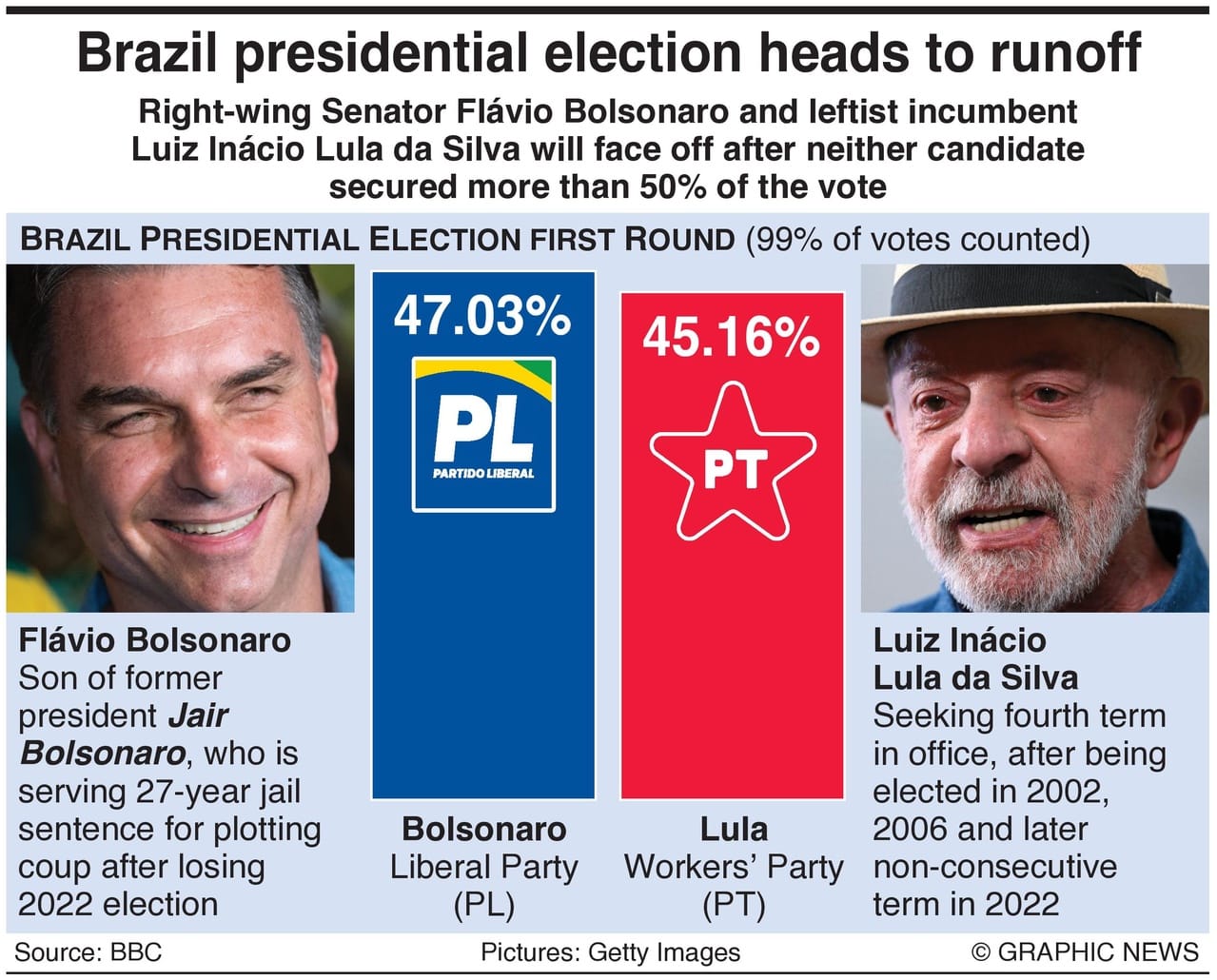
There will be a run-off between the two candidates on 25 October.
Flávio Bolsonaro is the son of the former right-wing president Jair Bolsonaro, who is serving a 27-year prison sentence for masterminding a failed coup after losing the 2022 election.
Sunday’s vote was close, with President Lula polling slightly ahead during the campaign. With almost all the votes counted, Bolsonaro had 47.03% to Lula’s 45.16%.
Bolsonaro’s result exceeded expectations, meaning the second round now looks like his to lose, given some of the other presidential candidates knocked out in the first round were right-wing alternatives, the BBC said.
🧭 Power & Capital · October 5, 2026
Where state power meets the boardroom.
🔷 What Is Driving China’s Push To Consolidate Its Banking Sector
🌍 Global Affairs
The world's flashpoints, in motion.
🟥 Why Did The US Remove All Bombers From RAF Fairford – TIPP News
🟥 Watch: Iran Shows Resolve, Starts Military Drills For Civilian Volunteers – TIPP Video
🟥 Watch: Video Captures Heavy Clashes Between Yemeni Forces And Houthis Near Bab el-Mandeb – TIPP Video
🟥 Watch: Imran Khan Loyalists March Toward Pakistan Capital To Demand His Release – TIPP Video
🟥 Russian Authorities Probe Death Of Researcher At Plague Institute – TIPP News
🟥 Housing Crisis Pushes Spain Toward November Election – TIPP News
🏛️ National Affairs
The fights shaping America right now.
🟫 Watch: Mass Shooting Erupts In Georgia's Vienna Leaving 2 Dead, 35 Injured – TIPP Video
🟫 California Woman Charged As Unregistered Chinese Agent – TIPP News
🟫 Democrats Use Epstein Files Fight In Colorado Congressional Race – TIPP News
🟫 Karoline Leavitt Lands Fox News Role After Leaving White House – TIPP News
🟫 Nobel Medicine Prize Goes To Scientists Behind Brain-Mapping Technique – TIPP News
📈 Economy
Prices, policy, and the pressure on your wallet.
🟩 It’s That ‘70s Show All Over Again – Editorial Board, Issues & Insights
💼 Markets & Business
The deals and tickers making moves.
🟧 Anthropic Targets Historic IPO As Investors Weigh AI Risks – TIPP News
🟧 Who Will Lead CNN After The Paramount-Warner Merger – TIPP News
Letters to the editor email: editor-tippinsights@technometrica.com
Subscribe Today And Make A Difference. Consider supporting Independent Journalism by upgrading to a paid subscription or making a donation. Your support helps tippinsights thrive as a reader-supported publication. Contact us to discuss your research or polling needs.
Reach our audience. For sponsorship and advertising opportunities, visit our Partner With Us page.