

How do Americans respond to the economic and political system known as socialism? For a decade or two after the collapse of socialism in Eastern Europe countries and other nations, the idea became untenable. Now, however, socialism has regained popularity among many, in particular Democrats, as the June I&I/TIPP Poll demonstrates.
In the latest online national poll, taken from May 26 through May 28, 1,589 voting-age respondents were asked the following question: “In general, do you have a favorable or unfavorable view of socialism?”
Those answering the poll, which has a margin of error of +/-2.7 percentage points, were surprisingly sanguine in their views: 33% said they were either “very favorable” (12%) or “somewhat favorable” (21%) toward socialism, compared to just 44% who said they were “somewhat unfavorable” (19%) or “very unfavorable” (25%) toward socialism.
Another 23% said they were “unsure.”
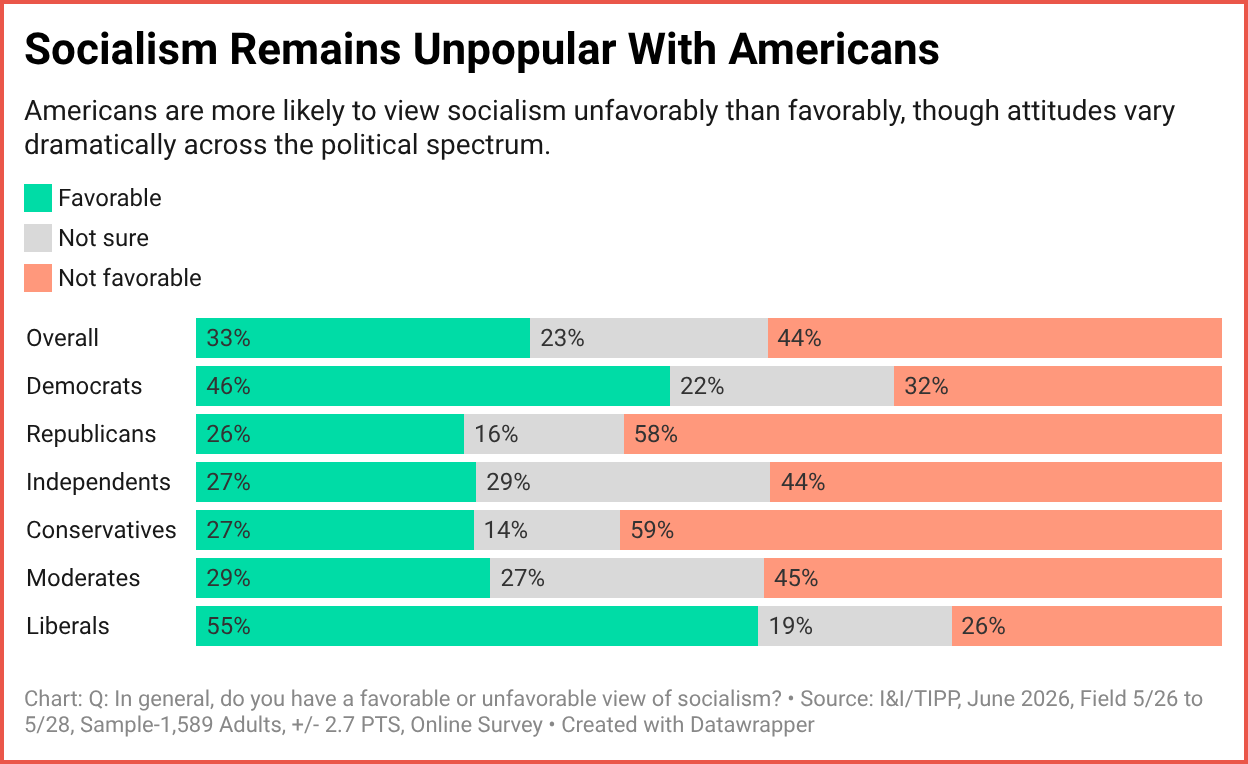
So one out of three voters in America thinks socialism is a good system.
But who are they? Mostly, Democrats. Among members of the Democratic Party, a plurality of 46% find socialism favorable, versus 32% unfavorable. Independents are slightly less, at 27% favorable, 44% not favorable, a plurality but not a majority.
Only among Republicans does an actual majority not like socialism: 26% favorable versus 58% unfavorable. But note also that even among GOP members, the conservative party of our tripartite system, one in four find socialism favorable.
It goes beyond party affiliation, with sharp splits by age (18 to 24 years, 44% favorable, and 25 to 44 years, 42% favorable), dropping with advancing age (45 to 64 years, 27% favorable and 65 years-plus, down to 21% favorable).
Men and women also split: Men (38% favorable) lean more toward socialism than women (28% favorable), though a plurality of both still find socialism unfavorable. Similarly, white Americans (29% favorable) are somewhat less pro-socialism than African-Americans and Hispanics (39% favorable).
A bigger shock: 44% of investors feel favorably toward socialism, but just 28% of non-investors do.
This wasn’t the only question. I&I/TIPP also asked: “Which economic system do you believe offers Americans a better future?”
Once again the answer surprised: only a third (33%) responded “capitalism,” while 16% said “socialism” and 26% opined “both equally.” Nearly a quarter (24%) said “not sure.”
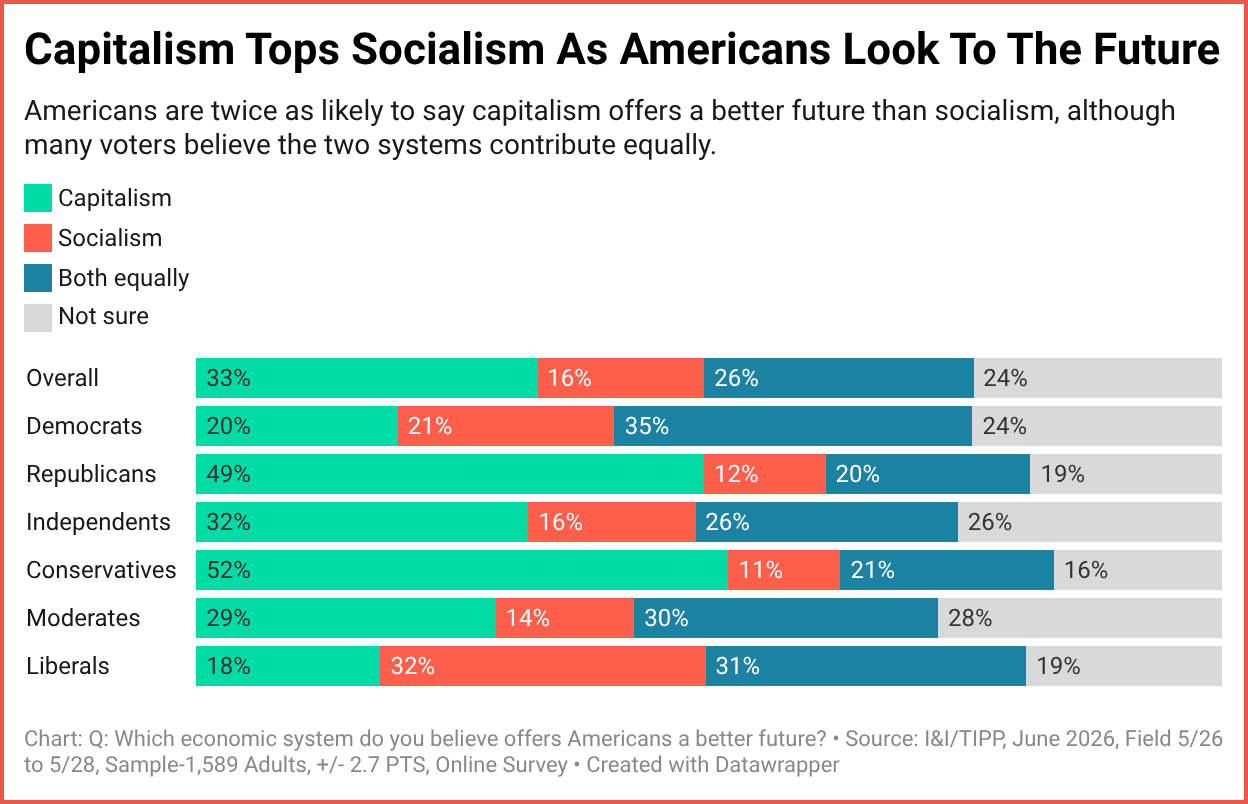
How could this be? Again, Democrats. That party’s members picked socialism (21%) over capitalism (20%), with 35% saying both equally. By comparison, independents chose capitalism (32%) over socialism (16%) and both equally (26%). Republicans selected capitalism (49%) by a wide margin over socialism (12%) and both equally (20%).
So the only group actually to prefer socialism is the Democratic Party.
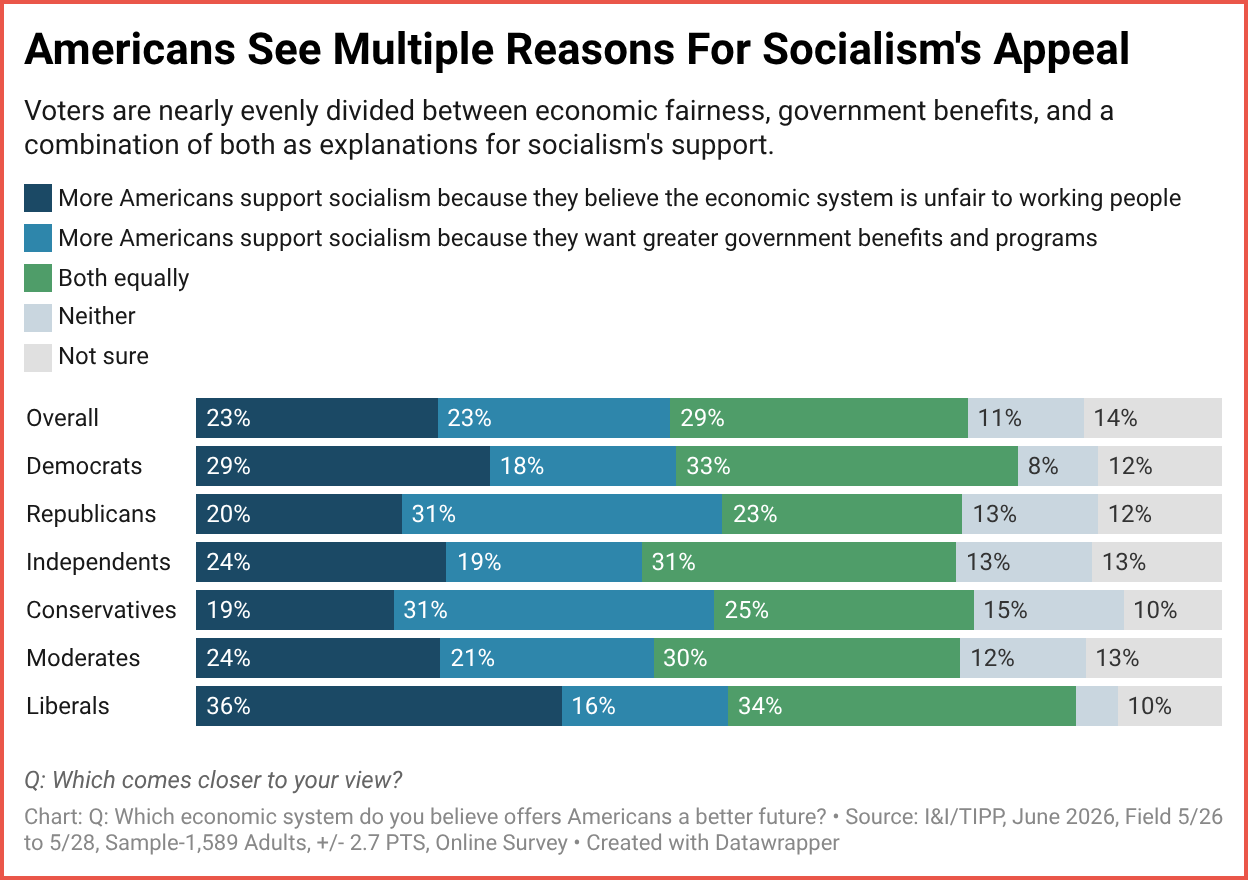
But why? We asked Americans: “Which comes closer to your view?”, followed by three choices.
The first possible response, “More Americans support socialism because they believe the economic system is unfair to working people,” won 23% support; the second possible response, “More Americans support socialism because they want greater government benefits and programs,” also won 23% backing.
But the big winner was “Both equally,” at 29%, while “neither” picked up just 11% support.
What does all this say? Perhaps that capitalism needs a new ad agency.
Calling the rise of socialism among Democrats “stunning,” CNN’s poll analyst Harry Enten recently notes, “Capitalism has absolutely fallen through the floor.”
But it should be clear: Even while 46% of Dems in the I&I/TIPP Poll find socialism favorable, 26% of Republicans and 27% of independents do too. That means not just Democrats are cooling on capitalism, but GOP and indie voters are also.
This trend has been developing for a while. A poll by the left-leaning Data for Progress group and reported by Politico found that “more than half of likely Democratic voters prefer socialist-aligned figures like Bernie Sanders, Alexandria Ocasio-Cortez and Zohran Mamdani to establishment politicians like Chuck Schumer, Hakeem Jeffries and Nancy Pelosi.”
While Americans seem unbothered by the prospect of socialism, do they know what it actually is?
Economist Daniel Mitchell, president of the Center for Freedom and Prosperity, notes the traditional economic definition of socialism: 1. “Government ownership of the means of production.” 2. “Central planning to determine the allocation of labor and capital.” 3. “Price controls as a necessary consequence of items #1 and #2.”
Are those what voters mean when they say “socialism”? If so, it is a matter of economic history that none of those policies have ever worked in actual practice. Indeed, they’ve led mainly to poverty and economic decline, as multiple studies have shown.
In its poll, Data for Progress defines Democratic Socialists as those who believe “that the government should take a more active role to improve Americans’ lives. They generally support higher taxes on corporations and high-income earners, support regulations that protect workers and consumers, and want more public ownership of key industries like housing, healthcare and utilities.”
But they believe in a lot more than that.
As the City Journal reported, the Democratic Socialists of America recently passed a “Workers Deserve More!” policy statement platform that “commits DSA to scrapping the U.S. Senate, ‘abolishing the carceral forces of the capitalist state,’ defunding the Department of War, amnesty for all immigrants, and ‘replac[ing] the president and Supreme Court with an executive and judiciary chosen by and subordinate to Congress.’”
In other words, an end to America as we now know it.
That goes far beyond their economic proposals. Even so, as the latest I&I/TIPP Poll shows, Americans appear to have edged closer to thinking socialism is an acceptable alternative to capitalism — even though the latter has an unmatched record for creating wealth and freedom, unlike socialism.
Which raises a question: Thirty seven years after the collapse of communism and socialism in 1989, have we forgotten how awful socialism was?
I&I/TIPP publishes timely, unique, and informative data each month on topics of public interest. TIPP’s reputation for polling excellence comes from being the most accurate pollster for the past six presidential elections.
Terry Jones is an editor of Issues & Insights. His four decades of journalism experience include serving as national issues editor, economics editor, and editorial page editor for Investor’s Business Daily.
Loved it, hated it, or somewhere in between — tell us. Grade this article here and help shape what lands in your inbox next.
🌍 Global Affairs
The world's flashpoints, in motion.
🟦 Iran’s Top Negotiators Travel To Oman For Hormuz Discussions – TIPP News
🟦 How China Is Poisoning America With Parkinson’s – Virginia Grace McKinnon, The Daily Signal
🟦 Why Did The U.S. Sanction Cambodia’s Prince Group – TIPP News
🟦 WHO Warns Of Rapidly Expanding Ebola Crisis In Congo – TIPP News
🏛️ National Affairs
The fights shaping America right now.
🟥 Mamdani-Backed Candidates Sweep New York Democratic Primaries – TIPP News
🟥 Judge Who Donated To Immigrant Legal Aid Group Blocks DOJ Immigration Probe Of Walz, Ellison – Fred Lucas, The Daily Signal
🟥 Judge Blocks Trump’s Use Of Revamped Immigration Database for Voter Checks – Luc Cohen, The Daily Signal
🟥 House Committees Threaten ActBlue With Contempt Charge To Gain 400 Documents On Potential Misconduct – Fred Lucas, The Daily Signal
🟥 Trump Administration Wins Ruling On Expedited Removal Policy – TIPP News
🟥 Establishment Put On Notice Over SAVE America Hypocrisy – Pedro Rodriguez, The Daily Signal
🟥 Supreme Court Weighs In On 2 Cases Involving Religious Freedom – Fred Lucas, The Daily Signal
🟥 Attorneys General Sue Over California’s Plastics Act – TIPP News
🟥 For the Love Of DEI, Virginia Democrats Inject Race Into Tourism – Virginia Grace McKinnon, The Daily Signal
🟥 Claire Valdez Wins Democratic Primary In New York’s 7th District – TIPP News
🟥 FCC Spectrum Auction Raises $3.5 Billion For Telecom Upgrades – TIPP News
🟥 Virginia Democrats Finalize Sweeping Budget Deal – Rich Tucker, The Daily Signal
🟥 Politics And Parenthood: Why Liberals Are Having Fewer Kids Than Conservatives – Kevin Stocklin, The Daily Signal
🟥 NASA Plans Mission To Rescue Aging Swift Space Telescope – TIPP News
📊 Market Mood · June 24, 2026
How the trading day is setting up.
🟩 Markets remained constructive as investors grew more confident that the U.S.-Iran peace framework will hold and allow energy supplies to normalize in the weeks ahead.
🟧 Attention is shifting from geopolitics back to the economy, with investors closely watching incoming data for signs that growth is slowing without slipping into recession.
🟦 Oil prices have retreated sharply from their wartime highs, easing inflation fears and reducing pressure on central banks to keep tightening monetary policy.
🟨 The AI investment boom remains the market's dominant long-term theme, although investors are becoming more selective as questions grow about funding costs, returns on capital, and regulatory oversight.
🗓️ Key Economic Events
On today's U.S. data calendar.
🟧 10:00 a.m. ET — New Home Sales (May)
Forecast: 695K | Previous: 693K
Housing remains one of the most interest-rate-sensitive sectors of the economy and offers a read on consumer confidence and affordability.
🟧 10:00 a.m. ET — Consumer Confidence (June)
Forecast: 101.0 | Previous: 98.0
Consumer sentiment can provide an early signal on future spending, which drives roughly two-thirds of U.S. economic activity.
🟧 Fed Speakers Throughout the Day
Focus: Inflation, growth, and the path of interest rates.
Markets will be listening for any follow-up commentary after last week's Fed meeting, particularly on whether easing energy prices could alter the outlook for rates later this year.
Letters to the editor email: editor-tippinsights@technometrica.com
Subscribe Today And Make A Difference. Consider supporting Independent Journalism by upgrading to a paid subscription or making a donation. Your support helps tippinsights thrive as a reader-supported publication. Contact us to discuss your research or polling needs.
Reach our audience. For sponsorship and advertising opportunities, visit our Partner With Us page.