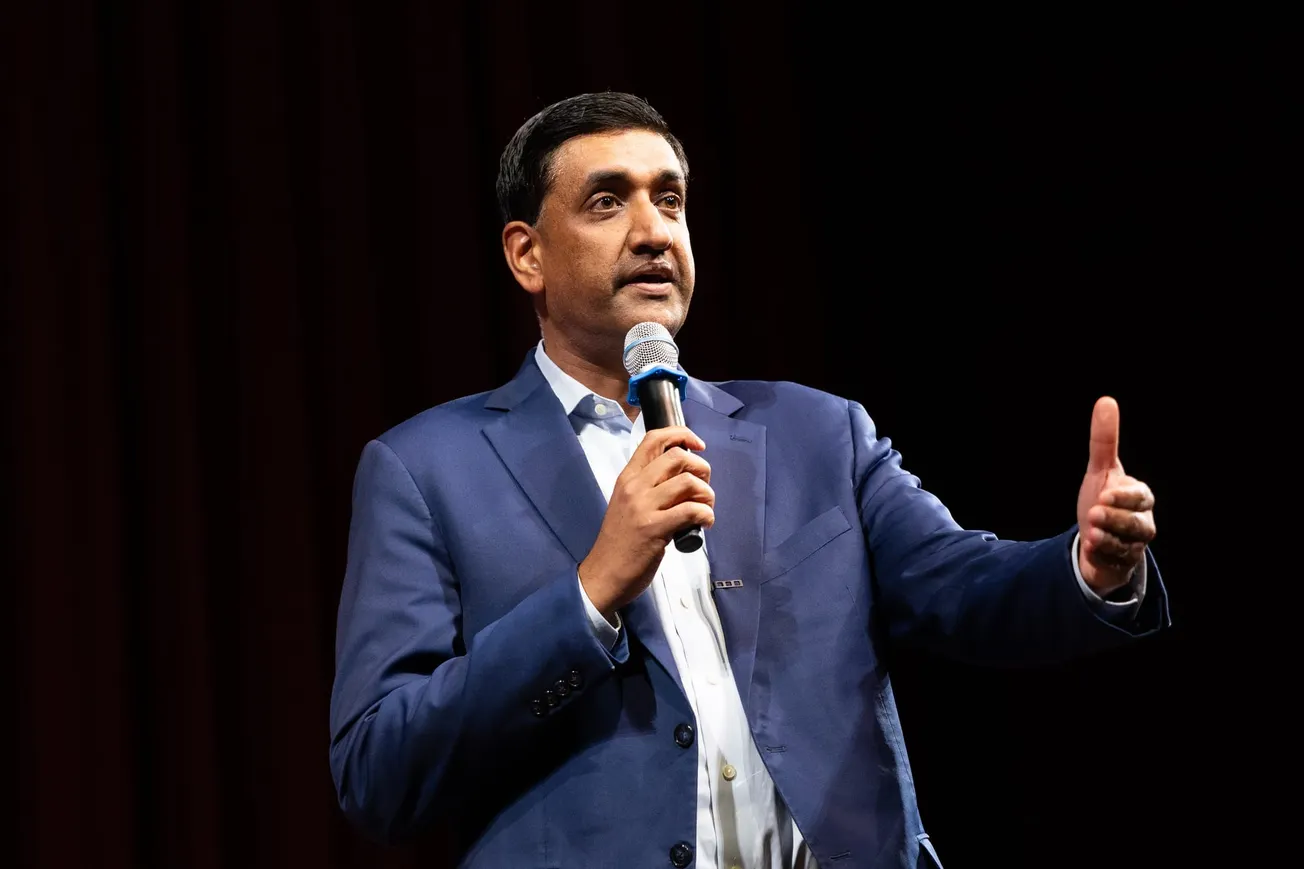
Ro Khanna has everything a Democratic presidential contender could want heading into 2028. He is 49, sharp, Silicon Valley-connected, and progressive enough to excite a base that is still searching for its next standard-bearer.
He has the pedigree (University of Chicago, Yale Law, a Stanford lectureship, Obama’s Commerce Department) and the committee assignments to match. On paper, he looks formidable. Now in his fifth term representing California’s 17th Congressional District in the heart of Silicon Valley, Khanna also serves as a vice chair of the Congressional Progressive Caucus.
Then he opened his mouth.
Appearing recently on Left Hook, the podcast hosted by New York Times contributing writer Wajahat Ali, Khanna offered a preview of what his presidential campaign might look like. If his performance is any indication, it will look a great deal like Hillary Clinton’s 2016 campaign and Kamala Harris’s 2024 one: well-credentialed, intellectually coherent within its own bubble, and utterly tone-deaf to the country that actually votes.
The political environment should, in theory, favor Democrats, though not on every front. Trump’s Iran deal, for all the criticism it has drawn, wound down months of fighting without committing a single ground troop and produced an interim agreement under which Tehran pledged to forgo a nuclear weapon. Crude oil, which spiked during the war, has since fallen nearly 40% from its spring peak to around $75 a barrel. That is one grievance Democrats can no longer bank on. But affordability and housing remain flashpoint issues well beyond the coasts. With the expiration of Biden-era premium credits, millions on the Affordable Care Act are quietly absorbing spiraling costs, deductibles, and co-pays, and Washington is saying almost nothing about it. The opening exists. The question is whether Democrats will walk through it or, as Khanna appears determined to do, nail it shut.
The Immigration Trap
Khanna’s most damaging moment came on immigration, the issue that, more than any other, handed Donald Trump all seven battleground states in 2024. Rather than acknowledge the reality that Americans across party lines rejected what they saw as four years of open borders, Khanna doubled down. Federal data recorded more than 10 million border encounters over those four years, along with an estimated 2 million “gotaways” who crossed undetected.
He called for abolishing ICE, replacing immigration enforcement with an agency reoriented around human rights and combating sex and child trafficking. He opposed enforcement operations targeting undocumented immigrants who, in his framing, are working and paying taxes.
His sentiment may be genuine, but the politics are disqualifying.
Americans have not forgotten Laken Riley, the 22-year-old Augusta University nursing student who was beaten with a rock and asphyxiated by a 26-year-old Venezuelan man, in the country illegally, while she jogged on the University of Georgia campus. Most congressional Democrats said little. President Biden mispronounced her name as “Lincoln Riley” during his March 2024 State of the Union address. The Laken Riley Act, which mandates detention and deportation of illegal immigrants charged with theft-related crimes, ultimately passed with bipartisan support in 2025 after Trump took office; 46 House Democrats and 12 Senate Democrats crossed the aisle to send it to the President’s desk.
Khanna’s position, stripped of its humanitarian framing, sends a straightforward message to prospective illegal immigrants: enter illegally, stay quietly, work and pay taxes, and you may remain indefinitely. With no viable amnesty legislation on the horizon, this situation invites permanent legal limbo. It is also the precise message that voters repudiated in November 2024. Besides, Americans recognize that dropping the word “illegal” in favor of softer terminology insults the millions of legal immigrants who have spent decades navigating the system by the rules.
The Court Gambit
Khanna’s comments on the Supreme Court were equally ill-advised. Calling the current Court a “Dred Scott Court,” a reference to the 1857 ruling that declared African Americans had no rights the white man was bound to respect, is reckless overreach. That decision was so monstrous it helped trigger the Civil War and ultimately produced the 13th and 14th Amendments.
The current Court includes three liberal justices: Sonia Sotomayor, Elena Kagan, and Ketanji Brown Jackson. Lumping them into a Dred Scott analogy to score points against the conservative majority strains credulity and trivializes one of the darkest chapters in American legal history.
Khanna also endorsed expanding the Court from nine to thirteen justices. Americans may have some appetite for modest reform. An 18-year term limit, for instance, polls reasonably well across party lines. But court-packing is another matter. Why thirteen? Why not twenty-one? And what structural safeguard prevents the next president, of either party, from simply appointing four ideologically aligned justices and doing it all over again? Khanna offers no answer.
The California Problem
Then there is the billionaire tax. Khanna has thrown his weight behind a California ballot proposal, pushed by a health-care workers’ union, that would levy a one-time 5% tax on the assets of the state’s billionaires; the mere prospect has prominent tech investors threatening to leave the state he represents. He backs a wealth tax at the national level, too. Whatever its merits in theory, championing a policy that has the wealthiest residents of your home state eyeing the exits is a difficult sell to the swing voters Democrats need in Pennsylvania, Michigan, and Wisconsin.
The Bottom Line
Ro Khanna is not without genuine strengths. His focus on rebuilding American manufacturing, his work on the China competition committee, and his willingness to engage seriously with defense and technology policy distinguish him from many of his progressive colleagues. There is a version of Ro Khanna who could be a serious general-election candidate.
This was not that version.
The 2024 election was, among other things, a clear instruction from the American electorate. Khanna, on the available evidence, has not read it. A Democratic Party that walks into 2028 with abolish-ICE as its immigration posture, court-packing as its judicial reform, and a national billionaire tax as its economic centerpiece will not need Donald Trump to defeat it. It will manage that on its own.
🌍 Global Affairs
The world's flashpoints, in motion.
🟦 Victor Davis Hanson: Europe Refuses To Enforce The Rule Of Law – Victor Davis Hanson, The Daily Signal
🟦 Why Did Khamenei Approve The U.S.-Iran Deal Despite His Concerns – TIPP News
🟦 What Is Driving Tensions Between The U.S. And Israel Over Iran? – TIPP News
🟦 U.S. Allows Commercial Shipping To Resume At Iranian Ports – TIPP News
🟦 Attack On Niger Airport Kills 11 Security Personnel – TIPP News
🟦 China’s Industrial Policy: Ambition, Inefficiency, And A Cautionary Tale For America – Lipton Matthews, Mises Wire
🏛️ National Affairs
The fights shaping America right now.
🟥 Supreme Court Makes Major 9-0 Ruling On Second Amendment And Drug Offenders – Fred Lucas, The Daily Signal
🟥 A Closed-Door GOP Battle Erupts Over Trump’s Plan – Virginia Grace McKinnon, The Daily Signal
🟥 Luigi Mangione Withdraws Psychiatric Defense in Murder Case – TIPP News
🟥 NYT Investigates Columnist Who Made Israeli Rape Dog Claims For Undisclosed Donor Ties – Pedro Rodriguez, The Daily Signal
🟥 FDA Lifts Restrictions On Testosterone Replacement Therapy – Pedro Rodriguez, The Daily Signal
🟥 White House Redirects $352 Million For Security Projects – TIPP News
🟥 Janeese Lewis George Wins Democratic Primary For Washington Mayor – TIPP News
🟥 Why Did The Appeals Court Uphold Ohio’s Social Media Restrictions – TIPP News
🟥 Oppose Graham Platner For His Socialism, Not Just His Outrageous Behavior – William L. Anderson, Mises Wire
🟥 Why I’m Fighting For Girls Sports In Arizona – Warren Petersen, The Daily Signal
🟥 Why Did The Interior Department Compare Algae Cleanup To Iran’s Navy – TIPP News
🟥 Strong Fathers Are Crucial For Society to Thrive And The Government Doesn’t Know It – Francesca Cella, The Daily Signal
📈 Economy
Prices, policy, and the pressure on your wallet.
🟩 Why The US President Loves “Inflation”? – Frank Shostak, Mises Wire
📊 Market Mood · June 19, 2026
How the trading day is setting up.
🟩 Markets remained resilient after this week's rally, supported by falling oil prices and expectations that the Strait of Hormuz will gradually reopen to global shipping.
🟧 Investors grew more cautious after planned U.S.-Iran nuclear talks were abruptly canceled, a reminder that the peace agreement remains fragile and key issues are still unresolved.
🟦 Oil headed for its steepest weekly decline in months as traders bet that additional Middle East energy supplies will return to the market, easing inflation pressures.
🟨 Attention is shifting from geopolitics to policy, with investors watching whether new Pentagon spending requests and ongoing U.S.-China semiconductor tensions could influence growth, deficits, and interest-rate expectations in the months ahead.
🗓️ Key Economic Events
On today's U.S. data calendar.
U.S. financial markets are closed on Juneteenth (June 19) in observance of the federal holiday
Letters to the editor email: editor-tippinsights@technometrica.com
Subscribe Today And Make A Difference. Consider supporting Independent Journalism by upgrading to a paid subscription or making a donation. Your support helps tippinsights thrive as a reader-supported publication. Contact us to discuss your research or polling needs.
Reach our audience. For sponsorship and advertising opportunities, visit our Partner With Us page.