Both Republicans and Democrats are focused on winning control of both Congress and the presidency over the next two years. But with only months to go before the congressional midterms, Democrats have a marginal lead in the race to control Congress, and no big presidential favorite has emerged for either party, the latest I&I/TIPP Poll shows.
The national online I&I/TIPP Poll asked 1,332 registered voters: “Which party do you prefer to control Congress after this year’s midterm election?” The poll, taken from May 26 to May 28, has a margin of error of +/-2.9 percentage points.
Who’s ahead? Democrats lead with 46% support, versus 41% support for Republicans. But there’s a large question mark hovering over the data: 12% of those responding said they weren’t sure who they want to control Congress. That 12% right now forms the political battleground for both major parties.
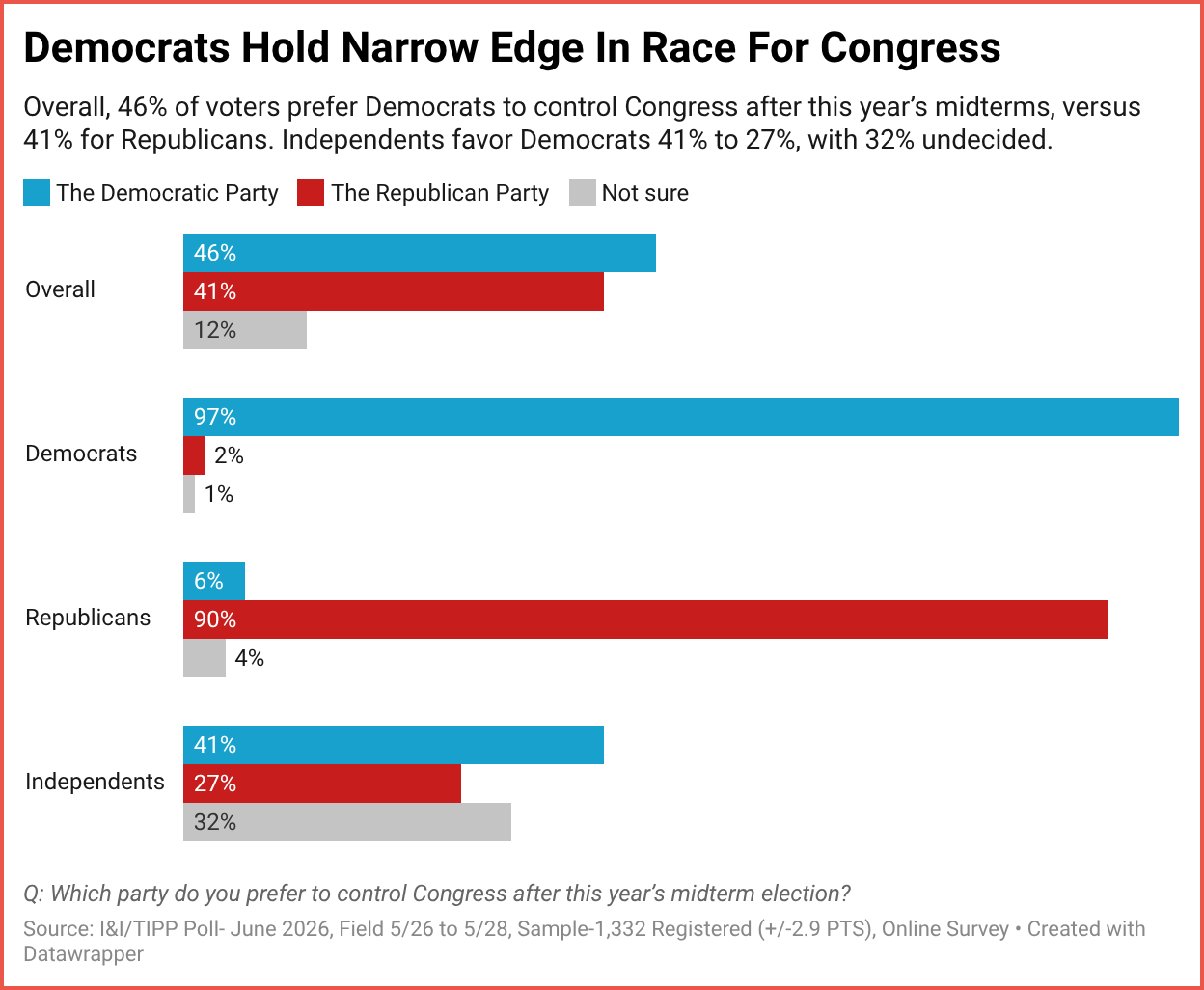
Predictably, voting choices for the two major parties skew sharply toward party affiliation.
Among Democrats, 97% want their own party in control, versus 2% who back the GOP, and just 1% who aren’t sure. That compares to Republicans, among whom 90% support continued GOP control of Congress, 6% say they’ll vote Dem, and 4% are unsure.
But the swing vote will be the independents. Among this changeable group, 41% support Democrats, 27% Republicans, but a hefty 32% still aren’t sure. That will give both major parties’ candidates a chance to bolster their totals with a sizable bloc of still-uncommitted indie voters.
So while the Dems cling to a lead, that lead is somewhat tenuous.
If Republicans have a problem, it might be this: when voters self-identify not by party but by ideology — describing themselves as conservative, liberal, or moderate — the GOP underperforms, especially among those who call themselves conservative.
Within that group, 74% say they’d prefer Republican control, but a surprisingly large 21% of the conservatives say they’d prefer Democrats. Meanwhile, among those who consider themselves to be moderates, 54% prefer Democrats, just 31% Republicans. Liberals are solidly aligned to changing control of Congress, with 83% favoring Democrats and only 10% favoring Republicans.
To maintain their grip on Congress, Republicans will have to convince both their conservative and moderate voters that they will do a better job.
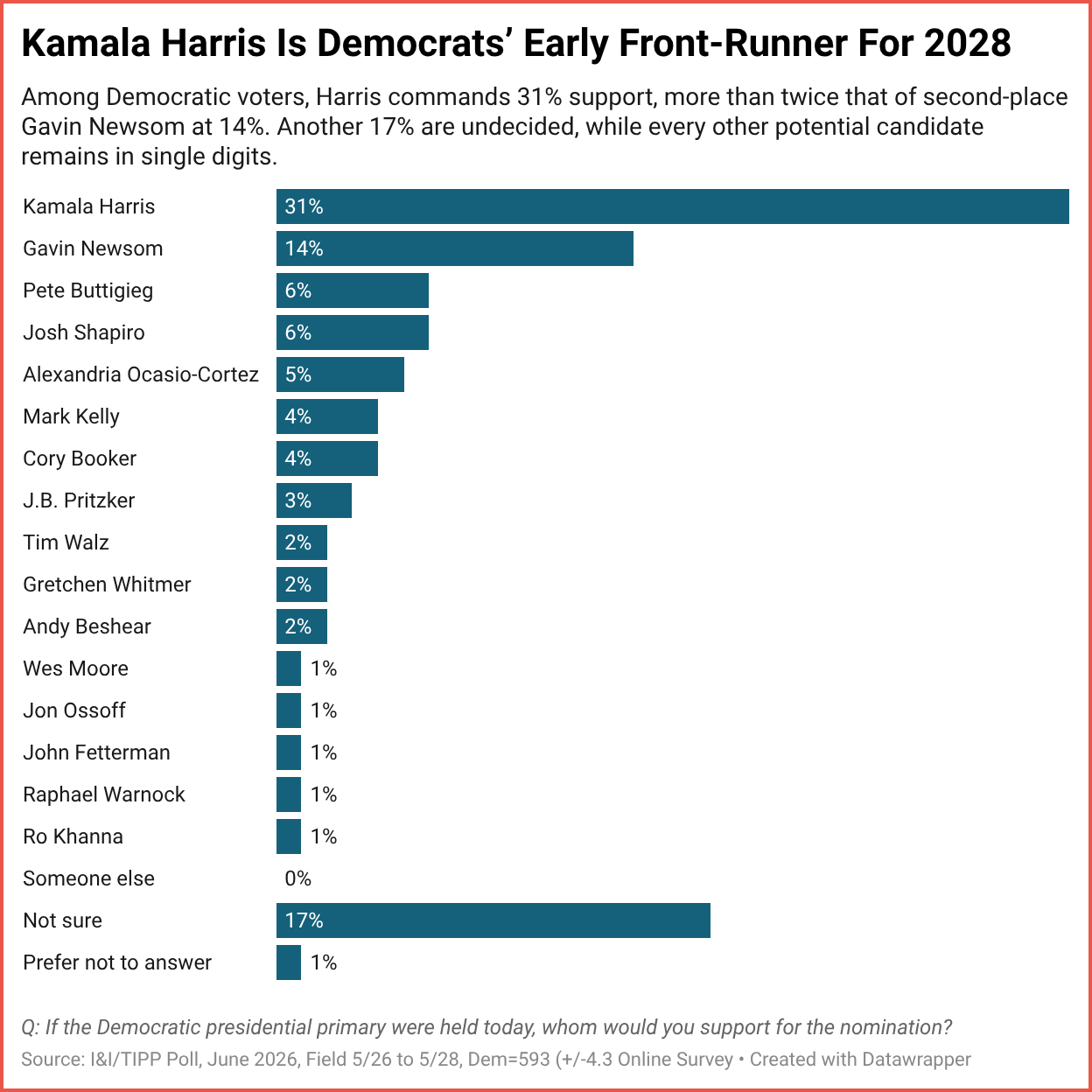
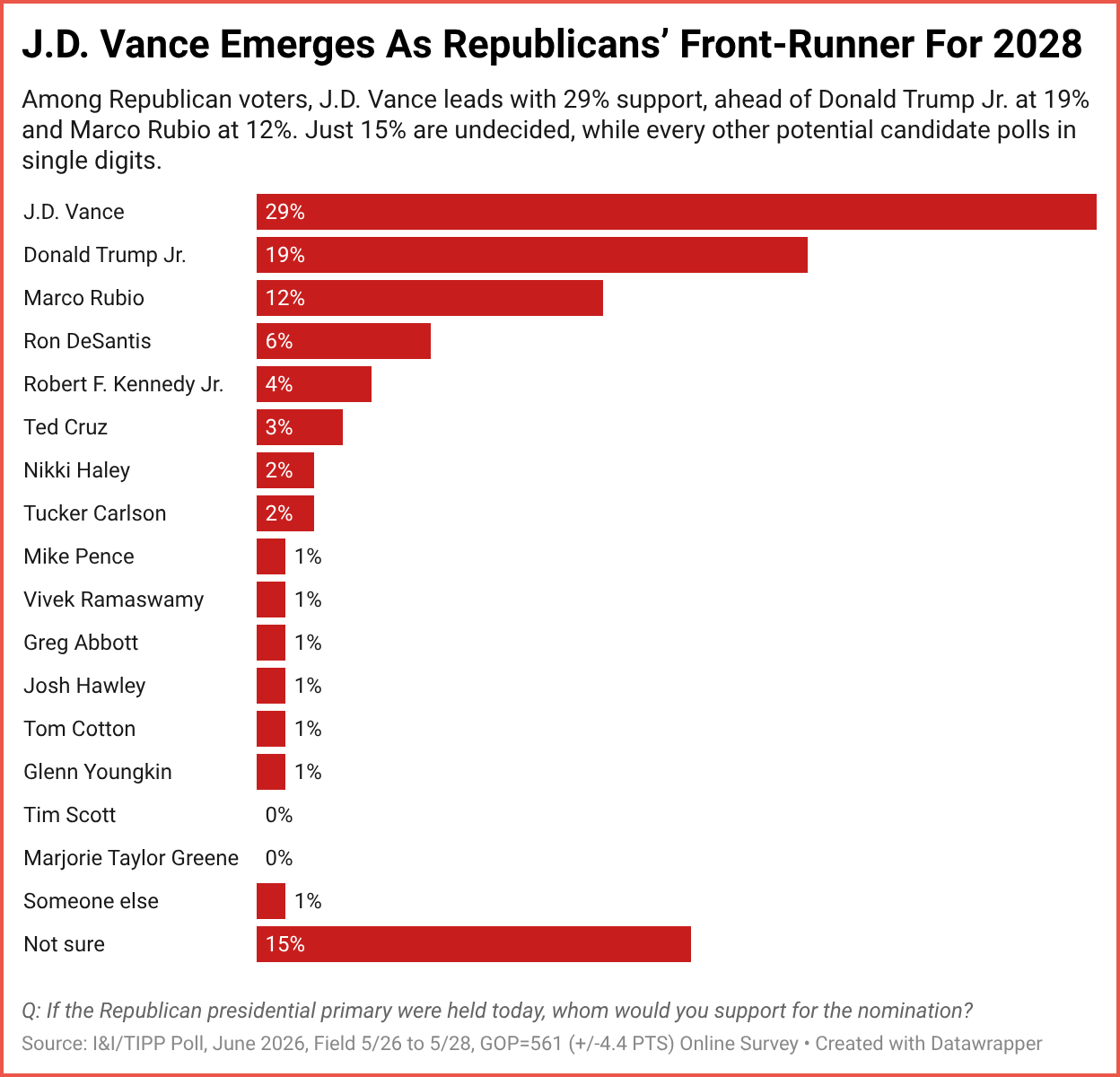
I&I/TIPP also asked voters in each party: “If the (Democratic/Republican) presidential primary were held today, whom would you support for the nomination?”
Neither party has a candidate with an insurmountable amount of backing. It’s way too early for that.
For the Democrats, 16 possible candidates were listed as possible primary contestants, but only five of those received 5% or more of Dem support: Former Vice President Kamala Harris (31%), California Gov. Gavin Newsom (14%), former Transportation Secretary Pete Buttigieg and Pennsylvania Gov. Josh Shapiro (6%), and New York Rep. Alexandria Ocasio-Cortez (5%).
The only other big support number came with “not sure”, at 17%.
Republicans have a somewhat similar picture among the top five of their 16 potential candidates: Current Vice President J.D. Vance (29%), Donald Trump Jr. (19%), Marco Rubio (12%), Florida Gov. Ron DeSantis (6%) and U.S. Secretary of Health and Human Services Robert F. Kennedy, Jr. (4%) round out the list, with none of the other 11 candidates getting more than 3% support.
So the Democrats have perhaps a slight edge, especially in the midterms, which are now less than five months away.
What can the Republicans do to regain the top spot against their Democrat rivals? That depends.
Voters have routinely complained about the cost of living, which soared under President Joe Biden and which, lately, has begun rising again as the U.S.-Iran war disrupts oil shipments from the Mideast. That sent oil prices above $100 a barrel and pushed U.S. gasoline prices to a current $4.07 a gallon.
That surge in prices has had a major impact on Americans’ finances. In May, consumer prices jumped 4.2%, the biggest rise since April of 2023. Of that 4.2% leap in inflation, 60% was due to energy costs.
Voters know this. Our own I&I/TIPP Poll last month reported that 67% of Americans blame higher energy costs on the U.S.-Iran war. Fair or not, those in power will get blamed. The Republicans who now control Congress will bear the brunt of public displeasure this fall if prices don’t begin to decline.
But there are other vital issues for Congress to address that will also resonate with voters. These are the so-called “80-20” issues that the vast majority of voters support, but which have trouble getting through Congress.
As columnist and author Glenn K. Beaton recently wrote: “Some issues are no-brainers for politicians: Transsexuals in women’s sports and girls’ bathrooms. Showing an ID to vote. Securing the border. Enforcing the criminal laws. Judging people by merit. These are 80/20 issues where 80% of the citizens are on one side and only 20% are on the other.”
Anyone who wants to win, be they Republican or Democrat, should want to be in the “80” part of that equation, not the “20” part.
The same is true, by the way, for the presidency. While that’s not decided this year, presidential campaigns will kick off next year, now six months away.
For potential Republican candidates, Trump holds a lesson: As The Federalist recently noted, “Voters like Trump, not because of his hair or sometimes-embarrassing comments, but because he’s changing how the Republican Party does business.”
GOP frontrunner Vance has a chance to cash in on that popularity, assuming Trump’s remaining time in office is viewed as a success.
For Democrats, who now favor Harris, they will be looking mainly for one thing: electability. In the 2024 election, they jettisoned an aging, enfeebled Biden in favor of his No. 2, Harris. Unfortunately, she was untested in a national campaign and lost the Electoral College in a landslide.
Will the Democrats go with Harris anyway, or pick someone else? The list of those having double-digit voter support is thin: Harris and Newsom. That’s it.
The point is, right now, no one has a clear inside track to the presidency. As then-Democratic frontrunner and former governor of Vermont Howard Dean’s infamous 2004 campaign “scream” showed, it’s easy to trip up on the hustings, for Democrats, Republicans, and independent candidates.
I&I/TIPP will be along for the ride, with timely polls and opinions as the 2026 and 2028 elections unfold.
I&I/TIPP publishes timely, unique, and informative data each month on topics of public interest. TIPP’s reputation for polling excellence comes from being the most accurate pollster for the past six presidential elections.
Terry Jones is an editor of Issues & Insights. His four decades of journalism experience include serving as national issues editor, economics editor, and editorial page editor for Investor’s Business Daily.
🌍 Global Affairs
The world's flashpoints, in motion.
🟦 Alleged U.S.-Iran Deal Text Reveals Sweeping Peace Framework – TIPP News
🟦 U.S. Reportedly Denies Israel Access To Iran Deal Before Signing – TIPP News
🟦 What Did Trump MeanBy Saying ‘There Would Be No Israel’ Without Him? – TIPP News
🟦 Israel Fails To Sabotage Islamabad Accord… At Least For Now – Larry C. Johnson, Ron Paul Institute for Peace and Prosperity
🟦 Time for Trump To Tell Benjamin Netanyahu To Go Away! – Philip Giraldi, Ron Paul Institute for Peace and Prosperity
🟦 Post-Iran War: The End Of An Era, Not To Decline, but As A Trigger To Abrupt Change – Alastair Crooke, Ron Paul Institute for Peace and Prosperity
🟦 Why Iran Signs The MOU: Realism Over Illusion – Ashes of Pompeii, Ron Paul Institute for Peace and Prosperity
🟦 Iran’s National Anthem Booed During World Cup Match In Los Angeles – TIPP News
🟦 Biden’s Closed Circle On Russia – James Carden, Ron Paul Institute for Peace and Prosperity
🟦 Why Are U.S. Officials Advising Caution For Bahamas Visitors? – TIPP News
🏛️ National Affairs
The fights shaping America right now.
🟥 Congress’s Failure Is Liberty’s Gain – Ron Paul, Ron Paul Institute for Peace and Prosperity
🟥 New Report Backs Suicide Conclusion In Jeffrey Epstein Death – TIPP News
🟥 Newsom Says He Is Under DOJ Investigation – Pedro Rodriguez, The Daily Signal
🟥 Hillary Clinton Says Biden’s Reelection Bid Was A Mistake – TIPP News
🟥 Diddy’s Prison Release Date Moved Up To February 2028 – TIPP News
🟥 One Dead, One Injured in Shooting At Delaware Hospital – TIPP News
🟥 Fifteen Charged With Obstructing Federal Immigration Operations In Minnesota – TIPP News
🟥 Trump-Backed Collins Secures Nomination To Face Ossoff – TIPP News
🟥 White House Ballroom Cost Estimate Climbs To $600 Million – TIPP News
🟥 Kennedy Extends Quarantine Of Hantavirus-Exposed Woman – TIPP News
🟥 National Hurricane Center Monitoring Potential Gulf Storm – TIPP News
📈 Economy
Prices, policy, and the pressure on your wallet.
🟩 The Ignoramus-in-Chief Declares: “I Love the Inflation” – Vincent Cook, Mises Wire
🟩 Raising Interest Rates Does Not Counter Inflation – Frank Shostak, Mises Wire
🟩 Are All Billionaires Thieves Or Can One Legitimately Earn Wealth? – Clifford F. Thies, Mises Wire
🟩 Moloch In The Regulatory State – Thiago V. S. Coelho, Mises Wire
🟩 Why Justice Mattered To Rothbard – Wanjiru Njoya, Mises Wire
💼 Markets & Business
The deals and tickers making moves.
🟧 Is DoorDash Down? What We Know About The Latest Outage – TIPP News
🟧 SpaceX Beats Microsoft In Market Value After IPO Rally – TIPP News
🟧 What Does SpaceX’s $60 Billion Cursor Acquisition Mean For AI – TIPP News
🟧 ‘Affordability’? Virginia Drives Gun Manufacturer To Cheaper Georgia – Joe Thomas, The Daily Signal
📊 Market Mood · June 17, 2026
How the trading day is setting up.
🟩 Markets stayed relatively calm as investors looked beyond the Middle East conflict and focused on the Federal Reserve’s first policy decision under Chair Kevin Warsh.
🟧 The Fed is widely expected to hold rates steady, but markets are watching closely for updated forecasts and clues on whether policymakers are leaning toward future hikes or cuts.
🟦 Oil prices continued to fall as details of the U.S.-Iran framework agreement emerged and traders prepared for the reopening of the Strait of Hormuz later this week.
🟨 SpaceX remained the market’s hottest story, extending its remarkable post-IPO surge and briefly surpassing Amazon in market value as investors doubled down on transformative technology themes.
🗓️ Key Economic Events
On today's U.S. data calendar.
🟧 8:30 a.m. ET — Retail Sales (May)
Retail Sales: +0.5% vs. +0.5% previous
Core Retail Sales: +0.6% vs. +0.7% previous. A key test of consumer spending strength and whether higher energy costs are beginning to affect household demand.
🟧 9:30 a.m. ET — President Trump Speaks
Markets will listen for comments on the U.S.-Iran agreement, the reopening of the Strait of Hormuz, and the economic outlook ahead of the Fed decision.
🟧 10:30 a.m. ET — Crude Oil Inventories
Forecast: -3.6M barrels vs. -7.227M previous. Energy traders will look for evidence that supply conditions are improving as Gulf shipping routes gradually reopen.
🟧 2:00 p.m. ET — Federal Reserve Decision, Statement & Economic Projections
Forecast: 3.75% (unchanged). Investors will focus less on the rate decision itself and more on updated forecasts for inflation, growth, and the future path of interest rates.
🟧 2:30 p.m. ET — FOMC Press Conference
Chair Kevin Warsh's first post-meeting press conference is the day's main event. Markets will be looking for signals on whether falling oil prices reduce the need for future rate hikes.
Letters to the editor email: editor-tippinsights@technometrica.com
Subscribe Today And Make A Difference. Consider supporting Independent Journalism by upgrading to a paid subscription or making a donation. Your support helps tippinsights thrive as a reader-supported publication. Contact us to discuss your research or polling needs.
Reach our audience. For sponsorship and advertising opportunities, visit our Partner With Us page.