By Shashi Tharoor, Project Syndicate | June 30, 2026
Over the last 12 years, Indian Prime Minister Narendra Modi has overseen dizzying progress in economic modernization and state capacity-building, as well as dismaying setbacks on institutional independence and minority inclusion. This record offers important insights into how India will navigate the 21st century.
NEW DELHI—On June 10, Narendra Modi became the country’s longest continuously-serving elected prime minister, overtaking India’s independence-era hero, Jawaharlal Nehru, who served 4,398 days in office following the first general elections. While Nehru led India for five years before those first elections, and Indira Gandhi served longer overall, but not continuously, Modi undoubtedly ranks alongside them as one of India’s three most influential post-independence leaders. Modi’s legacy, like theirs, will define India’s path.
Already, Modi has led India’s most profound realignment since 1947, overseeing dizzying progress in economic modernization and state-capacity development, as well as dismaying setbacks on institutional independence and minority inclusion. Analyzing these shifts is not merely an academic exercise. It is a means of discerning how India will navigate the 21st century.
Modi’s crowning achievement has been the creation of state-of-the-art technological and physical infrastructure, which has fundamentally altered the lives of more than 1.4 billion people. Before Modi became prime minister in 2014, hundreds of millions of Indians were excluded from the formal banking sector. Their dependence on informal alternatives created space for corruption and systemic “leakages” (funds lost to intermediaries).
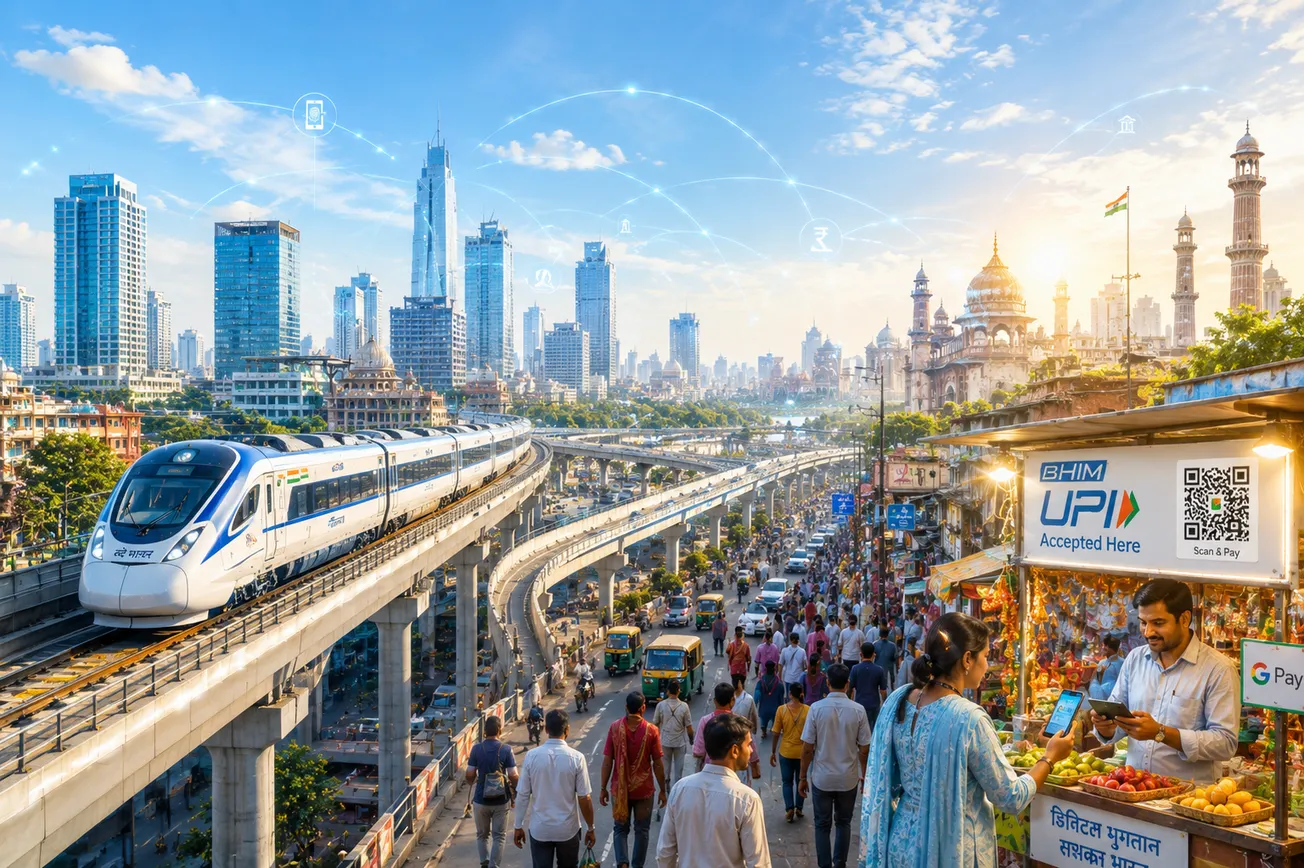
Building on an initiative begun by his predecessor, Manmohan Singh, Modi oversaw the implementation of a new system that bypassed legacy banking structures, instead linking zero-balance bank accounts (Jan Dhan Yojana), biometric identity cards (Aadhaar), and mobile phone numbers. This “JAM trinity” gave rise to the Unified Payments Interface, a public, real-time payment protocol which enables everyone from roadside vendors to tech giants to process transactions instantly with zero fees.
More important, this approach enabled the expansion of the Direct Benefit Transfer system, under which subsidies and benefits are credited directly to beneficiaries’ bank accounts. Since its introduction in 2013, the DBT, along with other welfare schemes, has helped lift an estimated 250 million people out of multidimensional poverty. Moreover, by eliminating intermediaries, this system has sharply curbed corruption in funds transfers, though it thrives in other areas of the economy.
Infrastructure is another positive legacy. For decades, substandard logistics impeded India’s economic growth. Modi’s government brought a wartime-like sense of urgency to the problem, pouring record-breaking investment into highways, airports, and high-speed rail networks. Ports are being modernized and expanded. Rural electrification is largely complete. And clean drinking water has been piped into more than 100 million rural homes that previously relied on community wells.
On foreign policy, Modi has emulated Nehru, asserting India as a formidable and independent actor on the world stage. Rather than take partisan positions in global geopolitical rivalries, he has upheld India’s long-standing commitment to strategic autonomy and pioneered the doctrine of “multi-alignment.”
This has meant strengthening relations with the Gulf monarchies, serving as a voice for the Global South in international fora, and concluding trade deals with the European Union and the United Kingdom. It has also meant upholding ties with Russia—from which India sources critical defense equipment—while maintaining a robust strategic relationship with the United States. India remains a pillar of the US-led Quad security alliance, along with Australia and Japan, though President Donald Trump’s administration has lately cast doubt on America’s commitment to the Quad and its ambition to rein in the influence of a rising China.
Mistakes have been made. For example, India arguably should have positioned itself as a neutral party and potential mediator in the Iran war, rather than giving the impression that it was on the US and Israel’s side. Nonetheless, during Modi’s tenure, India has established itself as an independent pole in the global order.
But Modi’s record also attracts considerable criticism. The foundational philosophy of the Modi government, Hindutva, seeks to anchor India’s cultural identity in the Hindu heritage of 80% of the population. For India’s Muslim and Christian minorities, this effort—and the ideological intolerance of Modi’s Bharatiya Janata Party—has directly contributed to a growing sense of social and political marginalization.
Critics warning that India’s pluralistic guardrails are being eroded point to the 2019 Citizenship Amendment Act, which introduced religion as a criterion for refugees to receive citizenship, explicitly excluding Muslims. The rising influence of hardline Hindu-nationalist forces, together with aggressive ruling-party messaging that demonizes minorities (especially Muslims), have compounded these concerns.
More broadly, the Modi government is criticized for disarming or co-opting vital democratic institutions, ranging from the mainstream media to independent national supervisory bodies like the Election Commission and the Information Commission and even elements of the judiciary. Independent journalists, civil-society organizations, and political opponents regularly face intense legal and financial scrutiny through state investigative agencies. Global democracy watchdogs have sounded the alarm about the narrowing of India’s civic spaces, describing the country as an “electoral autocracy” or an “illiberal democracy.”
India also faces economic challenges. To be sure, it is the world’s fastest-growing major economy, with rapidly expanding domestic manufacturing and tech startup ecosystems. But that has not translated into enough high-quality, formal-sector jobs for the millions of young Indians entering the workforce every year.
To some, Modi is the leader who finally shattered the status quo, building an Indian state that is faster, more capable, and more assertive globally than it was a decade ago and rests on an unapologetic newfound civilizational confidence. To others, Modi is the figure who eroded the liberal-democratic norms and vibrant debate that India long proudly embodied.
Both assessments have merit. Moreover, both outcomes stem from the same phenomenon: the centralization of power. The very changes that enabled Modi’s government to develop India’s infrastructure, strengthen its benefits system, and project geopolitical strength also left India’s pluralistic institutions vulnerable and enabled the promotion of bigotry and intimidation against minorities.
India under Modi has been neither an unadulterated economic miracle nor a simple case of democratic decline. It is an ambitious, formidable country charting its own path. The world must meet it on those complicated terms.
Shashi Tharoor, a former UN under-secretary-general and former Indian Minister of State for External Affairs and Minister of State for Human Resource Development, is an MP for the Indian National Congress and Chairman of the Parliamentary Standing Committee on External Affairs. He was re-elected to the Lok Sabha for a fourth successive term, representing Thiruvananthapuram. He is the author, most recently, of Ambedkar: A Life (Aleph Book Company, 2022).
Loved it, hated it, or somewhere in between — tell us. Grade this article here and help shape what lands in your inbox next.
Copyright Project Syndicate
🧭 Power & Capital · July 3, 2026
Where state power meets the boardroom.
🔷 Google Loses Appeal Against €4.1 Billion EU Antitrust Fine
🔷 China-Based Tycoon Neville Roy Singham Under Investigation
🔷 5 Taxpayer Wins From Vance’s Fraud-Fighting Task Force
🌍 Global Affairs
The world's flashpoints, in motion.
🟥 China's Foreign Minister Begins Nordic Tour In Denmark – TIPP News
🟥 India PM Narendra Modi To Visit New Zealand Next Week – TIPP News
🟥 Brazil Introduces New Meat Export Rules For EU Market – TIPP News
🏛️ National Affairs
The fights shaping America right now.
🟫 Air Force Major Arrested After Capitol Protest Calling For Trump's Impeachment – TIPP News
🟫 GOP Congresswoman Tells Naturalized Terrorists To GTFO Of America – Virginia Grace McKinnon, The Daily Signal
🟫 Why Did The Appeals Court Limit Migrant Detention – TIPP News
🟫 ‘The House Is On Fire’: House Passes Online Protections To Shield Children From Porn – Virginia Grace McKinnon, The Daily Signal
🟫 Former Olympian Indicted Over Lincoln Memorial Reflecting Pool Damage – TIPP News
🟫 Empire State Building Climbers Face Felony Charges – TIPP News
🟫 California Resident Convicted In Nancy Guthrie Hoax Case – TIPP News
🟫 Heritage Foundation Awards $1M In Prizes To Nonprofits – Francesca Cella, The Daily Signal
🟫 On Little Bighorn Anniversary, Remember Custer’s Crimes – James Bovard, Mises Wire
🟫 Calhoun’s Answer To The Abolition Petitions – Wanjiru Njoya, Mises Wire
📈 Economy
Prices, policy, and the pressure on your wallet.
🟩 U.S. Job Growth Slows Sharply In June – TIPP News
🟩 The Supreme Court And The Supreme Fed – Jonathan Newman, Mises Wire
💼 Markets & Business
The deals and tickers making moves.
🟧 Zuckerberg Says Meta's AI Agent Progress Has Been Slower Than Expected – TIPP News
📊 Market Mood · July 3, 2026
How the trading day is setting up.
🟩 Markets are ending the week on a positive note as softer-than-expected U.S. jobs data eased fears of another near-term Fed rate hike and lifted global equities.
🟧 Investors remain selective on AI stocks after recent volatility, but encouraging business activity across Asia is helping restore confidence in the broader technology sector.
🟦 Oil prices remain near pre-conflict levels as shipping through the Strait of Hormuz continues to normalize, easing inflation concerns that dominated markets earlier this year.
🟨 With the June jobs report behind them, investors now shift their focus to next week's Fed minutes and the start of second-quarter earnings season for clues on the economy and interest-rate outlook.
🗓️ Key Economic Events
On today's U.S. data calendar.
🟧 U.S. Markets Closed — Independence Day (Observed)
The NYSE, Nasdaq, and U.S. bond markets are closed in observance of Independence Day. Trading resumes Monday, July 6.
🟧 No Major U.S. Economic Reports Scheduled
With financial markets closed, there are no significant U.S. economic data releases on today's calendar. Investors will instead digest Thursday's employment report and prepare for next week's Fed minutes and the unofficial start of second-quarter earnings season
Letters to the editor email: editor-tippinsights@technometrica.com
Subscribe Today And Make A Difference. Consider supporting Independent Journalism by upgrading to a paid subscription or making a donation. Your support helps tippinsights thrive as a reader-supported publication. Contact us to discuss your research or polling needs.
Reach our audience. For sponsorship and advertising opportunities, visit our Partner With Us page.