By Guillermo Ortiz, Project Syndicate
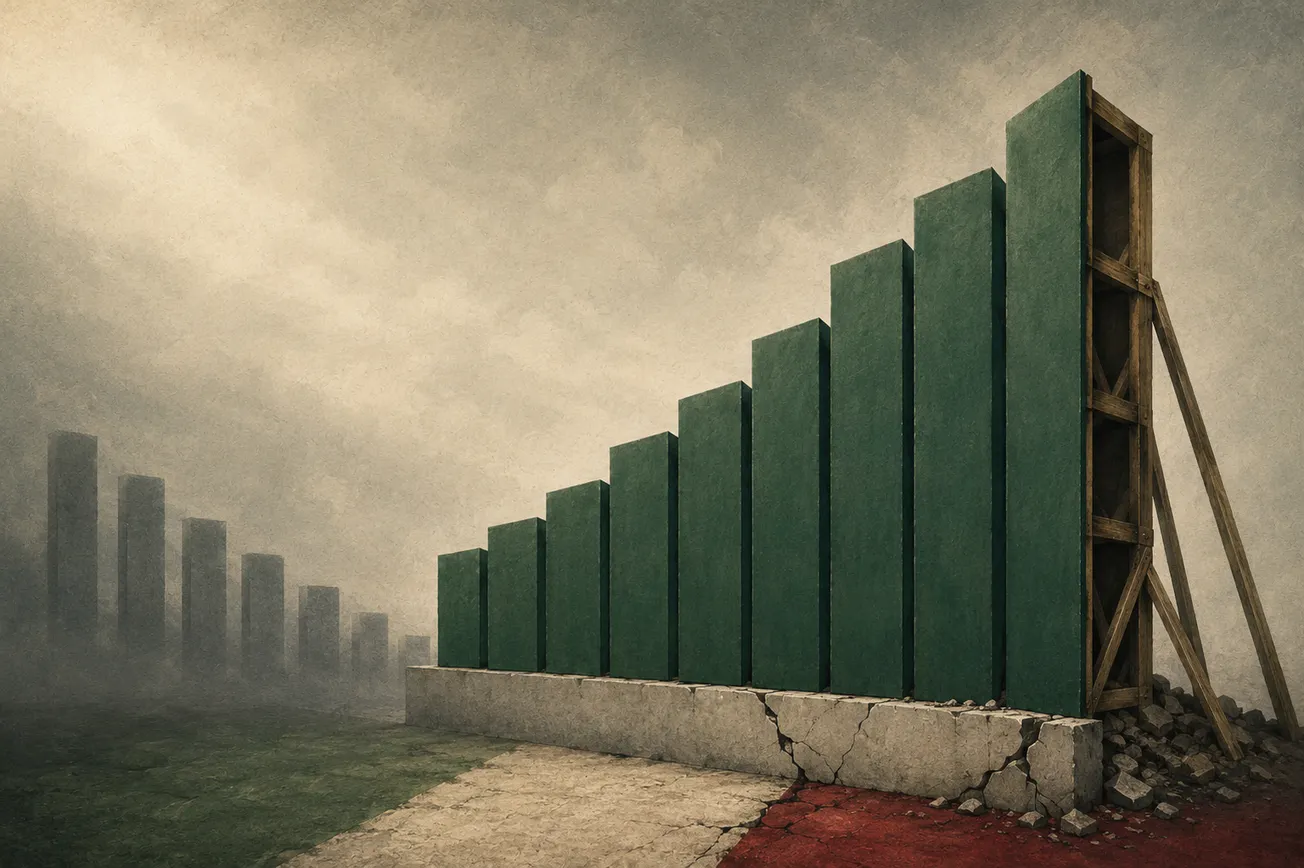
By cherry-picking 12 data points that supposedly contradict top ratings agencies’ assessment of Mexico’s economy and fiscal outlook, Mexican President Claudia Sheinbaum recently presented a just-so story that should convince no one. A glimpse of what her list excludes makes that clear.
MEXICO CITY—In response to Moody’s and S&P’s negative assessments of Mexico’s economic and fiscal outlook, President Claudia Sheinbaum recently offered 12 economic indicators to show that “the Mexican economy is doing very well.” But while each is technically accurate, the list fails to tell the whole story or account for hidden fragilities.
The first claim is that Mexico ranks among the top ten destinations for foreign direct investment. But the composition of FDI matters more than the ranking. In Mexico’s case, reinvested earnings made up 68% of 2025 FDI, whereas new investment accounted for just 18%. That is up from 8.6% in 2024, but still well below the 44–48% share seen in 2021–22. Moreover, the OECD ranking that they use for many of the figures is misleading. Since the vast majority of OECD members are advanced economies, these indicators end up comparing Mexico mostly against countries like Germany or Japan. If they presented a comparison with Brazil, India, or Vietnam, the picture would be less flattering.
Second, Sheinbaum notes that Mexico ranks first among OECD countries for real (inflation-adjusted) wage increases since 2018. That is a genuine achievement (the minimum wage has increased 148% cumulatively). But productivity has not kept pace. According to Mexico’s national statistics office, the labor productivity index decreased 0.5% year on year in the first quarter of 2026, with industrial activities down 1.2%. The fact that wages are rising fast while productivity remains flat means that employer margins are being compressed, not that the economy has become more competitive.
The third point touts Mexico’s second-lowest unemployment rate in the OECD, behind only Japan. But with 55% of its workforce informally employed, this figure tells us almost nothing about labor-market health. Comparing Mexico, which has no federal unemployment insurance, to Japan, which has essentially no informal sector, borders on statistical malpractice.
To be sure, the list also mentions record levels of formal employment, with 22.7 million registered jobs as of June 2026. But this apparent growth does not mean that the share of formal employment has grown. Indeed, job creation has been decelerating for months, yet informal employment has kept growing through 2025–26.
Fifth, the government boasts the highest base wage in Mexico’s history: 669 pesos per day, up 6.4% year on year. But, again, when set against productivity growth of roughly 0.1–2%, this reflects a trend that cannot be sustained.
Sixth, annual trade between Mexico and the United States has reached an all-time high of $839 billion. But this figure reflects North American production integration, not an achievement of domestic policy. Worse, it ignores the fact that the Trump administration just declined to renew the US-Mexico-Canada Agreement for a full term, opting instead for rolling annual reviews. And the same problem applies to the seventh point: that Mexico sells more to the world than ever.
Eighth, fixed investment grew 5.9% year on year in April 2026. But the first quarter told a less promising story: private consumption fell 0.8% from the previous quarter, gross fixed capital formation fell 1.9%, and private investment was down 4.5% year on year. This contraction extends back to 2024, and it cannot be erased by a single-month base effect.
The ninth point—that the Monthly Private Consumption Indicator grew 2.1% year on year—is not even good news. Rather, it confirms a broader deceleration.
The tenth point is perhaps even more misleading: that overall economic activity has maintained an upward trend and reached a new high. But cumulative GDP growth over 2019–24 was about 5.5% for the full six years. At under 1% on an annualized basis, that is the weakest growth rate since President Miguel de la Madrid’s 1983–88 term. In the first quarter of this year, annual GDP growth was just 0.4% and fell 0.6% quarter on quarter. An economy can post a nominal “new high” some years and still be growing more slowly than at almost any point in four decades.
Eleventh, industrial activity is said to have rebounded in April, reaching its highest level since October 2024. But this is another base-effect story in which a comparison against a prior trough overstates a recovery. In reality, annual industrial productivity was still falling in the same period.
The final point is that the inflation rate continues to fall, reaching 3.6%, its lowest level in eight months. But this figure rests to some extent on price agreements with gas stations and tomato growers. Core inflation, the better trend signal, was still running above 4% as of July.
What this list leaves out is as important as what it includes. Moody’s and S&P are rightly worried about Mexico’s debt-to-GDP ratio, which the Mexican government puts at almost 51.7%, against the International Monetary Fund’s broader gross public-sector debt estimate of 62%. They know that Pemex, the state-owned oil company, is still heavily indebted and dependent on federal transfers. And they can see that judicial reforms have cast a cloud of uncertainty over the economy, and that the government’s energy framework is keeping out private capital.
There is a difference between managing the economic cycle—which this administration has done with more discipline than many expected—and fixing the structural problems behind many years of low (below 2%) growth. In a recent survey conducted by Banco de México, 41 specialists scored “governance risk” at 5.7 out of 7 (up from 5.6), with public finances (5), insecurity (6.2), weak rule of law (5.9), corruption (5.8), and impunity (5.7) topping the list.
These risks are not hypothetical. US prosecutors have indicted Sinaloa’s governor and nine other officials for alleged ties to the Sinaloa Cartel’s “Chapitos” faction, and several politicians from Morena, the incumbent party, are under investigation for similar dealings with organized crime. None of these cases has produced a conviction, and those involved deny wrongdoing; but the accumulation of such stories has made infiltration by organized crime a governance concern in a way that it wasn’t two years ago.
These concerns will remain central as Mexico approaches midterm elections next June. This will be the first real referendum on Sheinbaum’s government, and 12 cherry-picked statistics are unlikely to make up for her softening approval ratings or expanding criminal investigations of figures within her party. Rating agencies and Mexican citizens alike will be watching for evidence that Mexico’s government can indeed govern, rather than simply tell a good story.
Guillermo Ortiz, a former finance minister of Mexico and governor of Banco de Mexico, is Treasurer of the G-30.
Loved it, hated it, or somewhere in between — tell us. Grade this article here and help shape what lands in your inbox next.
Copyright Project Syndicate
🧭 Power & Capital · July 30, 2026
Where state power meets the boardroom.
🔷 US Issues New Iran-Related Sanctions Targeting Insurers, More Tankers
🌍 Global Affairs
The world's flashpoints, in motion.
🟥 The Peacemaker – Editorial Board, TIPP Insights
🟥 Russian Missile Reportedly Strikes Deep Inside Poland – TIPP News
🟥 Iran Threatens Fresh Action After American Military Offensive – TIPP News
🟥 US Rejects Iran's Claims Of Destroying F-35 Fighter Jets – TIPP News
🟥 Netanyahu Denies Israeli Effort To Influence US Iran Policy – TIPP News
🟥 Arab States Seek To Stay Out Of Iran-Israel Conflict – TIPP News
🟥 Trump Concludes Meetings With Zelenskyy, Netanyahu – Elizabeth Troutman Mitchell, The Daily Signal
🏛️ National Affairs
The fights shaping America right now.
🟫 Fauci Faces Florida Inquiry Over COVID Response – TIPP News
🟫 Committee Could Hold Fauci In Contempt Of Congress, Paul Warns – TIPP News
🟫 Watch: Fauci Lied About Covid, Got Rich During Pandemic, Says Sen. Hawley – TIPP Videos
🟫 Watch: Trump Says He Watched Whole Fauci Hearing – TIPP Videos
🟫 Trump Weighs Pulling Blanche Nomination Amid Senate Standoff – TIPP News
🟫 Former Obama Counsel Faces Backlash After Comments On Epstein Accuser – TIPP News
🟫 Why Are Americans Turning Against Flock Safety Cameras – TIPP News
🟫 Is The US Running Out Of Missiles? – Elizabeth Troutman Mitchell, The Daily Signal
🟫 In Death, Lindsey Graham Still Shapes World Stage – Virginia Grace McKinnon, The Daily Signal
📈 Economy
Prices, policy, and the pressure on your wallet.
🟩 What Caused The US Economy To Miss Growth Expectations – TIPP News
🟩 Markets Question Warsh After Fed Holds Interest Rates Steady – TIPP News
🟩 Labor Department Reports Modest Rise In Unemployment Claims – TIPP News
💼 Markets & Business
The deals and tickers making moves.
🟧 AI Spending Drives Sharp Split Between Microsoft And Meta – TIPP News
🟧 Yum Reports Strong Quarter As Taco Bell Faces Health Scare – TIPP News
Letters to the editor email: editor-tippinsights@technometrica.com
Subscribe Today And Make A Difference. Consider supporting Independent Journalism by upgrading to a paid subscription or making a donation. Your support helps tippinsights thrive as a reader-supported publication. Contact us to discuss your research or polling needs.
Reach our audience. For sponsorship and advertising opportunities, visit our Partner With Us page.