
Companies spanning tech giant Microsoft to grocer Kroger have announced layoffs this year, deepening concerns that AI adoption will upend established industries.
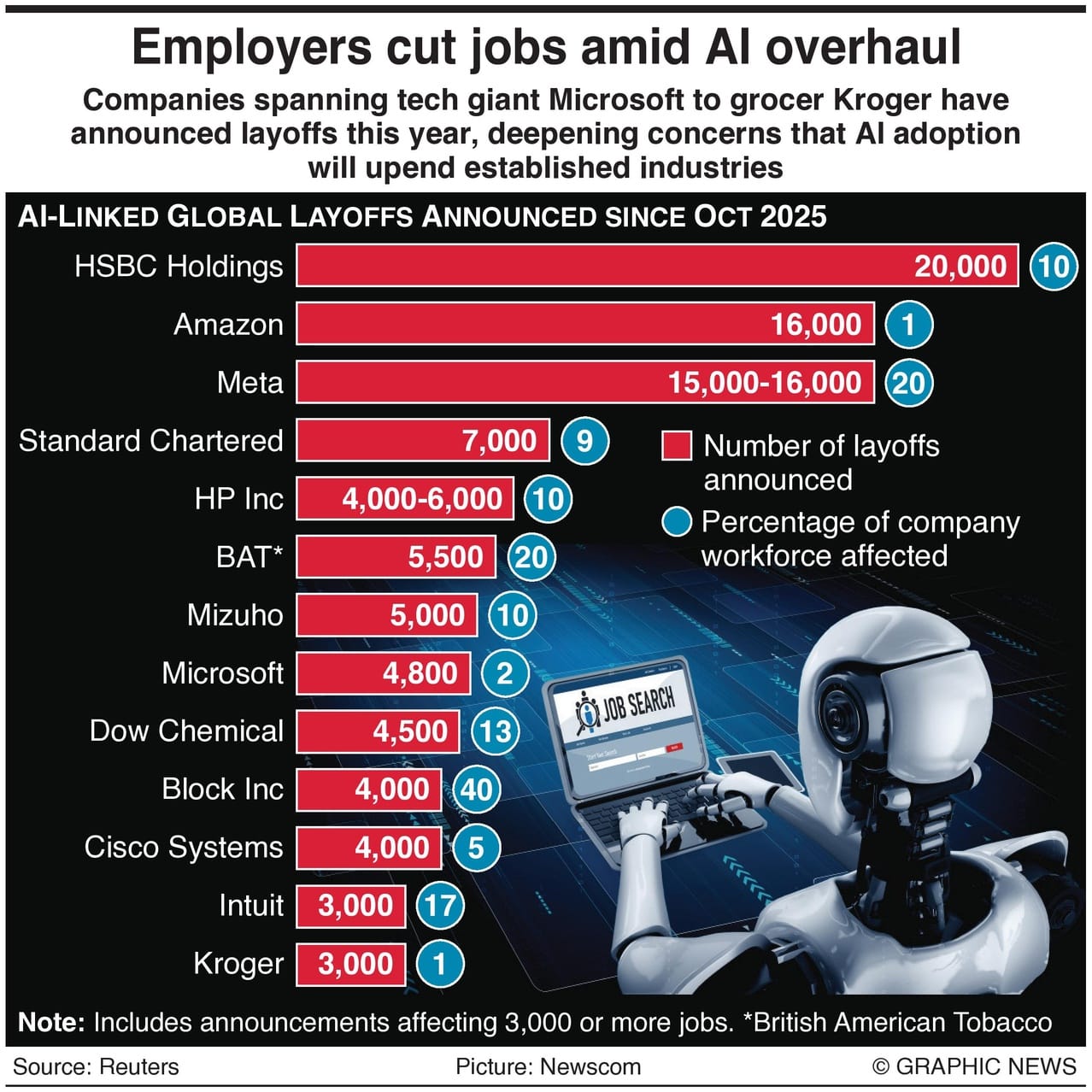
Since Oct 2025, job losses have emerged in sectors most exposed to automation, according to Reuters.
Among the announced layoffs, HSBC Holdings plans to cut 20,000 jobs as part of an AI-driven push. Amazon cut 16,000 corporate jobs, citing AI and efficiency-driven overhauls. Standard Chartered announced over 7,000 job cuts over four years, driven by AI-driven operational streamlining. HP Inc. announced global cuts of 4,000-6,000 jobs by the end of 2028, attributed to AI and operational streamlining.
British American Tobacco (BAT) plans to cut 5,500 jobs, about 20% of its workforce, with AI-driven overhaul to lower costs and lift profits. Mizuho Financial Group announced up to 5,000 job cuts over 10 years as part of its long-term AI-driven streamlining plan. Microsoft announced 4,800 job cuts, impacting its commercial and Xbox businesses. Dow announced 4,500 job cuts, representing 13% of its workforce, due to automation and AI streamlining.
🔗 Further Reading
Deeper on what you just read.
🟨 Rising Majority Say AI Is A Job Killer That Will Lead To Higher Energy Costs: I&I/TIPP Poll – Terry Jones, TIPP Insights
🟨 Utopia Yesterday, Apocalypse Today – tippinsights Editorial Board, TIPP Insights
🟨 OpenAI Unveils ChatGPT Platform For Financial Research And Analysis – TIPP Staff, TIPP Insights
The Staggering Costs Of A Single AI Data Center
Breaking down the estimated costs of building a single AI data center in Texas reveals why developers are facing tens of billions in expenses, a Bloomberg study finds.
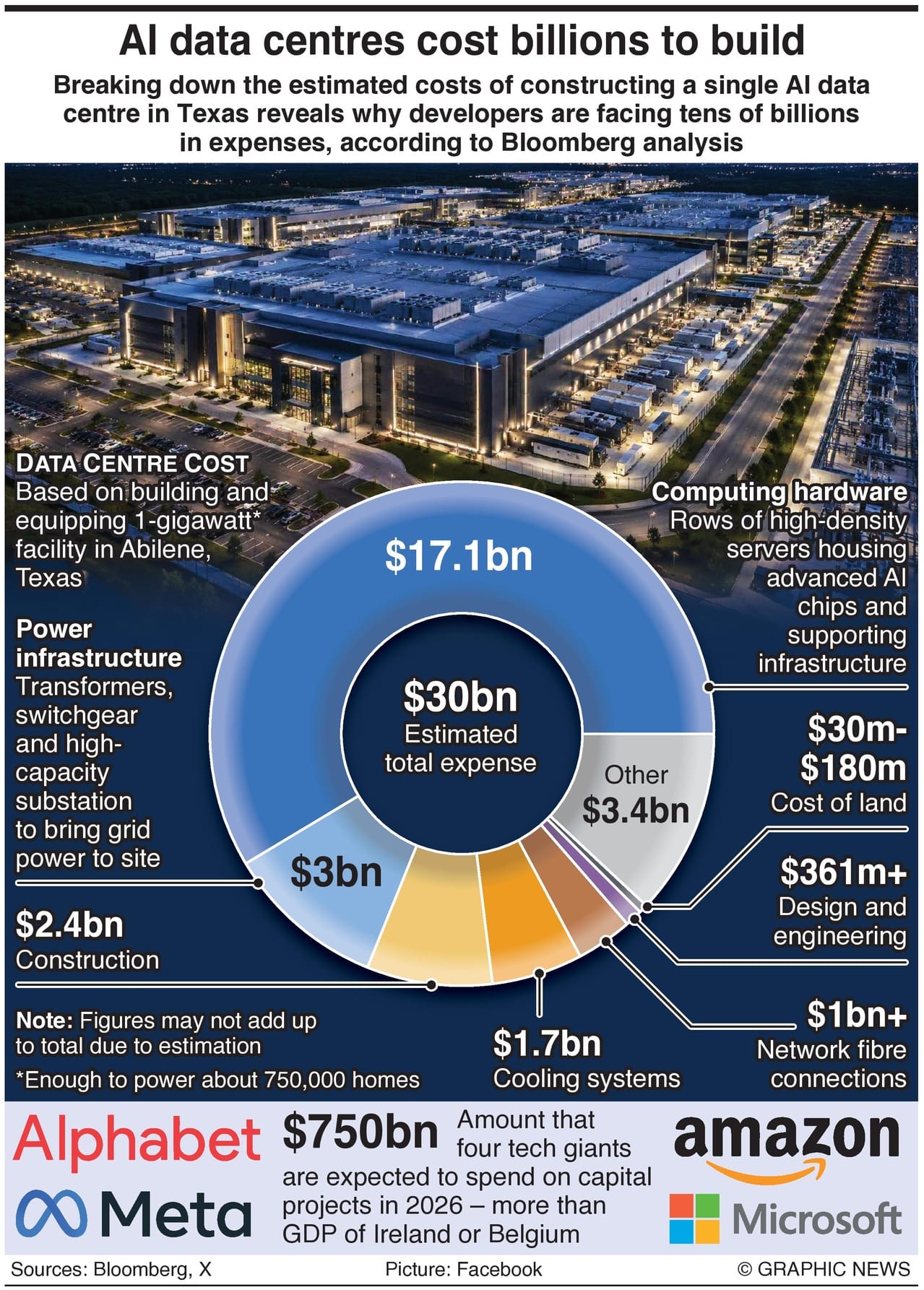
A 1-gigawatt data center in Abilene, Texas would cost roughly $30 billion to build and equip – $17 billion of which goes on servers and chips – according to analysis by Bloomberg that draws on an exclusive cost breakdown prepared with real estate services firm Cushman & Wakefield.
Four tech giants – Meta Platforms, Amazon, Microsoft and Google parent company Alphabet – together expect to spend about $750 billion on capital expenditures this year, with data centers absorbing most of the money.
That sum exceeds the entire gross domestic production of Ireland or Belgium. It is more than half of what every company in the S&P 500 spent on capital projects last year. Spread across U.S. households, it comes to about $5,500 each.
🔗 Further Reading
Deeper on what you just read.
🟨 Data Centers, Polling, November Elections, And The Way Forward – Steve Cortes, The Daily Signal
🟨 Data Center Water Usage Has Been Blown Far Out Of Proportion – Issues & Insights Editorial Board, Issues & Insights
🟨 Democracy vs. Data Centers – Angela Huyue Zhang, Project Syndicate
🟨 DeWine Takes Action on Data Centers – Rebecca Downs, The Daily Signal
🟨 Nevada Governor’s Race Heats Up Over Controversial Data Center Projects – TIPP News
🟨 Google Bets $15 Billion On Finland’s Booming AI Infrastructure – TIPP News
Sodium-Ion Batteries Offer Alternative To Lithium
Left behind by China’s dominance of the lithium-ion battery industry, South Korea has now set national targets to prioritize the development of sodium-ion batteries for domestic and commercial energy storage.
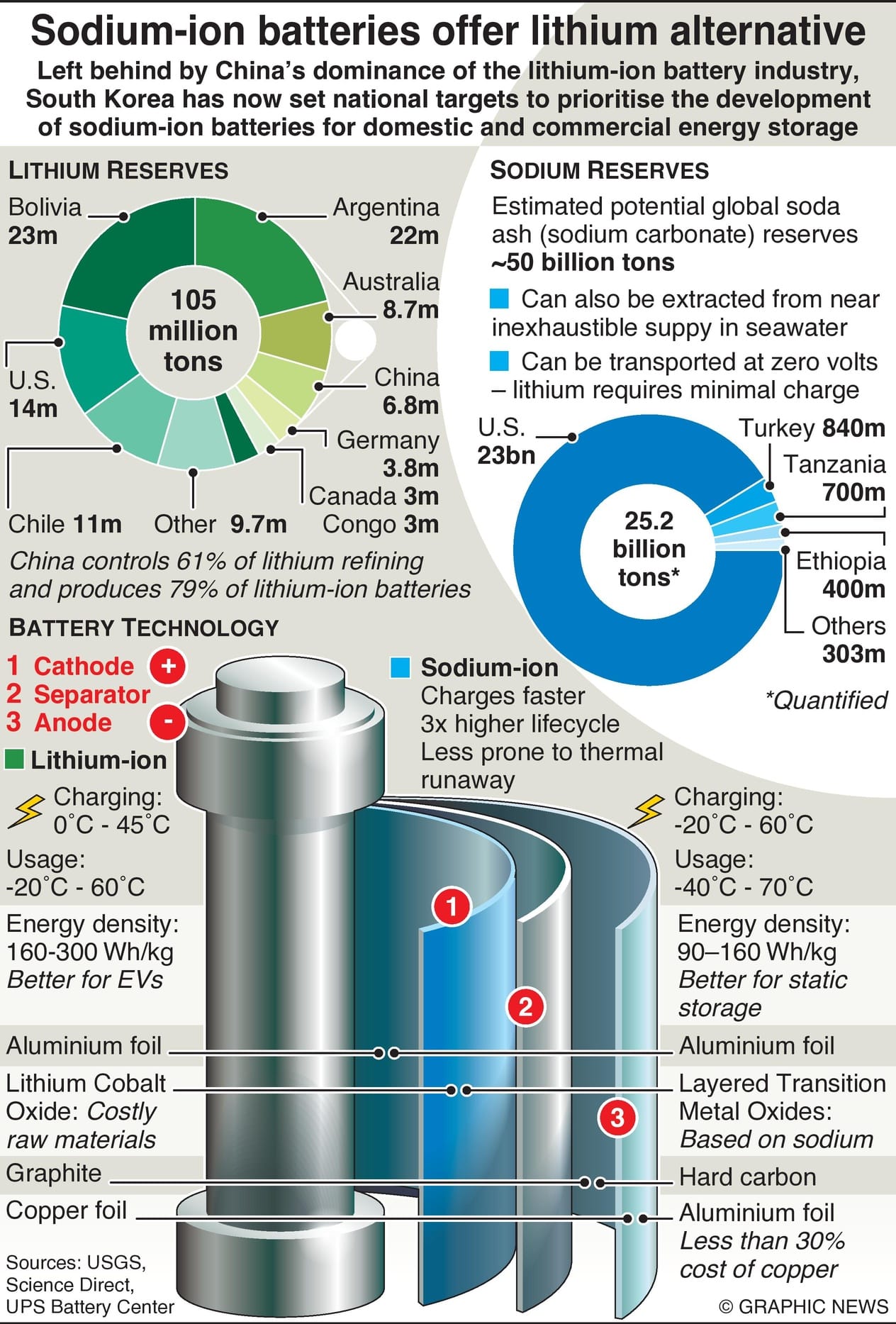
While lithium reserves are primarily found in the Americas, China controls 61% of lithium refining and produces 79% of lithium-ion batteries. Reserves of soda ash (sodium carbonate), from which most sodium is derived, are up to 500 times greater than global lithium reserves, with an almost inexhaustible supply of sodium also found in seawater.
Cathodes in lithium-ion batteries rely on metals like cobalt and nickel that are expensive, and environmentally problematic to extract, while the anodes use copper rather than cheaper aluminum.
Sodium-ion batteries however have a lower energy density than lithium-ion batteries, meaning they are best suited to uses where size or weight are less critical, such as energy storage for domestic and commercial applications or low-cost EVs.
🔗 Further Reading
Deeper on what you just read.
🟨 Rare Earths Are China’s Trump Card – Angela Huyue Zhang, Project Syndicate
🟨 How China Dominates The World’s Critical Minerals Production – Kyle McCollum, The Daily Signal
🟨 National Insecurity: America’s Continuing Reliance on Critical Chinese Materials – Benjamin Weingarten, RealClearInvestigations
🟨 The Dragon's Chokehold – Editorial Board, TIPP Insights
🧭 Power & Capital · October 14, 2026
Where state power meets the boardroom.
🔷 Trump Meme Coin Dinner Draws Buyers Linked To Foreign Crypto Exchanges – Power & Capital Desk, TIPP Insights
🔷 Trump Announces Plans For Major Oil, Gas And Mineral Exploration In Greenland – Power & Capital Desk, TIPP Insights
🌍 Global Affairs
The world's flashpoints, in motion.
🟥 Iran Warns US Navy As Strait Of Hormuz Shipping Faces Fresh Threats – TIPP News
🟥 Zelensky Says Russia Violated Trump’s Energy Ceasefire With Fresh Attacks – TIPP News
🟥 I&I/TIPP Poll Finds Surprising Pockets Of Support For Military Action Against Iran – TIPP News
🟥 Watch: Yemeni Houthis Target Saudi Infrastructure In Escalating Cross-Border Attacks – TIPP Video
🟥 Pope Leo Recovering In Rome Hospital After Cancerous Lung Growth Is Removed – TIPP News
🟥 Watch: Students Clash With Police As Albanian Protests Escalate Into Violence – TIPP Video
🟥 Watch: Leaders Of India’s ‘Cockroach’ Movement Jailed Following Voter Roll Protests – TIPP Video
🟥 The Neutrality Referendum: Why Switzerland Must Tie Its Politicians’ Hands – Claudio Grass, Mises Wire
🟥 How Was The World’s Oldest Shipwreck Discovered In Turkey – TIPP News
🏛️ National Affairs
The fights shaping America right now.
🟫 The Only Way To Fight Government Corruption – Ron Paul, Ron Paul Institute for Peace and Prosperity
🟫 Donald Trump Rallies Ohio Crowd In Youngstown, Weeks Before Election – Rebecca Downs, The Daily Signal
🟫 What Did A New Report Reveal About AI Use In Ransomware Attacks – TIPP News
📈 Economy
Prices, policy, and the pressure on your wallet.
🟩 US Inflation Rises To 3.7% In September, Exceeding Forecasts – TIPP News
🟩 Social Security Announces $75 Monthly Benefit Increase For 2027 – TIPP News
💼 Markets & Business
The deals and tickers making moves.
🟧 Netflix To Cut Nearly 1,000 Jobs In Workforce Restructuring – TIPP News
🟧 Bank Of America Profit Drops 17% As Trading Revenue Disappoints – TIPP News
🟧 Berkshire Hathaway Raises Stake In Nasdaq-Listed Bending Spoons To 4% – TIPP News
Letters to the editor email: editor-tippinsights@technometrica.com
Subscribe Today And Make A Difference. Consider supporting Independent Journalism by upgrading to a paid subscription or making a donation. Your support helps tippinsights thrive as a reader-supported publication. Contact us to discuss your research or polling needs.
Reach our audience. For sponsorship and advertising opportunities, visit our Partner With Us page.