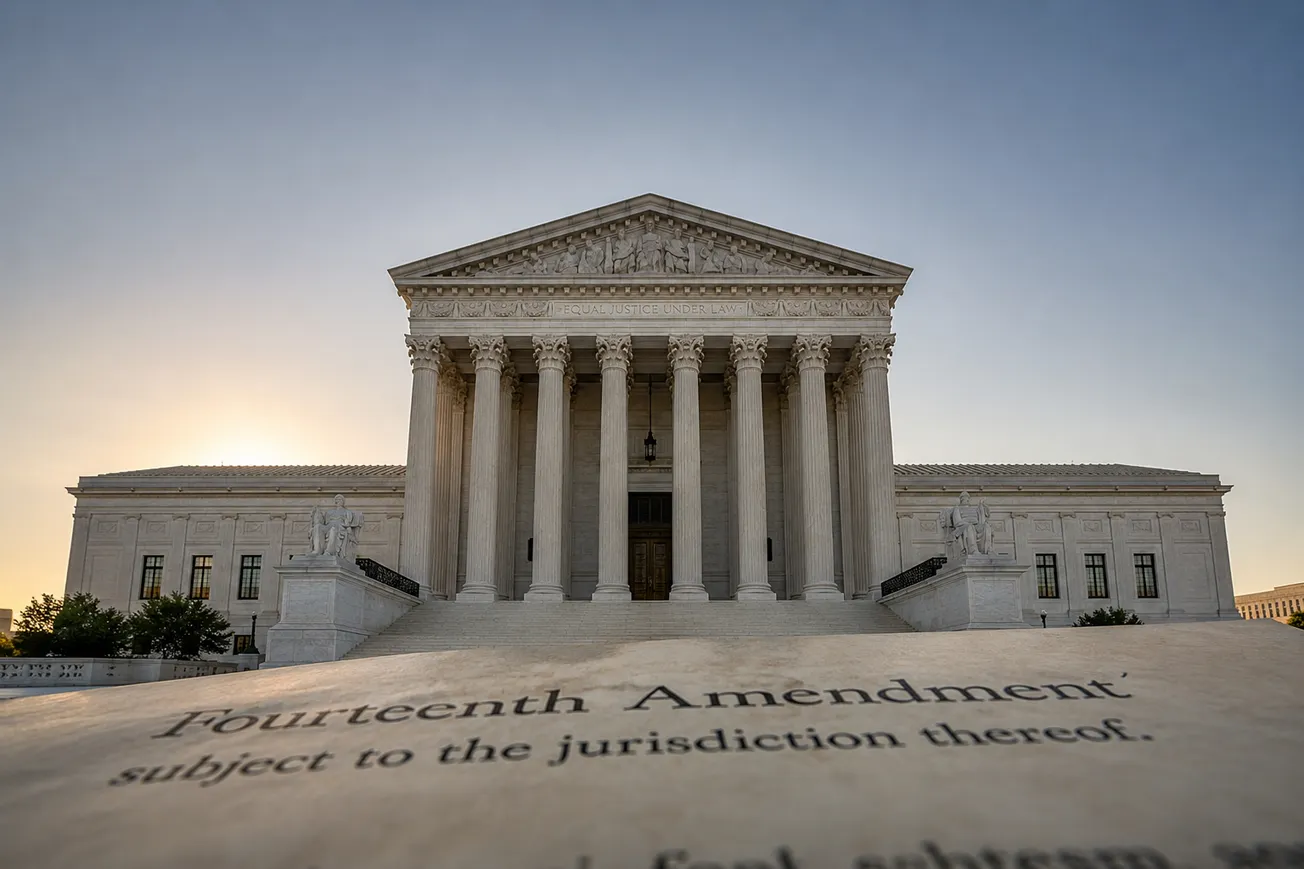
The Supreme Court will rule any day now on President Trump’s birthright-citizenship order, perhaps within hours. Whichever way it goes, the ruling will be narrower than it looks, and the argument behind the order will not end with it.
Start with what the two sides actually agree on, because months of noise have buried it. The challengers and the government accept that a single case governs this dispute: United States v. Wong Kim Ark, the 1898 decision that recognized the citizenship of a man born in San Francisco to Chinese parents. The case is styled Trump v. Barbara, after the pseudonym of a pregnant woman who sued to block the order, one of a class of immigrant parents joined by several Democratic-led states. John Sauer, the Solicitor General, who is the federal government’s top courtroom lawyer, told the justices in April that he was not asking them to overrule the 1898 case. The challengers asked the Court to reaffirm it. Both sides want the same precedent to win.
Whether the 1898 ruling still stands is not really in dispute; what it means is the whole fight. The government says it requires allegiance, the enduring bond between a person and the country that claims him, while the challengers argue that birth on U.S. soil alone is enough.
The Fourteenth Amendment grants citizenship to those “born or naturalized in the United States, and subject to the jurisdiction thereof.” The entire debate centers on that second clause. Advocates of unconditional birthright citizenship would have it do little or no work at all, and the courts have largely interpreted it to cover nearly everyone born on U.S. soil, with only a handful of narrow exceptions: the children of foreign diplomats, of occupying soldiers, and of tribal nations once treated as sovereign. But those words are not decoration. A basic rule of constitutional interpretation is that every word carries meaning, and “subject to the jurisdiction thereof” is no exception. A clause that survived the arduous process of drafting, debate, and ratification earned its place. The framers did not include those words merely to have them read out of the Constitution.
So what does “subject to the jurisdiction thereof” mean? The government’s answer is allegiance. The idea goes back long before the United States existed. Under English common law, people owed loyalty to the ruler who protected them. That bond of loyalty, not a person’s mere presence in the country, determined who belonged. The government argues that the modern equivalent of that bond is domicile: the settled intention to make the United States a permanent home. On that view, a child born to parents who are here unlawfully, or who are here lawfully but only temporarily, falls outside the clause because their parents’ enduring allegiance remains with another country.
That reading is not a theory invented for this case. We traced its legal roots in Rewrite Birthright to Right the Ship. Senator Lyman Trumbull, who sponsored the Civil Rights Act of 1866 that preceded the Fourteenth Amendment, said the law granted citizenship to children born to parents “domiciled in the United States.” Justice Joseph Story’s 1834 treatise likewise excluded the children of parents staying in the country only temporarily. And the Supreme Court’s 1898 decision, on which this case largely rests, referred to domicile more than 20 times. The government’s point is hard to wave away: the Court used that word deliberately, and courts do not repeat themselves by accident.
The United Kingdom, whose common law helped shape America’s, ended unconditional birthright citizenship in 1983. Today, a child born there receives citizenship only if at least one parent is a citizen or a settled resident. Most other wealthy democracies have adopted similar rules, tying citizenship at birth to a parent’s legal connection to the country. Such a rule would not make the United States an outlier; it would put it back in step with most of the developed world. American law is read first through its own history, not through what other nations choose. But read honestly, that history points the same way.
A country can reasonably require that citizenship at birth reflect a genuine connection to the nation, not simply the place where a child happens to be born. We made that case in The Birthright Covenant. When citizenship is automatic, it creates an incentive for illegal immigration because the child receives a benefit most other developed countries no longer offer. A U.S.-born child’s citizenship does not legally shield the parents from deportation, but it can complicate enforcement and, over time, make it easier for families who entered illegally to remain. Birth tourism follows the same logic, with foreign parents traveling to the United States so their child will acquire U.S. citizenship at birth. At its core, the question is what citizenship means if it can be obtained by violating the very laws of the country that grants it.
If the Court rules against the order, it will likely conclude that the word “domicile” in the 1898 decision merely described the facts of that case, not a constitutional requirement. That is a plausible reading, but it is not the only one. The Fourteenth Amendment was drafted, debated, and ratified word by word, and every part of it deserves to be taken seriously. The question of who owes allegiance to this country, and what the country owes in return, cannot be settled by simply assuming the answer. A court can say what the Constitution requires, but not what the country should choose.
However it rules, the headlines will overstate it. A ruling against the order will be cast as the Court blessing birthright citizenship for all; a ruling for it as the Court abolishing it. Both readings are wrong. Whatever the Court decides, it is the law, and it commands respect. But the Court is judging one executive order, not writing the nation’s citizenship policy. That policy is still ours to write.
Loved it, hated it, or somewhere in between — tell us. Grade this article here and help shape what lands in your inbox next.
🧭 Power & Capital · June 30, 2026
Where state power meets the boardroom.
🔷 Fraud Cartels Monopolize Big Tech. New Legislation May Stop That – Power & Capital Desk, TIPP Insights
🔷 Congress Scrambles To Cover Cost Of Iran War – Power & Capital Desk, TIPP Insights
🔷 Medicare To Cover Weight-Loss Drugs Under New Pilot Program – Power & Capital Desk, TIPP Insights
🔷 Newsom Wants The Jacobins Cheering And The Billionaires Staying – Power & Capital Desk, TIPP Insights
🌍 Global Affairs
The world's flashpoints, in motion.
🟥 How Did The Shooting At A German Welfare Facility Unfold – TIPP News
🟥 How Are Human And Great Ape Laughter Connected? – TIPP News
🏛️ National Affairs
The fights shaping America right now.
🟫 Supreme Court Strengthens Privacy Protections For Cellphone Data – TIPP News
🟫 Navy Launches Recovery Mission For Missing U.S. Marine – TIPP News
🟫 Authorities Regain Partial Control After Jail Uprising – TIPP News
🟫 Mamdani’s Welcome Of Former TPS Holders Sparks Calls for Criminal Prosecution – Pedro Rodriguez, The Daily Signal
🟫 ‘ASK MERCY OF GOD’: Republicans Slam Dems Over Endorsement Of Leftist Group Under Federal Indictment – Tyler O’Neil, The Daily Signal
🟫 JetBlue Plane Reports Drone Strike Near JFK Airport – TIPP News
🟫 U.S. House Approves Child Online Safety Package – TIPP News
🟫 Why Did Speaker Johnson Send The Housing Bill To The White House – TIPP News
🟫 Firefighters Say Karen Bass Failed Them—Now They’re Taking Their Case to Voters – Angelina Delfin, The Daily Signal
🟫 ‘CULTURAL CORRECTION’: 10 Major Brands Dial Back The LGBTQ Pride – Tyler O’Neil, The Daily Signal
🟫 The SAVE America Act Stands A Chance After All – Rebecca Downs, The Daily Signal
🟫 I Ran Arizona’s ESA Program. Here’s What The Critics Won’t Tell You. – Christine Accurso, The Daily Signal
🟫 World Cup Tourists See What Too Many Americans Have Forgotten – Josh Hammer, The Daily Signal
🟫 Our Favorite Patriotic Tunes, Part 1: ‘God Bless America’ vs. ‘This Land Is Your Land’ – Al Perrotta, The Daily Signal
🟫 When The Culture’s View Of Family Invades The Church – Timothy Goeglein, The Daily Signal
🟫 The Conservative Movement And ‘The Odyssey’ – Ty Ruddy, The Daily Signal
🟫 How To Grow Closer To Your Family This Summer – Thomas Griffin, The Daily Signal
🟫 NASA Plans Mission To Rescue Aging Swift Space Telescope – TIPP News
📊 Market Mood · June 30, 2026
How the trading day is setting up.
🟩 Markets are poised for a steady open as easing Middle East tensions and renewed strength in technology shares continue to support investor sentiment.
🟧 The AI trade remains the market's biggest driver, but investors are becoming more selective, rewarding companies with strong earnings while scrutinizing heavy AI spending.
🟦 Oil prices remain near pre-conflict levels, helping ease inflation concerns and reducing pressure on central banks, even as traders continue to monitor U.S.-Iran diplomacy.
🟨 Investors now turn their attention to key labor market data and consumer confidence reports, looking for fresh clues on the economy ahead of Thursday's closely watched jobs report.
🗓️ Key Economic Events
On today's U.S. data calendar.
🟧 10:00 a.m. ET — JOLTS Job Openings (May)
Forecast: 6.95 million | Previous: 6.86 million
A key measure of labor demand that helps investors gauge whether hiring is cooling enough to ease inflation pressures without signaling a weakening economy.
🟧 10:00 a.m. ET — Consumer Confidence (June)
Forecast: 101.2 | Previous: 98.0
Consumer sentiment is a leading indicator of future spending and offers insight into the strength of the U.S. economy.
Letters to the editor email: editor-tippinsights@technometrica.com
Subscribe Today And Make A Difference. Consider supporting Independent Journalism by upgrading to a paid subscription or making a donation. Your support helps tippinsights thrive as a reader-supported publication. Contact us to discuss your research or polling needs.
Reach our audience. For sponsorship and advertising opportunities, visit our Partner With Us page.