By Shang-Jin Wei, Project Syndicate | July 2, 2026
While the prevailing economic narrative in the United States has often extolled free markets, policymaking itself has always been more pragmatic. From its very founding, the US has had a hybrid model in which the state directs, subsidizes, and occasionally bails out private enterprise in the service of national priorities.
NEW YORK—As the United States marks 250 years since the signing of the Declaration of Independence this summer, there is no better time to reckon with one of the great myths of American economic life: that the country’s prosperity was built on laissez-faire capitalism. From its very founding, the US has had a hybrid model in which the state directs, subsidizes, and occasionally bails out private enterprise in the service of national priorities. While the prevailing narrative has often extolled free markets, policymaking itself has been more pragmatic.
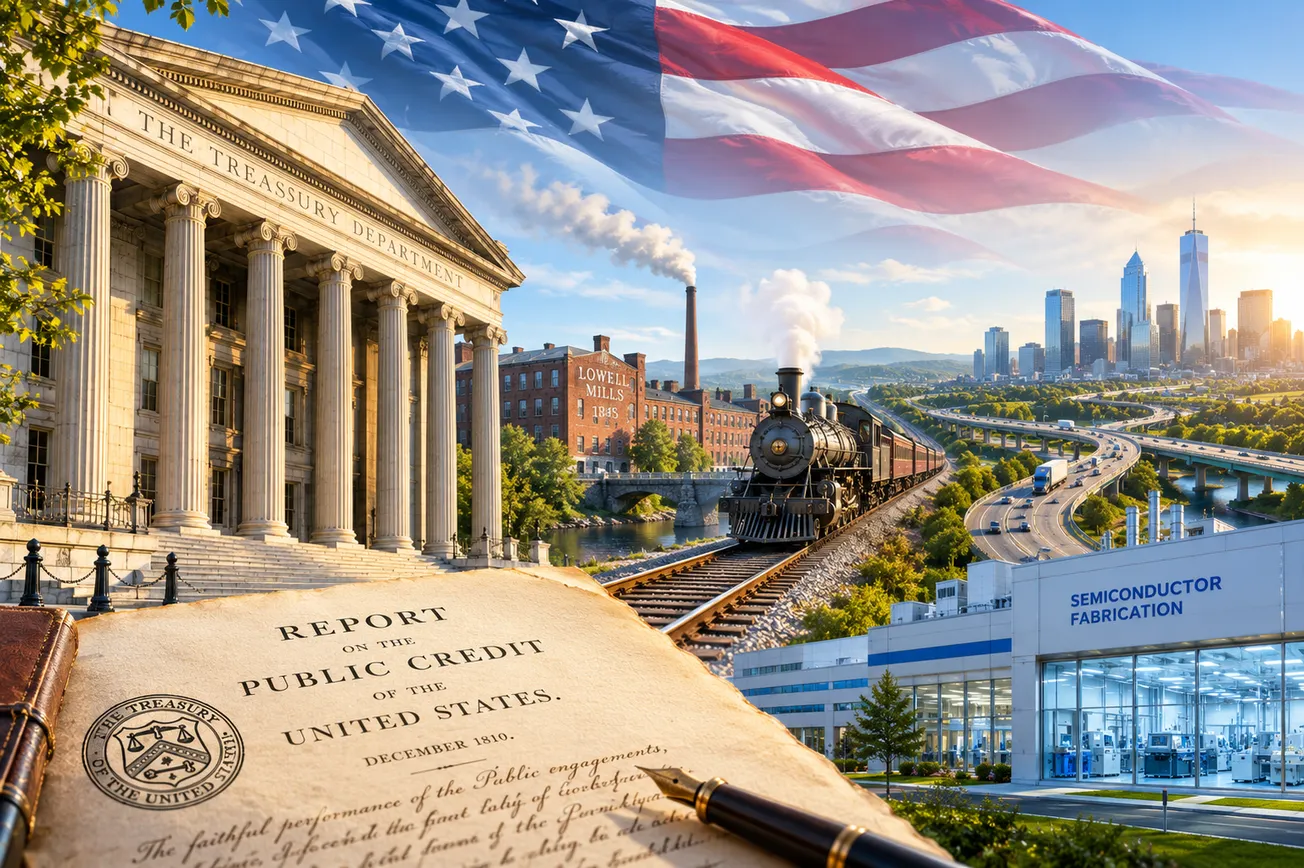
This story begins not with Barack Obama’s health-care program, or even with Franklin D. Roosevelt’s New Deal in the 1930s, but with the very first US administration, under George Washington. In 1791, Secretary of the Treasury Alexander Hamilton submitted to Congress what was arguably the first government document in world history to lay out a systematic, intellectual case for industrial policy. In his Report on Manufactures, he noted that infant industries in the US, particularly textiles and garments, could not compete effectively against established British manufacturers without government protection. He proposed the use of tariffs and subsidies to nurture the industries of the future.
Hamilton lost the immediate battle when a still agrarian-minded Congress tabled his report. But he ultimately won the war, because his ideas would go on to shape American economic policy for the next century. Henry Clay’s “American System,” along with the protective tariffs that helped industrialize the North and the federal land grants that built the transcontinental railroads, all bore Hamilton’s intellectual fingerprints. Industrial policy, it turns out, was not invented in Brussels, Beijing, Tokyo, or Moscow.
This founding pragmatism never disappeared. During the 20th century, the Cold War forged the military-industrial complex. DARPA invented the internet, NASA developed and then spun off technologies that would shape entire industries, and federal procurement contracts sustained America’s aerospace and semiconductor sectors for decades. The Interstate Highway System, built under Dwight Eisenhower, was not only one of the largest infrastructure investments in history; it was also a decisive federal subsidy to the automobile industry. And when the 2008 financial crisis hit, the government took equity stakes in banks and automakers, once again flouting free-market orthodoxy.
Yet the myth of laissez-faire America has proved remarkably durable, functioning almost as a national religion, even as the practice diverged from the creed. Moreover, the same orthodoxy, promoted through the US-dominated World Bank and USAID, sometimes served as a barrier to practical economic development in other countries.
In a recent research paper, “The United States as an Active Industrial Policy Nation,” Jiandong Ju, Yuankun Li, and I document this gap between rhetoric and reality. We systematically analyzed all 12,167 congressional acts and 6,030 presidential orders issued between 1973 and 2022, using large language models to identify policies that deliberately altered the economic structure away from laissez-faire outcomes. The results are striking.
We identified 267 congressional acts and 187 presidential orders containing significant new industrial policies. That is more than nine new industrial-policy directives per year across a half-century period, and the pattern holds regardless of which party controlled the White House or Congress. Every president from Richard Nixon to Joe Biden promulgated new industrial policies. The difference between the two parties has been a matter of degree, not of kind.
Our research also uncovers some interesting features of US industrial policies. For example, we find that American policymakers have historically built guardrails into economic interventions. Some 59% of all industrial-policy laws and orders carry an explicit expiration date, with an average duration of roughly four years. Many are framed explicitly as pilot programs—experiments that can be wound down if they fail. Some include conditional triggers: “Buy America” procurement preferences, for example, apply only if the domestic price is no greater than 125% of the international market price. If the inefficiency becomes too large, the subsidy lapses.
As America turns 250, the pendulum has swung visibly back toward explicit state capitalism. The CHIPS and Science Act, the Inflation Reduction Act, and the aggressive tariffs deployed by both President Donald Trump and Biden do not represent major qualitative departures from American tradition.
But the current debate—between those who see creeping socialism and those demanding a more equitable distribution of the gains—risks overlooking a longer continuity. The US has never been a pure laissez-faire economy. From the very beginning, it has been a state that is willing to use its power strategically, what it regards as the failure of laissez-faire, while maintaining a competitive private sector as the engine of growth and innovation.
The real secret of American economic success over the past 250 years is not a dogmatic commitment to either markets or the state. It is a pragmatic willingness to use both. As the country looks toward the future, that pragmatism may be one of its most important inheritances.
Shang-Jin Wei, a former chief economist at the Asian Development Bank, is Professor of Finance and Economics at Columbia Business School and Columbia University’s School of International and Public Affairs.
Loved it, hated it, or somewhere in between — tell us. Grade this article here and help shape what lands in your inbox next.
Copyright Project Syndicate
🧭 Power & Capital · July 2, 2026
Where state power meets the boardroom.
🔷 Report Says OpenAI Weighs 5% Stake For Trump Administration
🔷 What Is Behind The EU's $4.7 Billion Fine On Google
🔷 Study Warns UK-US Pharma Deal Could Cost 229,000 Lives
🔷 House Democrats Question Funding Behind Trump's America 250 Celebrations
🌍 Global Affairs
The world's flashpoints, in motion.
🟥 Kyiv Hit By Major Russian Air Assault As Death Toll Rises – TIPP News
🟥 Watch: 20 Dead In Ukraine's Kyiv After Russian Attack – TIPP Videos
🟥 CSIS Estimates Ukraine War Has Caused Over 2 Million Casualties – TIPP News
🟥 Iran's Navy At The Bottom Of The Ocean: Vance – TIPP Videos
🟥 Papal Clash: Vatican Excommunicates Breakaway Catholic Priests, Bishops – TIPP News
🟥 Watch: Asked Roosevelt About Democrats Giving Panama Canal Away For $1: Trump – TIPP Videos
🏛️ National Affairs
The fights shaping America right now.
🟫 Why Is Trump Taking Cues From Gavin Newsom? – Editorial Board, Issues & Insights
🟫 As U.S. Nears Its 250th Birthday, Nearly 3/4 Still Say They’re Proud To Be American: I&I/TIPP Poll – Terry Jones, TIPP Insights
📈 Economy
Prices, policy, and the pressure on your wallet.
🟩 How Many Jobs Did The US Add In June – TIPP News
💼 Markets & Business
The deals and tickers making moves.
🟧 Tesla Reports Strongest Quarterly Delivery Growth In A Year – TIPP News
🟧 Why Did Tesla Stock Fall Despite Strong Delivery Numbers – TIPP News
🟧 Microsoft Creates New AI Team To Help Businesses Adopt AI – TIPP News
🟧 Why Does Robinhood Believe AI Can Rival Human Traders – TIPP News
Letters to the editor email: editor-tippinsights@technometrica.com
Subscribe Today And Make A Difference. Consider supporting Independent Journalism by upgrading to a paid subscription or making a donation. Your support helps tippinsights thrive as a reader-supported publication. Contact us to discuss your research or polling needs.
Reach our audience. For sponsorship and advertising opportunities, visit our Partner With Us page.