
The Fourth of July is usually a time for fireworks, picnics, and, for some, quiet reflection on what it means to be an American. But this Fourth is special, marking the 250th anniversary of the United States. Are Americans still proud of what they’ve built? A solid majority says yes, the latest I&I/TIPP Poll shows.
The national online I&I/TIPP Poll asked 1,589 adults: “As the United States approaches its 250th anniversary, how proud are you to be an American?” The response was strong: 72% said they were either “very proud” (48%) or “somewhat proud” (24%), while 24% said they were “not very proud” (15%) or “not proud at all” (9%).
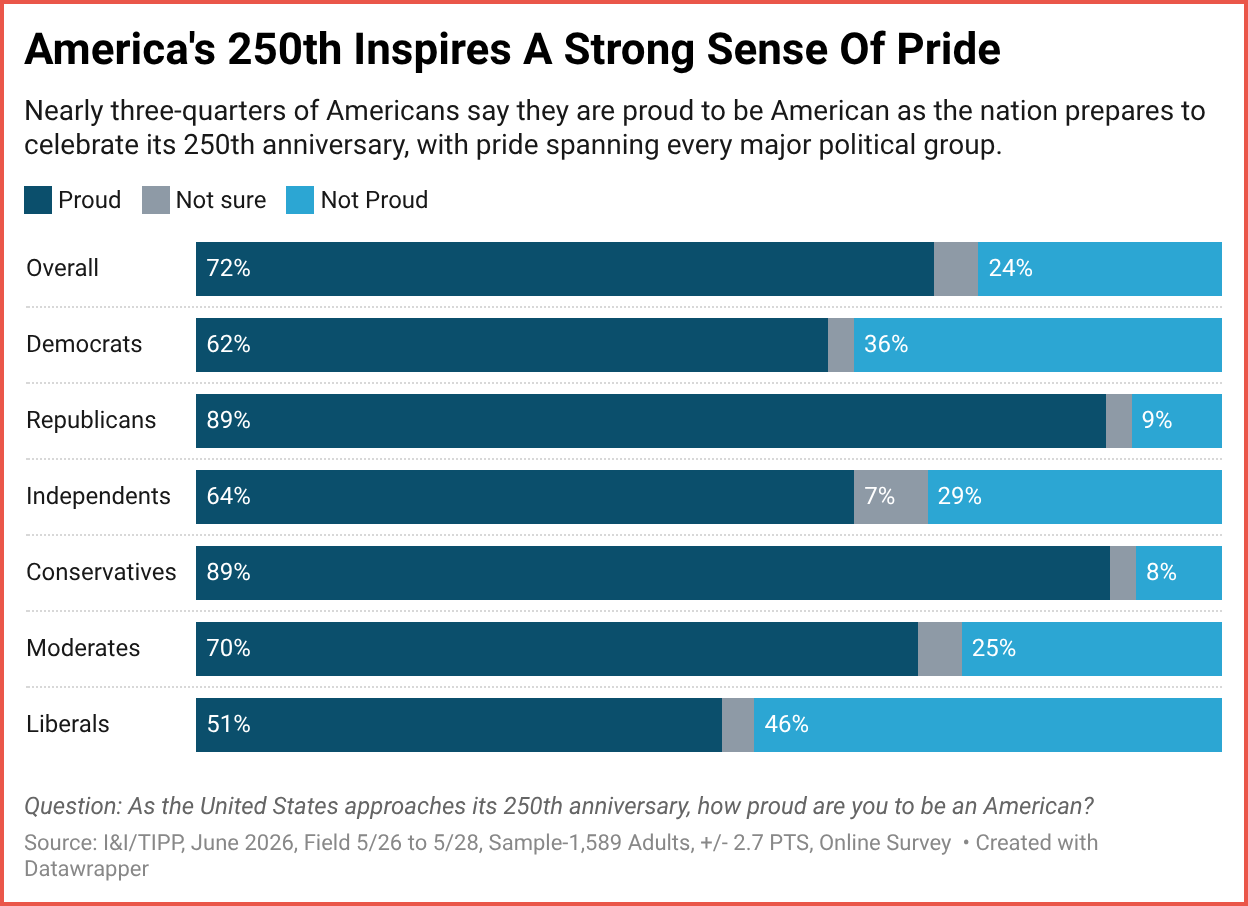
The poll, taken from May 26 through May 28, has a +/-2.7 percentage point margin of error.
But there might be an asterisk on the poll, at least as far as the demographic breakdown goes.
For instance, as a matter of politics, one group is far more proud to be American than others: Republicans. They tip the scale at 89% proud vs. just 9% not proud. Democrats are least proud (but still a majority): 62% proud, 36% not proud. Independents are slightly more: 64% proud, 29% not proud.
What’s behind this? The real dividing line isn’t party affiliation, but ideology.
Among those who describe themselves as “conservative,” 89% say they’re proud, and 8% not proud. But among moderates, it’s 70% proud, 25% not proud; with liberals, proud responses fall to just 51%, but a hefty 46% respond “not proud.”
Could it be that America-smitten European soccer tourists are prouder and more impressed with America than American liberals are?
There’s one more eye-grabbing difference: The older you are, the more likely you are to say you’re proud
I&I/TIPP also asked voters: “Do you believe the United States today is living up to the ideals of the nation’s founders?”
Overall, 43% responded either “yes, very much” (16%) or “yes, somewhat” (27%), while the no answers received a slim majority of 52%, with 25% choosing “no, not much” and 27% “no, not at all.” Just 5% said they weren’t sure.
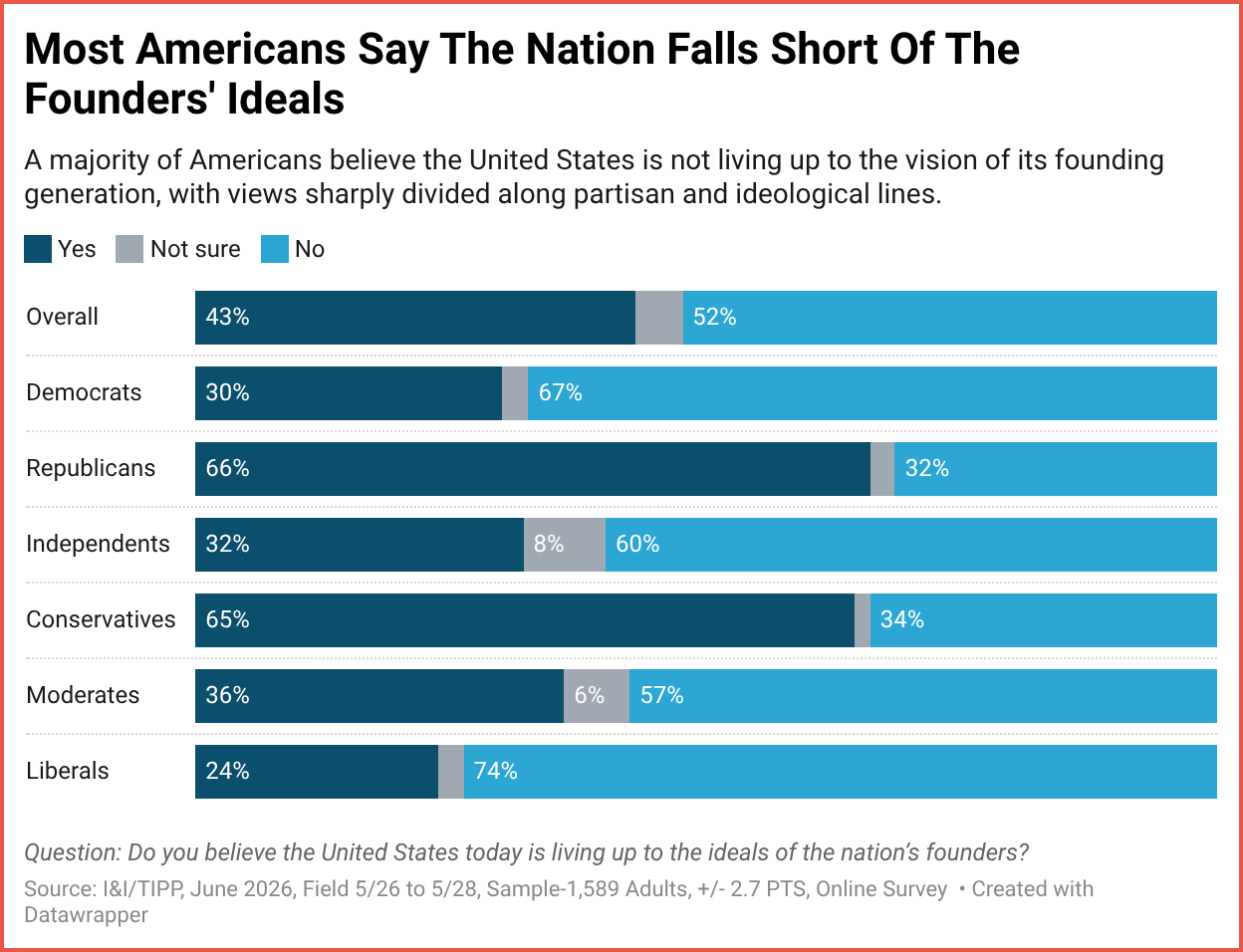
As is often the case, political affiliation tells the tale. Among Democrats, for instance, “yes” answers (30%) were outweighed by “no” answers (67%) by more than 2-to-1. Independent voters weren’t much different, at 32% “yes,” and 60% “no.”
That leaves the GOP, which sees a very different America: Among Republicans, 66% responded “yes,” just 32% “no.”
For a final question, I&I/TIPP asked those taking the poll to respond to two separate statements about the U.S.’ 250th anniversary celebration and choose which of two statements (or both, or neither) comes closest to their view.
The first statement: “America’s 250th anniversary should be a time to celebrate the nation’s achievements.”
The second: “America’s 250th anniversary should also be a time to reflect on the nation’s failures and divisions.”
Among all respondents, 37% picked the first statement, while just 18% selected the second. But a near-equal 36% of respondents said “both equally,” while just 5% said “neither.”
So roughly 73% want to celebrate the nation’s achievement, with half of those saying they also wish to reflect on our “failures and divisions.” And about a quarter wanted only negative reflection or none at all.
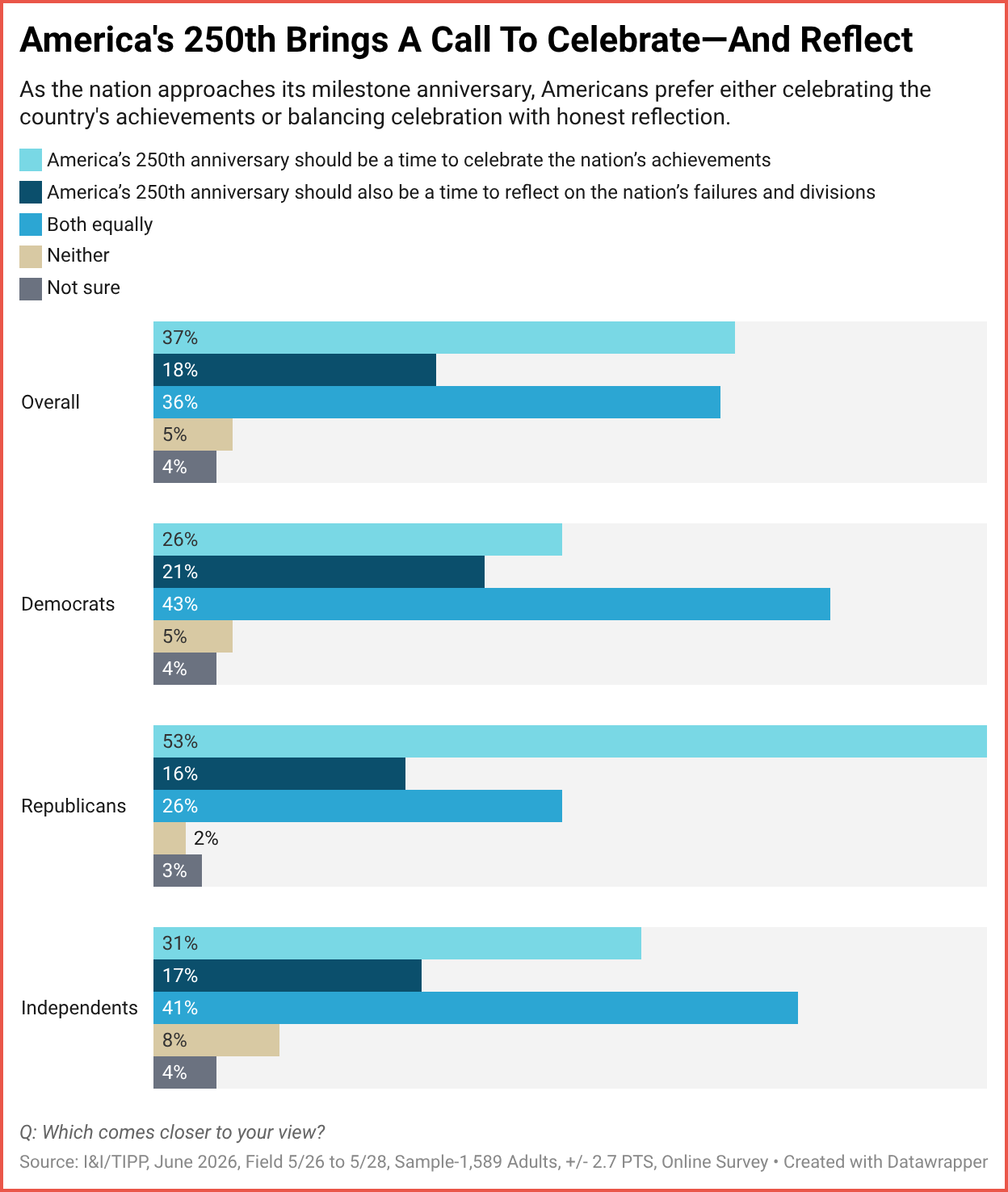
Again, perhaps predictably, political ties matter in how people answered.
Democrats, for instance, gave 26% to “celebrate the nation’s achievements,” while 21% selected “reflect on the nation’s failures and divisions.” By far, the largest selection was “both equally,” at 43%. Likewise, indie voters gave 31% to “celebrate achievements,” 17% to “failures and divisions,” and 41% to “both equally.”
Republicans see things differently, with a 53% majority picking the “celebrate achievements” response, only 16% wanting focus on “failures and divisions,” and 26% desiring “both equally.”
These results point to a troubling conclusion: Democrats, especially those in the Democratic Socialist wing and others on the far left, are falling out of love with America. And it’s been happening for some time.
Polls going back at least to 2001 show that the number of Americans saying they’re proud of what the U.S. has achieved has been on a steady decline. But that decline accelerated during the first and second terms of President Donald Trump.
Why? Democrat leaders, activists, and those on the party’s far-left wing are furious with Trump and, by extension, the moderate and independent voters who elected him. The Democrats have been drifting further left, moving away from their moderate middle-class support for years.
That could be seen in the run-up to the president’s Ultimate Fighting Championship Freedom 250 celebration of the nation’s 250th anniversary. Left-leaning actors and activists held a counter-demonstration, the Rise Up, Sing Out event in New York.
There, as in other venues, the language was angry and notably anti-Trump in content.
“I hate to say it, but loving our country is starting to sound like an abused spouse saying they love their abuser,” actor Robert De Niro said in typical remarks. “I can’t love a country that’s led by a racist, misogynist, xenophobic tyrant. And let me just say it: I can’t love the country that’s led by Donald Trump and his sycophant Congress.”
That’s pretty much it in a nutshell. As a recent USA Today story noted, “New polling shows a historic, and deeply partisan, decline in how proud Americans feel about their country, with Democrats driving nearly all of the drop.”
A recent headline from the center-left online news provider Politico tells the tale: “Centrist Democrats are freaking out about progressives’ winning streak.” There’s more here, here, and here.
America is undergoing a political and cultural schism today unseen since the 1960s years of campus rage and revolution. Yet, even so, as the I&I/TIPP Poll clearly shows, there is some hope because, despite their differences, a majority of Democrats, Republicans, and independents still remain proud to be Americans.
I&I/TIPP publishes timely, unique, and informative data each month on topics of public interest. TIPP’s reputation for polling excellence comes from being the most accurate pollster for the past six presidential elections.
Terry Jones is an editor of Issues & Insights. His four decades of journalism experience include serving as national issues editor, economics editor, and editorial page editor for Investor’s Business Daily.
Loved it, hated it, or somewhere in between — tell us. Grade this article here and help shape what lands in your inbox next.
🧭 Power & Capital · July 2, 2026
Where state power meets the boardroom.
🔷 Elon Musk Denies WSJ Report On SpaceX AI Handset Prototype
🔷 Alibaba Agrees To $600 Million DOJ Settlement
🔷 SCOTUS Clears Way For Coordination With Candidates, Parties in Fundraising
🌍 Global Affairs
The world's flashpoints, in motion.
🟥 What Did Trump Say About U.S.-Iran Relations – TIPP News
🏛️ National Affairs
The fights shaping America right now.
🟫 The Closet Door Of Socialism Has Been Opened – Editorial Board, Issues & Insights
🟫 Trump Reacts To Birthright Citizenship Ruling – Elizabeth Troutman Mitchell, The Daily Signal
🟫 Hill GOP Erupts Over Birthright Citizenship Decision – Pedro Rodriguez, The Daily Signal
🟫 Supreme Court Rules On State Laws Excluding Men From Women’s Sports – Fred Lucas & Tyler O’Neil, The Daily Signal
🟫 Two SCOTUS Wins For Gun Rights, But Questions Remain About The ‘History And Tradition’ Test – Nikhil Agarwal, Issues & Insights
🟫 Marjorie Taylor Greene Says She Is Exploring New Political Party – TIPP News
🟫 Why Is The U.S. Murder Rate Falling To Historic Lows – TIPP News
🟫 CDC Warns of Early Surge In West Nile Virus Cases – TIPP News
🟫 Authorities Describe ‘Horrific’ Conditions Inside Ohio Home – TIPP News
🟫 Two Arrested After Climbing Empire State Building Antenna – TIPP News
📈 Economy
Prices, policy, and the pressure on your wallet.
🟩 Study Links GLP-1 Weight Loss To Higher Employment Among Women – TIPP News
🟩 The Economic Reasons Why Oil Consumers Need To Be “Gouged” – Vincent Cook, Mises Wire
💼 Markets & Business
The deals and tickers making moves.
🟧 CMA CGM To Acquire FedEx Supply Chain For $1.4 Billion – TIPP News
📊 Market Mood · July 2, 2026
How the trading day is setting up.
🟩 Markets are holding up despite a pullback in semiconductor stocks, with investors looking beyond recent volatility to focus on today's pivotal U.S. jobs report.
🟧 The AI trade is taking a breather after an exceptional quarter, as traders rotate out of high-flying chipmakers and reassess valuations across the technology sector.
🟦 Oil prices have fallen to four-month lows as progress in U.S.-Iran diplomacy and the reopening of the Strait of Hormuz continue to ease inflation concerns.
🟨 Today's employment report is expected to set the market's direction, with a strong reading likely to reinforce expectations for tighter Fed policy, while a weaker report could revive hopes that rates remain on hold
🗓️ Key Economic Events
On today's U.S. data calendar.
🟧 8:30 a.m. ET — Nonfarm Payrolls (June)
Forecast: +110K | Previous: +98K
The week's most important report. A stronger-than-expected reading could strengthen the case for another Fed rate hike, while a weaker result would ease pressure on policymakers.
🟧 8:30 a.m. ET — Unemployment Rate (June)
Forecast: 4.3% | Previous: 4.3%
Markets will watch for any sign of softening in the labor market that could alter expectations for the Fed's next move.
🟧 8:30 a.m. ET — Average Hourly Earnings (June)
Forecast: +0.3% m/m | Previous: +0.3% m/m
Wage growth remains a key inflation indicator and will be closely scrutinized alongside payrolls for clues about underlying price pressures.
Letters to the editor email: editor-tippinsights@technometrica.com
Subscribe Today And Make A Difference. Consider supporting Independent Journalism by upgrading to a paid subscription or making a donation. Your support helps tippinsights thrive as a reader-supported publication. Contact us to discuss your research or polling needs.
Reach our audience. For sponsorship and advertising opportunities, visit our Partner With Us page.