By Guillermo Ortiz, Project Syndicate | Jun 8, 2026
Mexico’s recent ratings downgrades are merely a symptom of a more serious malady: the ruling Morena party’s efforts to consolidate power permanently. To ensure the legal predictability foreign investors require, President Claudia Sheinbaum would need to confront Morena’s ideological legacy and, more importantly, its cartel ties.
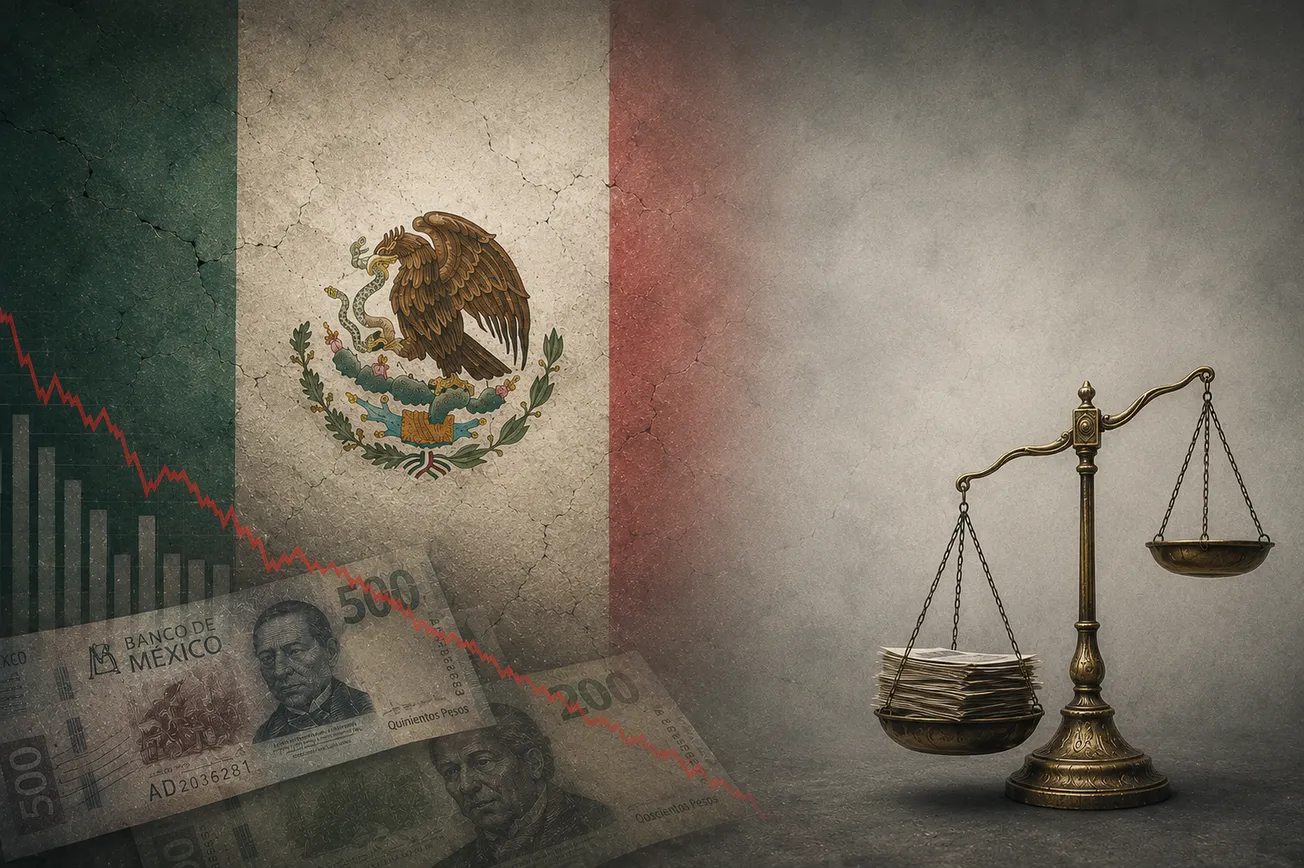
MEXICO CITY—Mexico is in trouble. Not the kind that governments can manage through policy adjustments, but a deeper structural malaise that compounds quietly until a crisis erupts. Two recent credit-rating downgrades, by Moody’s and S&P, have made the problem legible to international markets, but its causes remain misunderstood.
The ratings agencies cite fiscal deterioration—rising budget deficits, state-owned oil giant Pemex’s dire financial straits, and bloated transfer programs—as the main reason for the downgrade. They are not wrong. But this fiscal imbalance is a symptom of a more serious malady: a governance model suspicious of markets, hostile to independent institutions, and incapable of providing the legal predictability that investors require. The real indictment of Mexico today is not primarily fiscal. It is political.
Over the seven years that the Morena party has governed Mexico—first under former President Andrés Manuel López Obrador (AMLO) and now under President Claudia Sheinbaum—the country has registered its worst growth performance since the “lost decade” of the 1980s. Real GDP growth has averaged below 1% annually. As supply chains shifted out of China, nearshoring should have delivered a historic windfall but has instead underperformed dramatically.
The promise of Mexico becoming the great beneficiary of deglobalization has not materialized. The opportunity was there, but the policy environment repelled the capital needed to seize it. Dismantling regulatory agencies, packing the judiciary, and governing by executive decree are a recipe for stagnation, not a competitive, high-growth economy.
This brings us to the crux of the matter: Mexico is no longer a democracy in any meaningful sense of the term.
The evidence is overwhelming. AMLO spent his six years in office systematically weakening every institution capable of checking executive power, from the electoral authority and the Supreme Court to autonomous regulatory bodies and the free press. Sheinbaum has continued and, in some respects, accelerated that project. The 2024 judicial reform, which introduced the popular election of federal judges, was the decisive blow. Instead of democratizing the courts, it politicized them—and in today’s Mexico, a politicized court is a Morena court.
The consequences for the rule of law have been immediate and severe. Foreign investors who had been cautiously optimistic about Sheinbaum’s early signals have grown alarmed. Without independent courts capable of enforcing contracts and protecting property rights, no serious investment framework is possible. Sheinbaum says she wants private capital. But to deliver a legal system that investors trust, she needs to confront her party’s ideological legacy, which she seems unwilling to do.
In fact, Sheinbaum’s government has taken another step toward the permanent consolidation of power. Congress recently passed a constitutional reform that would allow elections to be invalidated on grounds of foreign interference. In a political system where the governing party controls the judiciary, the electoral authority, and the legislature, such a law is not a safeguard for sovereignty. It is a tool for maintaining the status quo and a shield against external scrutiny.
Consider what such scrutiny has already uncovered. In late April, the US Justice Department unsealed an indictment accusing Sinaloa Governor Rubén Rocha Moya of conspiring with the Sinaloa cartel’s Chapitos faction to traffic drugs into the United States. The indictment alleges that the faction secured Rocha Moya’s victory in the 2021 gubernatorial race by stealing ballots and kidnapping and intimidating opposition candidates.
According to prosecutors, Rocha Moya (a close ally of AMLO) met with cartel leadership while campaigning and pledged to install cartel-friendly officials in the Sinaloa government. Physical evidence includes handwritten monthly bribe lists seized in Mexico, with the names and positions of the officials being paid, and how much.
Sheinbaum’s response to the extradition request was telling: she refused to comply, demanding “irrefutable evidence” and noting that if evidence is not provided, it is clear that the charges were politically motivated.
The Rocha Moya indictment is not an isolated case. It reflects the reality that organized crime does not merely operate alongside Mexico’s political system; in many parts of the country, it is the political system. The 2021 Sinaloa gubernatorial race, according to the US government, was a transaction, not an election.
This raises the most uncomfortable question in Mexican politics today. If cartel financing flowed to the Morena party in a 2021 gubernatorial race, why would the 2024 presidential election—far larger and involving the same political networks—be immune? The question is not whether, in the eyes of Mexican voters, Sheinbaum won legitimately. It is whether the party apparatus that delivered her historic win was clean. In this context, the government’s supposed defense against foreign interference looks less like democratic protection and more like preemptive prohibition of formal efforts to raise this question.
That is why Sheinbaum cannot break with her predecessor. To move against cartel influence in Mexican politics would require moving against the network that brought her to power.
Mexico’s credit-rating downgrades signal growing fiscal risk. But financial markets are slower to price the risk of a country sliding from an imperfect democracy into a competitive authoritarian regime. Mexico has crossed that threshold. The costs are only beginning to add up.
Guillermo Ortiz, a former finance minister of Mexico and governor of Banco de Mexico, is Treasurer of the G-30.
Copyright Project Syndicate
Global Affairs
How Soon Could The Iran War End? Trump Gives Timeline – TIPP News
U.S. Promises Action After Helicopter Incident In Hormuz – TIPP News
US Military Investigates Apache Helicopter Incident Off Oman – TIPP News
Which Technology Helped Save US Crew Members Off Oman’s Coast – TIPP News
How China Is Expanding Its Strategic Partnership With Kim Jong Un – TIPP News
Why Did The U.S. Impose New Sanctions On Nicaraguan Officials – TIPP News
ICC Oversight Body Moves Forward With Case Against Prosecutor – TIPP News
Russia Receives Rare Lunar Soil From China’s Chang’e-6 Mission – TIPP News
Why Is The UK Buying AI Chips From Domestic Companies – TIPP News
Iran Demands FIFA Action Over Fan Ticket Controversy – TIPP News
National Affairs
Trump Nominates Todd Blanche for Attorney General – TIPP News
Why Did The House Panel Interview Jeffrey Epstein’s Former Assistant – TIPP News
Court Rules Trump Administration’s H-1B Surcharge Unlawful – TIPP News
High-Stakes Primaries Shape Key Senate And Governor Races – TIPP News
Nithya Raman Advances To Los Angeles Mayoral Runoff – TIPP News
Why Was A Somali Referee Denied Entry To The US For The World Cup – TIPP News
Magnitude 6.1 Quake Near Cuba Felt in Florida Cities – TIPP News
Economy
Geoeconomic Risk Just Hit Its Highest Level In 25 Years – Power & Capital Desk, TIPP Insights
What’s Driving The Sharp Rebound In The US Housing Market – TIPP News
Markets & Business
Trump Family Profits While Crypto Firm Struggles To Survive, Report Says – TIPP News
Letters to the editor email: editor-tippinsights@technometrica.com
Subscribe Today And Make A Difference. Consider supporting Independent Journalism by upgrading to a paid subscription or making a donation. Your support helps tippinsights thrive as a reader-supported publication. Contact us to discuss your research or polling needs.
Reach our audience. For sponsorship and advertising opportunities, visit our Partner With Us page.