By Rohan Sandhu, Project Syndicate | Jul 27, 2026
Generations of students in India have resigned themselves to the idea that the education system is primarily a sorting mechanism, which rewards compliance. But as recent protests showed, the system's rigidity, together with insufficient rewards in the form of good jobs, has rendered this approach untenable.
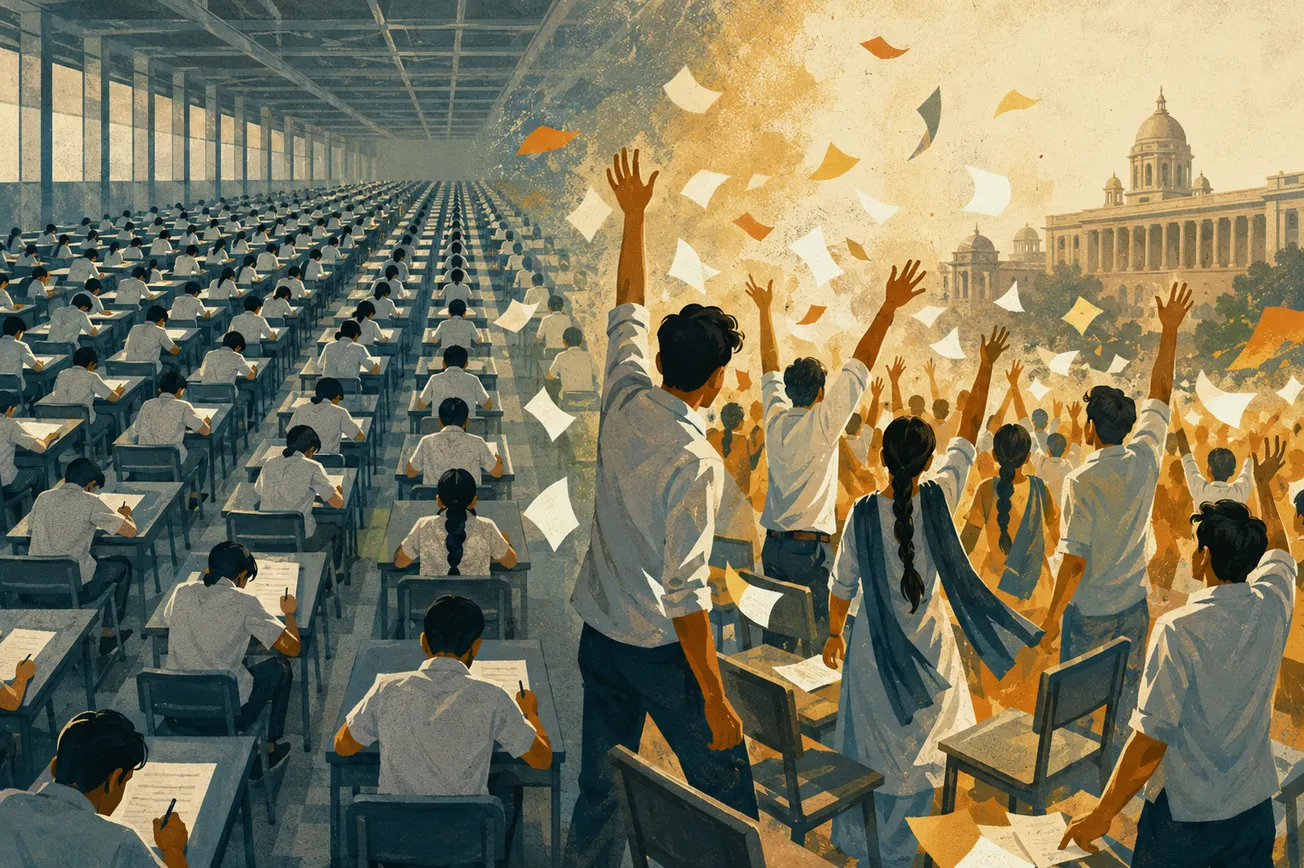
CAMBRIDGE—A reckoning has just played out on the streets of New Delhi and other major Indian cities. Tens of thousands of young Indians rose up against an education system that is failing them, ultimately securing the resignation of Education Minister Dharmendra Pradhan—a powerful symbolic victory. But the message of the protests is more profound: the socioeconomic compact between India’s youth and its political leadership has collapsed.
Each year, millions of Indian 17- and 18-year-olds spend months losing sleep over their 12th-grade board examinations, before regurgitating the same knowledge in a slew of college entrance exams. For another huge segment of students, the board examinations are irrelevant; their lives revolve around engineering, medicine, and law entrance exams, for which they have spent the better part of five years preparing. In the event of failure, economically privileged students might take a gap year and park themselves in coaching centers to prepare to try again.
The process is brutal enough in normal times. This year, over two million students took the highly competitive National Eligibility cum Entrance Test, in order to qualify for medical college, only to find out nine days later that the results had been voided, owing to allegations of a leak, and they would need to re-take the test. Another 1.8 million took the Central Board of Secondary Education’s annual examination, only to notice grading discrepancies that apparently resulted from a new digital marking system.
The Indian government’s response to the affected students’ plight—which has included extreme stress, exhaustion, and even suicide—has run from indifference to disdain and hostility. When young people marched to parliament to get their voices heard, they were met with violence. But the fury on the streets was difficult to quell. This was not a response to a one-off event, but an explosion of long-standing frustration.
For decades, successive cohorts of students—including mine about 20 years ago—have resigned themselves to the idea that the Indian education system is designed more as a sorting mechanism than as a means of building human capital. But even this characterization now feels overly generous. Students are forced to run a gauntlet of high-stakes exams, only to find that the transition to employment has completely fractured.
Recent research indicates that between 2011 and 2023, the number of college graduates aged 20–29 in India almost doubled, from about 32 million to 63 million. But around 40% of graduates under 25 are unemployed, and about 20% of those aged 25–29 remain out of work. Among young men, only about 4% of 12th-grade graduates, and 6.7% of college graduates, manage to obtain a permanent salaried job within a year of reporting themselves unemployed.
Other industry analyses suggest that only 8% of university graduates are in jobs that match their qualifications, while more than half work in low-skill roles that do not require a degree. With advances in AI threatening to wipe out the bottom rung of the career ladder, the situation is set to worsen.
This will only exacerbate India’s burgeoning youth mental-health crisis, which policymakers have so far failed to address in any meaningful way. In 2014–24, student suicides increased by nearly 80%, with nearly 124,000 students taking their lives over that decade. More broadly, suicide in India now accounts for nearly one in six deaths among individuals aged 15–29, surpassing deaths from road accidents and infectious diseases. In a large survey of university students across nine states, over 12% of respondents reported contemplating suicide over the past year. Between one-quarter and one-third of respondents reported moderate-to-severe anxiety and depression.
These outcomes amount to an indictment of an education system that has prioritized a narrow idea of achievement over psychological safety. Indian Prime Minister Narendra Modi himself effectively characterized the exam system in his book Exam Warriors. His intention was apparently to motivate students to fight their way to “victory.” But against what? A war, by definition, requires an enemy. In this paradigm, the student’s own curiosity must be systematically defeated.
More insidiously, this system functions as a training ground for a broader culture of compliance. Risk aversion and fear of failure are so acute in India that they are hampering entrepreneurship. Even as senior government ministers chide Indian startup founders for focusing on consumer services, rather than deeper innovations in areas like semiconductors, they preside over an education system that rewards rote learning, rather than critical thinking and experimentation.
In The Disengaged Teen, Jenny Anderson and Rebecca Winthrop describe four distinct modes of student engagement: achiever, passenger, resister, and explorer. For generations, the Indian system has produced mostly passengers, who went through the motions to ensure their survival, and high-performing achievers, whose pursuit of perfection was propelled by a debilitating fear of failure. Those who could not cut it became resisters, but because the paradigm was so rigid, they typically turned their resistance inward—a practice that left them deeply isolated and vulnerable to mental-health crises.
By enforcing and rewarding compliance, this system produces elites with little patience for questions about, let alone opposition to, the status quo. When students take to the streets to demand change, educated Indians are likely to say that they should go home and study.
But today’s young people fought anyway, making clear that the failure is the state’s, not theirs, and demanding democratic accountability. In doing so, they executed a profound psychological shift and displayed precisely the traits that make “explorers”: purpose, critical thinking, and a refusal to accept a broken status quo.
Rohan Sandhu is Director and Co-Founder of the Reimagining the Economy initiative at Harvard Kennedy School.
Loved it, hated it, or somewhere in between — tell us. Grade this article here and help shape what lands in your inbox next.
🧭 Power & Capital · July 27, 2026
Where state power meets the boardroom.
🔷 US Reaches Nuclear Power Deal With Saudi Arabia
🔷 Will Trump’s Plan To Make Data Centers Bring Their Own Energy Quell Anti-AI Sentiment?
🔷 Justice Department Memo Protects Parental Rights, Religious Freedom, Across The Federal Government
🌍 Global Affairs
The world's flashpoints, in motion.
🟥 Why Are Netanyahu And Zelenskyy Visiting Washington This Week – TIPP News
🟥 What Are The Biggest Obstacles To A US-Iran Peace Deal – TIPP News
🟥 Houthi Attacks Disrupt Key Red Sea Shipping Route – TIPP News
🟥 Iran Warns It Will Strike UK Air Base – Kurt Nimmo, Ron Paul Institute for Peace and Prosperity
🟥 Watch: Saudi Drone Shot Down Over Yemen, Claim Houthi Rebels – TIPP Videos
🟥 Another Domino Falls In The EU’s War On National Sovereignty – Paul McCarthy & Max Primorac, The Daily Signal
🟥 Nigeria’s Delay In Blasphemy Case Is Major Red Flag For Religious Freedom – Sean Nelson, The Daily Signal
🟥 France, Spain Battle Historic Wildfires Amid Heatwaves – TIPP News
🏛️ National Affairs
The fights shaping America right now.
🟫 Two Years Later, Maine Democrats Recreate Kamala 2.0 – Editorial Board, TIPP Insights
🟫 The GOP's Swag Deficit – Lawrence Kudlow, Fox News
🟫 Will Social Security Be There When You Retire? 47% Of Americans Say No: I&I/TIPP Poll – Terry Jones, TIPP Insights
🟫 Watch: Jewish New Yorkers Uncomfortable About Mamdani Rhetoric, Says Netanyahu – TIPP Videos
🟫 Democratic Infighting Threatens Party's House Comeback – TIPP News
🟫 Want To Rebuild Higher Education? Here Is The Guidebook – Sarah Lee, The Daily Signal
🟫 Police Hunt Second Suspect After Deadly Seattle Shooting – TIPP News
🟫 Michigan Battles Largest Cyclosporiasis Outbreak In Nine States – TIPP News
📈 Economy
Prices, policy, and the pressure on your wallet.
🟩 Treasury Market Rallies On Easing Iran Conflict – TIPP News
🟩 How Norway Built The World’s Largest Fund And A Thriving Economy To Boot – Joakim Book, Mises Wire
💼 Markets & Business
The deals and tickers making moves.
🟧 YouTube And NBCUniversal Strike Major Streaming Deal – TIPP News
🟧 How Chipmaker CXMT Became China's Most Valuable Listed Company – TIPP News
🟧 OpenAI Research Shows AI Is Reshaping Workplace Roles – TIPP News
🟧 Tech Giants Unite To Strengthen Open AI Security – TIPP News
🟧 CEO Behind Cracker Barrel Rebrand Exits Company – TIPP News
Letters to the editor email: editor-tippinsights@technometrica.com
Subscribe Today And Make A Difference. Consider supporting Independent Journalism by upgrading to a paid subscription or making a donation. Your support helps tippinsights thrive as a reader-supported publication. Contact us to discuss your research or polling needs.
Reach our audience. For sponsorship and advertising opportunities, visit our Partner With Us page.