In Grand Forks, North Dakota, a Chinese company bought farmland about a dozen miles from an Air Force base. The city blocked it after the Air Force called the project a national security threat, but it left a question: who is allowed to own the land next to the things America defends? This spring, a bipartisan bill took up that question, moving to bar foreign adversaries from buying land near sensitive military sites. A Republican chairman wrote it, and a Democratic senator signed on. On China, that kind of agreement is rare.
It is not rare with the public. More than six in ten Americans say Chinese companies should not be allowed to own farmland or critical infrastructure in the United States, and the agreement crosses party lines: 57% of Democrats and 70% of Republicans. The bill is catching up to a public that decided long ago.
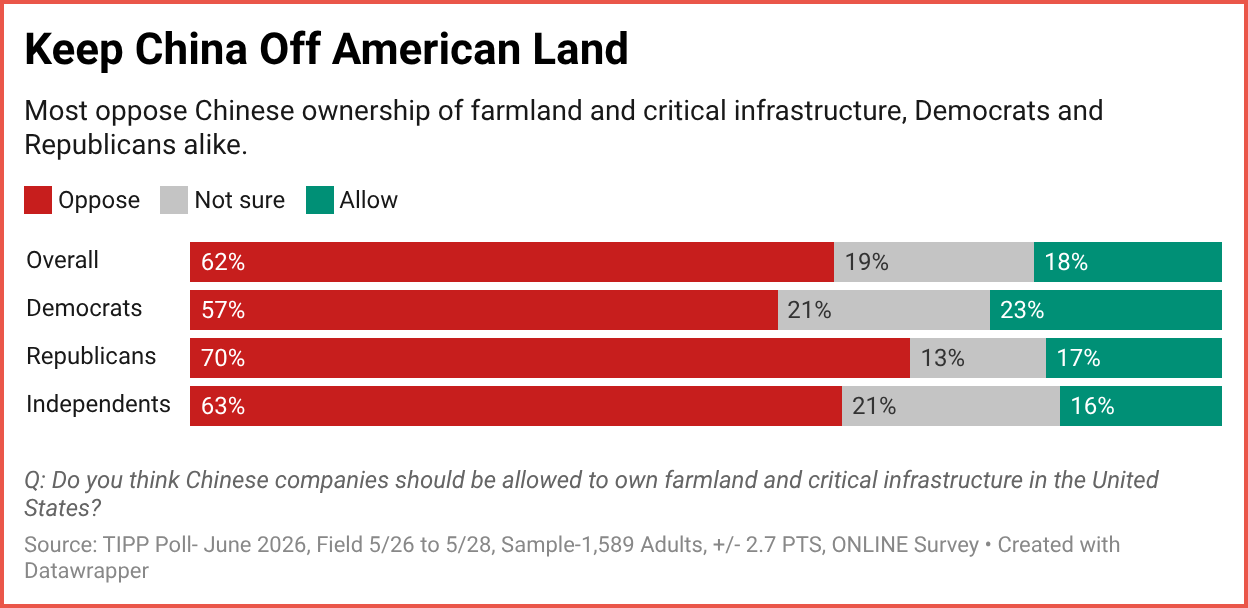
The fear here is not competition. It is that China is getting too close for comfort. Read the farmland numbers next to the rest of the survey and a pattern emerges that has nothing to do with winning a trade war and everything to do with proximity. Americans want China at arm's length rather than on the mat.
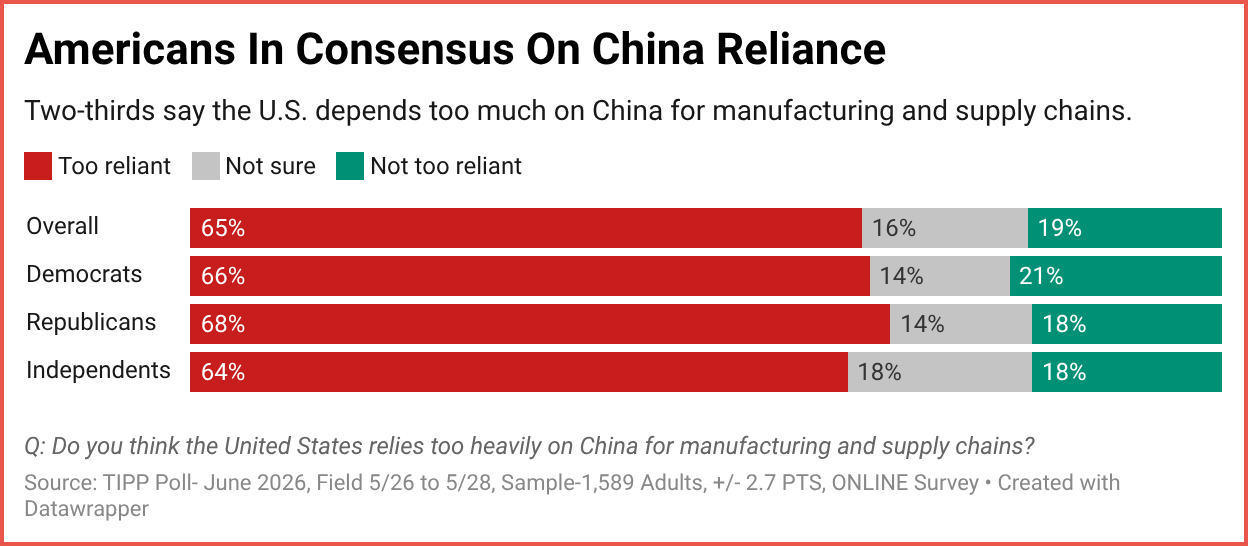
That sentiment widens past the land. Two-thirds of the public say the United States depends too much on China for manufacturing and supply chains; the feeling is shared nearly evenly, 66% of Democrats and 68% of Republicans. A country that gets its critical medicines and electronics from China gives Beijing the leverage, and most Americans want it loosened.
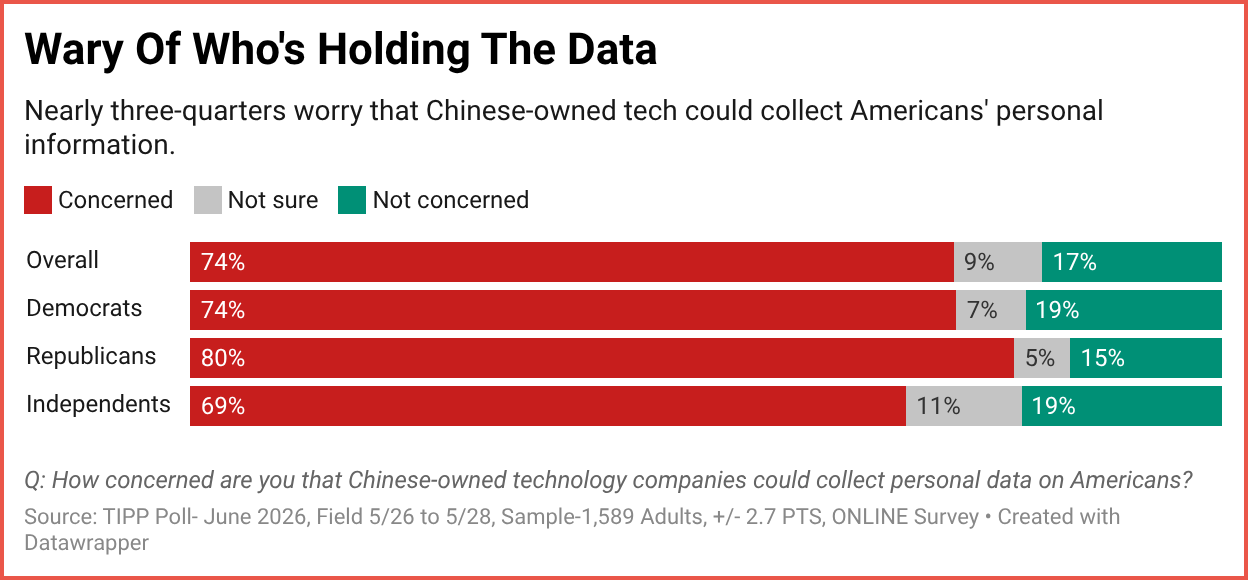
Then the instinct moves indoors. Nearly three-quarters of Americans are concerned that Chinese-owned technology companies could collect their personal data, and here the consensus is hardest of all: 74% of Democrats, 80% of Republicans. Security protocol required the President's own delegation to leave personal phones in the United States, carry clean burner devices, and discard everything Chinese-issued before boarding Air Force One last month. The land, the supply chain, and the phone in a pocket are all versions of the same question. How close is too close?
What ties the three survey results together is not hawkishness in the usual sense. A hawk wants to confront. These numbers describe something quieter and more defensive: a country that wants a cordon sanitaire. They want China off the soil near the base, fewer necessities made in its factories, and their data out of its reach. What Americans want is a wall, and a wall is not a war.
That distinction matters, because it marks where the consensus stops. The same public that agrees so broadly on holding China at a distance comes apart the moment the question turns to military force. Asked whether the United States should defend Taiwan, Americans are split, with a quarter giving no answer at all. Americans have found every reason to wall China out, and no casus belli over Taiwan.
Three years ago, a Chinese surveillance balloon drifted across the country at sixty thousand feet while Americans watched from their yards. When it was recovered, parts of it were American-made. That is the whole anxiety in a single object: the thing from outside, already inside, built partly from our own supply chain. This survey is what that morning left behind. The country wants the line drawn, and it wants to hold the pen.
The TIPP Off
What you should be reading right now
Global Affairs
Ambiguity Top And Bottom—Editorial Board, TIPP Insights
The Blueprint—Editorial Board, TIPP Insights
The Donroe Doctrine—Mark Pfeifle, TIPP Insights
Delcy’s ‘Gatekeeper’: Sources Say Ex-Trump Official Claver-Carone Holds Keys To Caracas—Max Blumenthal, Ron Paul Institute for Peace and Prosperity
Paradoxically Fear Is The Foundation Of Stability: Deterrence Works— Alastair Crooke, Ron Paul Institute for Peace and Prosperity
Neocon Podcaster Mark Levin Advocates Mass Murder In Iran—Kurt Nimmo, Ron Paul Institute for Peace and Prosperity
National Issues
Justice Clarence Thomas Is Right About Progressivism—William L. Anderson, Mises Wire
The Reagan Formula For A Dangerous World—Larry Kudlow, Fox Business
America's Stoic Mental Health Crisis—Editorial Board, TIPP Insights
Americans Feel The Pinch From Higher Gas Prices, Blame Iran War For The Surge In Energy Costs: I&I/TIPP Poll—Terry Jones, TIPP Insights
The Policy Pivot Trump Needs—Glenn Hubbard, Project Syndicate
One Biden-Era Policy Reversal Helped Unlock A Record US Oil Lease Sale—Virginia Grace McKinnon, The Daily Signal
Owens: Black Caucus & NAACP Are Stripping Dreams Away From Young Black Kids— Pedro Rodriguez, The Daily Signal
Spencer Pratt Claims Karen Bass Broke Election Law—She Posted The Evidence Herself—Angelina Delfin, The Daily Signal
‘Who Are These Masked Men?’—Joe Thomas, The Daily Signal
RGGI Will Cost Virginia Billions—Just Like It Cost Pennsylvania—Elizabeth Stelle, The Daily Signal
Fairfax GOP Stands Up To State Party On Abortion And Gender—Austin Ruse, The Daily Signal
El-Sayed Has ‘Struggles’ With the Question Of Whether Israel Should Be A Jewish State— Pedro Rodriguez, The Daily Signal
Georgia Gubernatorial Candidate Backs Men In Women’s Sports— Pedro Rodriguez, The Daily Signal
Congress Investigates Alleged Taxpayer-Funded Prison Sex Scandal Newsom Funded— Virginia Grace McKinnon, The Daily Signal
California Dem Congressman Starts Prison Sentence For Fraud Conviction—Pedro Rodriguez, The Daily Signal
Childcare Fraud Bills See Updates From Ohio Legislature— Rebecca Downs, The Daily Signal
California Advances Controversial 'Stop Nick Shirley Act'—Angelina Delfin, The Daily Signal
Irate Truck Driver Tells Off Anti-ICE Rioters At New Jersey Facility—Jarrett Stepman, The Daily Signal
Dr. Oz Visits The Buckeye State, Discusses Fraud Focus—Rebecca Downs, The Daily Signal
A Hidden Camera, A Catholic Pitcher, And A Baseball Team Now Under Scrutiny—Karly Tucker, The Daily Signal
REVAMPING DOGE: White House To Overhaul Grantmaking Process To Root Out ‘Woke’ Abuse—Tyler O’Neil, The Daily Signal
The Public Goods Circular Argument—Joshua Mawhorter, Mises Wire
The Newest Antitrust Fight: Congress Works To Protect This ‘Wild And Unruly’ Billion-Dollar Industry—Virginia Grace McKinnon, The Daily Signal
Murray Rothbard On War And “Isolationism”—Murray N. Rothbard, Mises Wire
Florida Senate President In Hot Seat Over Pro-DEI College President Pick—Pedro Rodriguez, The Daily Signal
📊 Market Mood — Monday, June 1, 2026
🟩 Markets started June on a positive note, with stocks building on recent record highs as investors remained optimistic that a U.S.-Iran agreement can still be reached.
🟧 Fresh military exchanges between the U.S. and Iran reminded investors that geopolitical risks remain elevated, even as ceasefire negotiations continue.
🟦 Oil prices moved higher again, reflecting concerns that shipping through the Strait of Hormuz may take months to normalize even if a deal is finalized.
🟨 The AI story remained front and center after Nvidia unveiled new processors for Windows PCs designed to run AI agents directly on personal computers.
🗓️ Key Economic Events — Monday, June 1, 2026
🟧 9:45 a.m. ET — S&P Global Manufacturing PMI (May)
Forecast: 55.3 vs. 54.5 previous. A stronger reading would signal continued expansion in manufacturing activity despite higher energy costs and geopolitical uncertainty.
🟧 10:00 a.m. ET — ISM Manufacturing PMI (May)
Forecast: 53.3 vs. 52.7 previous. Markets will watch for confirmation that U.S. factory activity remains resilient as businesses navigate inflation pressures and supply-chain challenges.
🟧 10:00 a.m. ET — ISM Manufacturing Prices (May)
Forecast: 85.3 vs. 84.6 previous. This inflation-sensitive measure will be closely monitored for signs that higher energy and input costs are continuing to work their way through the manufacturing sector.
Letters to the editor email: editor-tippinsights@technometrica.com
Subscribe Today And Make A Difference. Consider supporting Independent Journalism by upgrading to a paid subscription or making a donation. Your support helps tippinsights thrive as a reader-supported publication. Contact us to discuss your research or polling needs.
Reach our audience. For sponsorship and advertising opportunities, visit our Partner With Us page.