
By Jim O'Neill, Project Syndicate | Aug 20, 2026
What is the apparent fragility in the US bond market telling us? Since markets tend to be less wrong than those who comment on them regularly, their signals must be taken seriously, especially when they coincide with a relative softening in US inflation figures and other high-frequency economic indicators.
New to bond markets? Our explainer covers what yields are and why they move.
LONDON—As we approach the end of the northern summer, often a volatile period for financial markets, all eyes are on the apparent fragility of US bonds. Some observers will say that sustained weakness is a sign that the US market is losing its role as the anchor of the global financial system. Yet there is little evidence of this happening. On recent days when US bonds have traded especially poorly, so, too, have other markets around the world.
Moreover, while the dollar briefly plummeted following US President Donald Trump’s “Liberation Day” tariff tantrum last year, it has since recovered and remained broadly stable. The implication is that the greenback is still extremely important to many other countries, especially those facing their own government refinancing and debt-servicing challenges. To infer a reduced global role for the US Treasury market, one would need to see other major bond markets emerging as the beneficiaries of dollar weakness, and that has not happened.
True, many commentators warn that those days are coming, and I have some sympathy for their argument. But, at the moment, we have only warnings, not observable facts. It is also true that the US cannot simply persist with such large fiscal deficits—as it has done through the first Trump presidency, the Biden presidency, and now the second Trump presidency—and face no consequences. If anything, weakness in US markets and dollar depreciation would ultimately serve America’s own interests if it forced greater fiscal discipline on US policymakers.
In the meantime, though, the more interesting feature of US bonds’ recent performance is that it has coincided with somewhat better inflation figures and the arrival of a new US Federal Reserve chair who clearly believes in the disinflationary implications of the AI boom.
Of course, the markets could be wrong; but they are often less wrong than those of us who closely follow them. They will often latch on to something that most commentators are missing. What might that be? Let us consider the most likely possibilities.
First, the markets may believe that the slightly softer inflation data are only temporary, and that forthcoming data releases will confirm this conjecture. But I am not so sure, considering that the recent softening was unexpected and markets usually respond to such surprises.
Second, the market’s behavior might have something to do with the new Fed chair, Kevin Warsh, who has brought a fundamentally different philosophy of Fed governance and communication. No longer can markets expect “forward guidance” on future monetary-policy decisions. They will have to figure it out for themselves. Warsh has even gone so far as to suggest that the market’s reaction to his first press conference—when financial conditions suddenly tightened—already did some of the Fed’s job for it.
Still, I am not so sure of this interpretation, either, even though I am a huge believer in the power of financial conditions as a leading indicator in the US economy. After all, it is equally, if not more, likely that the markets think Warsh is being too cavalier about the underlying risks to growth. Perhaps they simply do not share his optimism about the imminent productivity benefits of AI.
A third (related) interpretation is that AI hyperscalers’ increasing reliance on corporate bond issuances (rather than free cashflows) to fund their expansion plans has had a negative effect on Treasuries, whose yields must rise to compete with all the new hyperscaler debt. If the sharp increase in demand for credit is playing a role in markets’ current outlook, the benefits had better show up in corporate earnings. Otherwise, equity markets will start to wobble again. (Equally, if US bond yields continue to climb, demand for stocks may ease.)
The final, obvious possibility is that bond investors are reacting to the US government’s worsening fiscal position and the utter lack of executive or congressional leadership on the issue. Hardly a day goes by without some financial or political commentator touting the miracle of America’s economic performance. But if everything was so great, one would expect an improvement in the cyclical US fiscal position; and if the US economy was as “exceptional” as some believe, the structural fiscal position would also be stronger.
So, as we approach September (the worst month for stocks, historically), all eyes will remain on the performance of US bonds. Whatever happens in that market will not stay there.
Jim O’Neill is a former UK Treasury minister and a former chairman of Goldman Sachs Asset Management.
Loved it, hated it, or somewhere in between — tell us. Grade this article here and help shape what lands in your inbox next.
Copyright Project Syndicate
U.S. National Debt Passes $40 Trillion For First Time
The U.S. national debt has surged by a third in less than five years, and doubled since Trump’s first term. Both parties are wary of cuts to healthcare and retirement benefits, while Republicans remain opposed to tax increases.
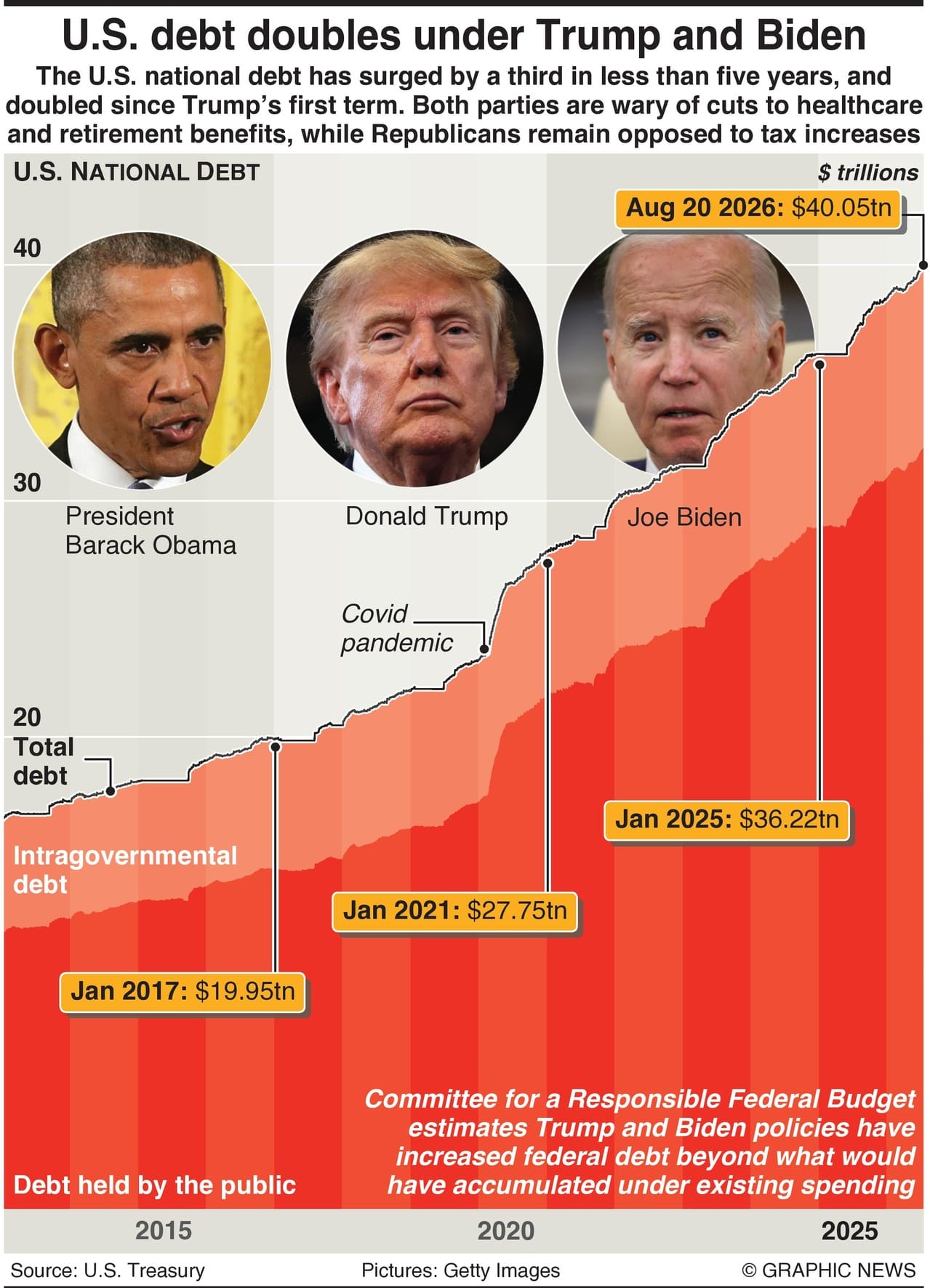
Treasury figures show public debt outstanding at $40.045 trillion, including $32.27 trillion in Treasury securities held by the public and $ 7.78 trillion in intra-governmental debt holdings.
Economists warn that a fiscal crisis is imminent, with costs for social safety-net programs and interest payments far outstripping revenues, which are being restrained by tax cuts. Debt rose by $11.4 trillion under Trump‘s two terms so far, and $8.4tn under Joe Biden.
🧭 Power & Capital · August 20, 2026
Where state power meets the boardroom.
🔷 Bessent Signals Tougher U.S. Sanctions Could Keep Iran War From Expanding
🔷 Bessent: Treasury Buyback Could Exceed Announced $4 Billion
🔷 Crypto Markets Rally As Trump Presses Congress On Regulation
🌍 Global Affairs
The world's flashpoints, in motion.
🟥 Russia Launches Massive Overnight Attack On Kyiv, Killing At Least 14 – TIPP News
🟥 Watch: Deadly Russian Missile Attack Hits Kyiv, Killing At Least 12 – TIPP Video
🟥 Trump Warns Iran’s Backers Of ‘Tremendous’ Economic Consequences – TIPP News
🟥 How Is The U.S. Keeping Oil Flowing Through The Strait Of Hormuz – TIPP News
🟥 Israel Pushes West Bank Settlement Project Despite Global Opposition – TIPP News
🟥 Biden’s Afghanistan Withdrawal Destroyed American Deterrence – Victor Davis Hanson, The Daily Signal
🟥 Trump Drill Cut Raises Questions About U.S. Commitment To South Korea – TIPP News
🟥 Watch: Kim Jong-Un Will Be Fine As Long As US Has A Smart President, Says Trump – TIPP Video
🟥 Watch: Chinese Humanoids Wow Audiences At Robotics Conference – TIPP Video
🏛️ National Affairs
The fights shaping America right now.
🟫 The Vindman File – Editorial Board, TIPP Insights
🟫 Department Of Education To No Longer Require School Discipline Policies That Discriminate On The Basis Of Race – Tyler O’Neil, The Daily Signal
🟫 How Are Data Centers Reshaping The 2026 Midterm Elections – TIPP News
🟫 Boston, Denver And Philadelphia Finalists To Host 2028 Democratic Convention – TIPP News
🟫 Dirty Pool And Frozen Eggs: 2028 Would-Be Candidates Already Going Shallow, Dark, And Destructive – Al Perrotta, The Daily Signal
🟫 Union Attack On Arizona School Choice Fails Again – Jason Bedrick, The Daily Signal
💼 Markets & Business
The deals and tickers making moves.
🟧 Walmart Reports Strong Quarter After Massive Tariff Refund – TIPP News
Letters to the editor email: editor-tippinsights@technometrica.com
Subscribe Today And Make A Difference. Consider supporting Independent Journalism by upgrading to a paid subscription or making a donation. Your support helps tippinsights thrive as a reader-supported publication. Contact us to discuss your research or polling needs.
Reach our audience. For sponsorship and advertising opportunities, visit our Partner With Us page.