
By Ross Levine and Amit Seru, Project Syndicate | August 6, 2026
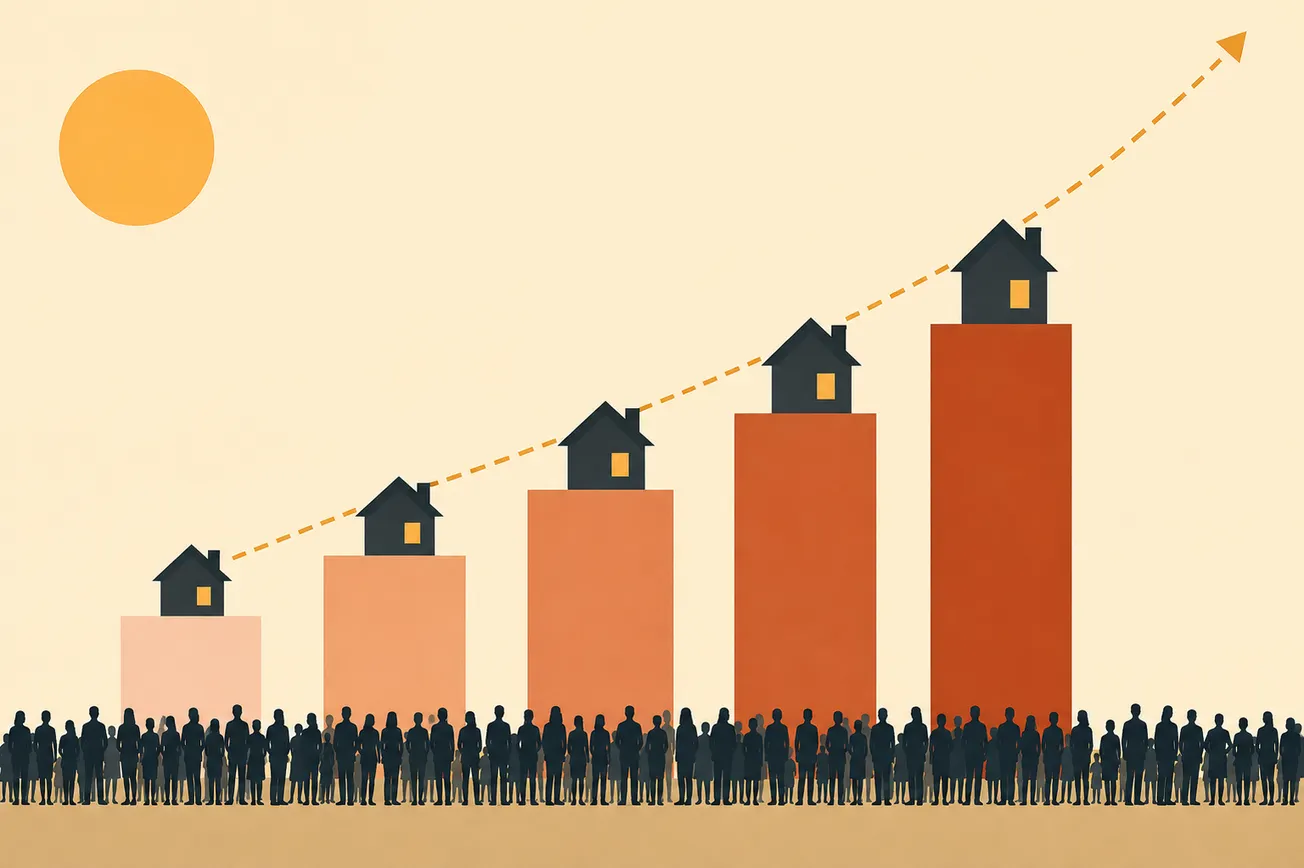
For decades, federal housing policy has favored cheaper financing over expanding the housing supply, despite evidence that expanding mortgage credit increases borrowing and house prices. The bipartisan 21st Century ROAD to Housing Act marks an important shift by emphasizing measures that make it easier to build more homes.
STANFORD—For half a century, US policymakers have mistaken mortgage policy for housing policy. Rather than making homes more affordable, their efforts to make mortgages cheaper have mostly produced more borrowing.
That paradox has been at the heart of the biggest housing debate on Capitol Hill in decades. The new bipartisan 21st Century ROAD to Housing Act, enacted on July 11, reflects two competing explanations for why so many families cannot afford to buy a home.
One emphasizes supply: the United States does not build enough homes where people want to live. Zoning restrictions, permitting delays, and a thicket of other regulations make new construction slow, costly, or—in some places—virtually impossible. The other explanation focuses on market-power: large institutional investors have acquired too many single-family homes, outbidding first-time buyers and turning would-be homeowners into tenants.
Both concerns deserve attention. In some communities, corporate landlords have indeed become highly visible buyers whose scale can reshape neighborhoods and rental markets. Congress was right to ask whether families and large investment funds compete on a level playing field.
But the two diagnoses are not interchangeable. Restricting who can buy a house may change who owns it; it does not create another house. Imagine 200 families bidding for 100 homes. Remove several investment funds from the bidding, and some families may have a better chance. But there are still only 100 homes. Unless supply grows, prices will remain under pressure, and another group of well-financed buyers can take their place.
The ROAD to Housing Act quietly recognizes this reality. Its most consequential provisions are not the restrictions on institutional buyers but the measures designed to make building easier by streamlining reviews, encouraging manufactured housing (prefabricated homes that can be mass produced), and rewarding communities that build more homes.
Together, these provisions mark a significant shift. For decades, policymakers assumed that expanding mortgage credit was the path to broader homeownership. The historical record suggests otherwise. Through Fannie Mae, Freddie Mac, and other federal programs, mortgage credit has become abundant, standardized, and widely available, even during financial crises. Yet the homeownership rate remains close to where it stood in the late 1970s. What has risen instead are house prices and mortgage balances.
In a new study, we examine five decades of data and research and find a remarkably consistent pattern: expanding mortgage credit increases borrowing and drives up house prices far more than it boosts homeownership. The effects are most pronounced where zoning and permitting prevent builders from responding to higher demand by building more homes.
The reason is simple. Give every bidder a larger line of credit while constraining the number of homes, and much of the subsidy goes to the seller. As a result, the federal subsidy becomes embedded in the price of the land, leaving buyers with cheaper mortgages but more expensive homes.
None of this means the federal mortgage system has no value. Fannie and Freddie provide liquidity, support a national market for 30-year fixed-rate mortgages, and keep credit flowing when private markets seize up. Those are important public benefits. The mistake is to confuse a well-functioning mortgage market with an affordable housing market. One determines how homes are financed, while the other depends on how many homes are built, where they are built, and what they cost.
That distinction matters because American housing policy is now pulling in opposite directions. While Congress has begun to recognize affordability as a supply issue, mortgage policy continues to treat it as a demand problem.
US President Donald Trump’s directive ordering Fannie and Freddie to purchase an additional $200 billion of mortgage-backed securities is a case in point. Lower mortgage rates may reduce monthly payments, but in supply-constrained markets they also drive up house prices. In other words, buyers borrow more without reducing the cost of buying a home.
The same logic applies to proposals to privatize Fannie and Freddie. Returning them to private ownership would make sense only if the federal government first defines the scope of its guarantee, requires the companies to hold enough private capital to absorb losses before taxpayers do, and establishes who will control them once they are privately owned. Otherwise, privatization would amount to little more than the old arrangement under a new label: shareholders collect the gains, politicians direct the companies, and taxpayers absorb the losses when the market turns. That was not a genuinely private market before 2008, and relisting Fannie and Freddie would not make it one now.
The debate over institutional investors therefore risks becoming a distraction. It offers a visible villain while diverting attention from the harder task of reforming a system that has subsidized nearly every bidder for decades, even as local governments limited the supply of homes.
Encouragingly, Congress has begun to address that imbalance. The new law combines competing policy priorities because building a bipartisan coalition required both: Democrats wanted greater protection for families and tenants, while Republicans wanted regulatory relief, community-bank provisions, and fewer barriers to construction. The compromise may endure precisely because neither side got to define the crisis on its own.
The underlying economics, however, remain unchanged. Market power can worsen outcomes in particular places, but only a larger housing supply can make homes more affordable and spare families from ever more expensive bidding wars.
For decades, American policymakers have focused on helping families buy the homes the country already has. Finally, they are beginning to focus on building the homes American families need. The logical next step is not another housing program but greater restraint in mortgage policy. Subsidizing every bidder while restricting construction cannot make housing more affordable—it simply changes who gets the keys.
Ross Levine is a senior fellow at the Hoover Institution.
Amit Seru is Professor of Finance at the Stanford Graduate School of Business and a senior fellow at the Hoover Institution.
Loved it, hated it, or somewhere in between — tell us. Grade this article here and help shape what lands in your inbox next.
Copyright Project Syndicate
🧭 Power & Capital · August 6, 2026
Where state power meets the boardroom.
🔷 Palo Alto Networks Faces Chinese Cybersecurity Investigation
🌍 Global Affairs
The world's flashpoints, in motion.
🟥 What Did Iran Say About A Possible U.S. Deal – TIPP News
🟥 Zelenskyy Says Ukrainian Drones Strike Key Russian Oil Facilities – TIPP News
🟥 Germany Airport Drone Incident Sparks Counterterrorism Probe – TIPP News
🟥 What Would Happen If Spain Had An Open Border With Morocco – Ryan McMaken, Mises Wire
🟥 FIFA President Infantino Faces Growing Calls To Resign – TIPP News
🟥 Watch: Indonesia’s National Park Faces Wildfire – TIPP Video
🏛️ National Affairs
The fights shaping America right now.
🟫 GOP-Led Senate Committee Approves Fauci Contempt Resolution – TIPP News
🟫 Fauci’s Lawyer Fires Back At Aaron Rodgers – Andrew Phelan, The Daily Signal
🟫 What Anthony Fauci Teaches Us About The American Government – Connor O’Keeffe, Mises Wire
🟫 Watch: National Guard Brings In Helicopters To Battle Washington Wildfires – TIPP Video
🟫 Watch: Trump Tears Into Abdul El-Sayed – TIPP Video
🟫 Supreme Court Announces 1st Arguments For October Term – Fred Lucas, The Daily Signal
🟫 Is Trump’s Flat Voter Favorability In August Bad News For GOP’s Midterm Hopes? I&I/TIPP Poll – Terry Jones, TIPP Insights
🟫 Mamdani Purges Business Leaders To Cement Socialist Control Of NYC – Jarrett Stepman, The Daily Signal
🟫 Virginia Primary Results Set Up Fall Matchups – Rich Tucker, The Daily Signal
🟫 Candidate Who Promised Not To Take Corporate Money Allegedly Took Corporate Money – Pedro Rodriguez, The Daily Signal
📈 Economy
Prices, policy, and the pressure on your wallet.
🟩 Gold Climbs To Seven-Week High On Weak Jobs Data – TIPP News
🟩 Monetary Savings Versus Real Savings – Frank Shostak, Mises Wire
💼 Markets & Business
The deals and tickers making moves.
🟧 SoftBank Profit Beats Estimates On Intel Investment Gain – TIPP News
🟧 Boeing 737 Max Faces New FAA Safety Inspection Order – TIPP News
🟧 Tech Leaders Claim AI Is Entering A Historic Phase – TIPP News
🟧 $1B Savings Drive Announced By World’s Largest Spirits Maker – TIPP News
Letters to the editor email: editor-tippinsights@technometrica.com
Subscribe Today And Make A Difference. Consider supporting Independent Journalism by upgrading to a paid subscription or making a donation. Your support helps tippinsights thrive as a reader-supported publication. Contact us to discuss your research or polling needs.
Reach our audience. For sponsorship and advertising opportunities, visit our Partner With Us page.