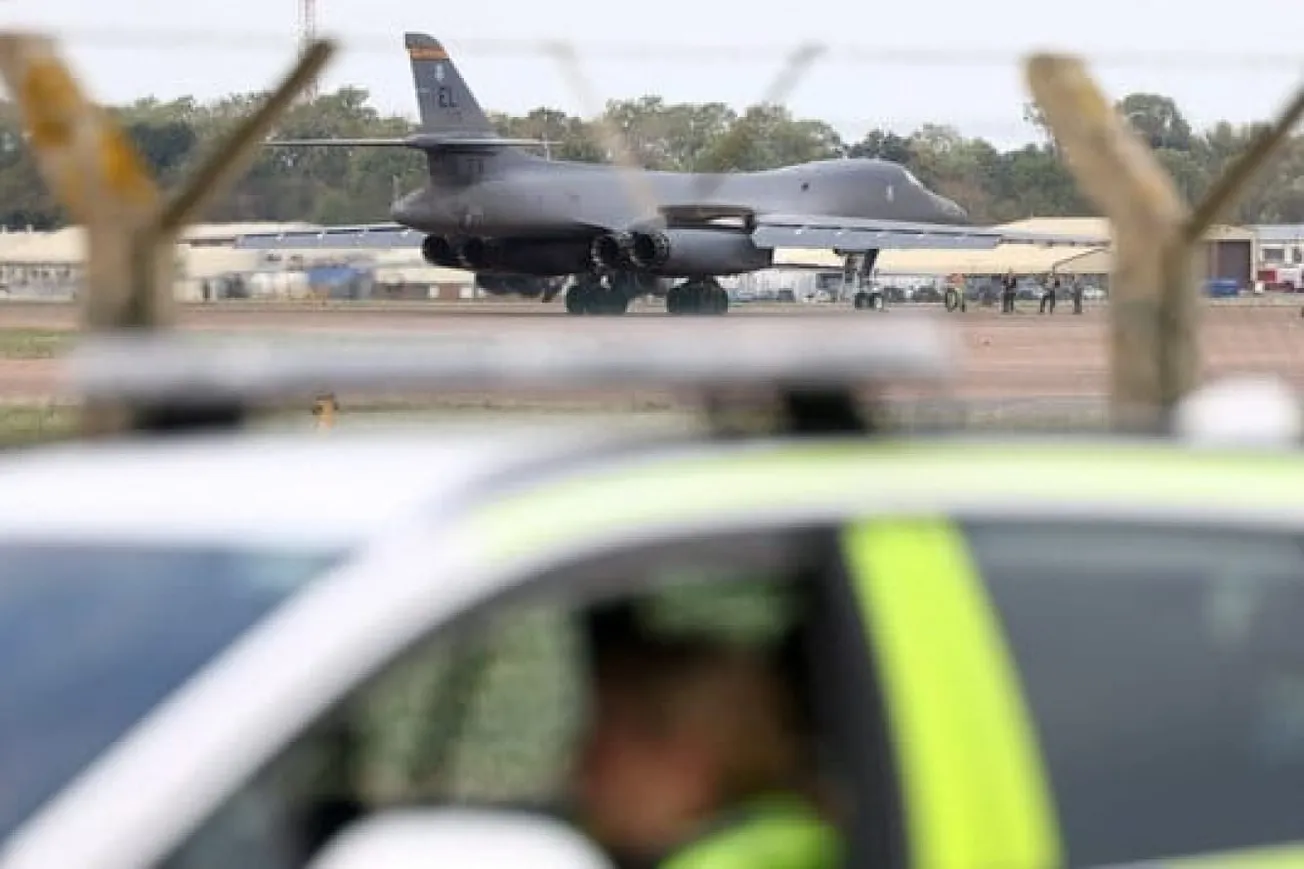

Ensuring the Strait of Hormuz is safe from mines could delay a return to normal shipping traffic by weeks following a deal to reopen the strategic waterway.
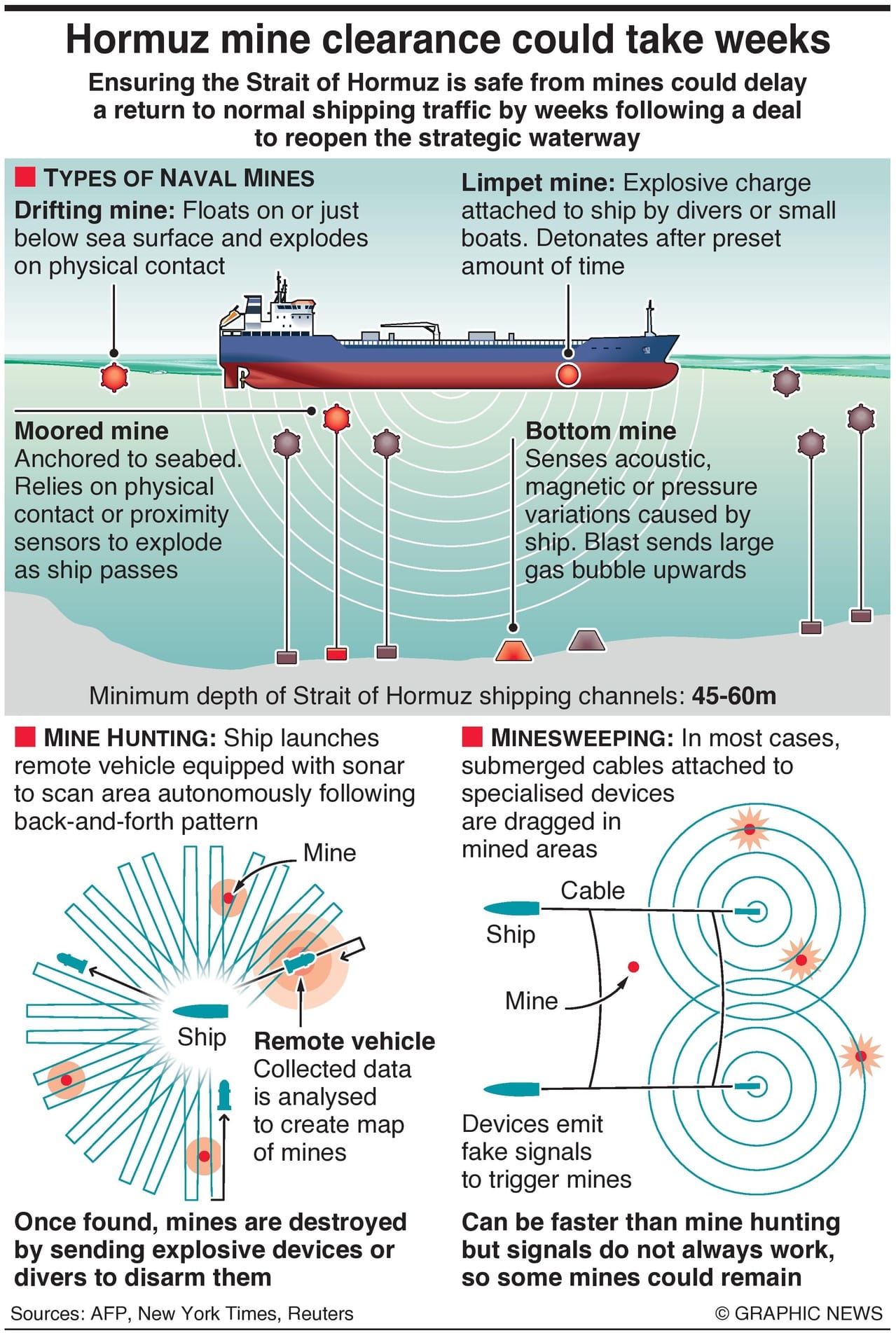
The operation by conventional minesweepers and state-of-the-art underwater drones could continue for 40 to 50 days before many insurance, shipping, or oil companies are confident enough to sail through, according to assessments from five Western maritime security sources.
That could potentially hold up tens of millions of barrels of oil, in addition to the oil supply from the Gulf already blocked since the United States and Israel attacked Iran on February 28, according to estimates based on pre-war flows.
It is unclear how many mines Iran may have laid in the strait, which handled 20% of the world’s daily supply of oil and liquefied natural gas before the war.
Iran, which has sought to assert its control over the waterway during the war, has threatened to deploy naval mines, without commenting on whether its forces have planted them, Reuters said.
Israel Launches Fresh Strikes On Lebanon Despite Ceasefire
Israeli forces have carried out fresh strikes in southern Lebanon despite a ceasefire and a U.S.-Iran framework agreement aimed at ending hostilities across the region.
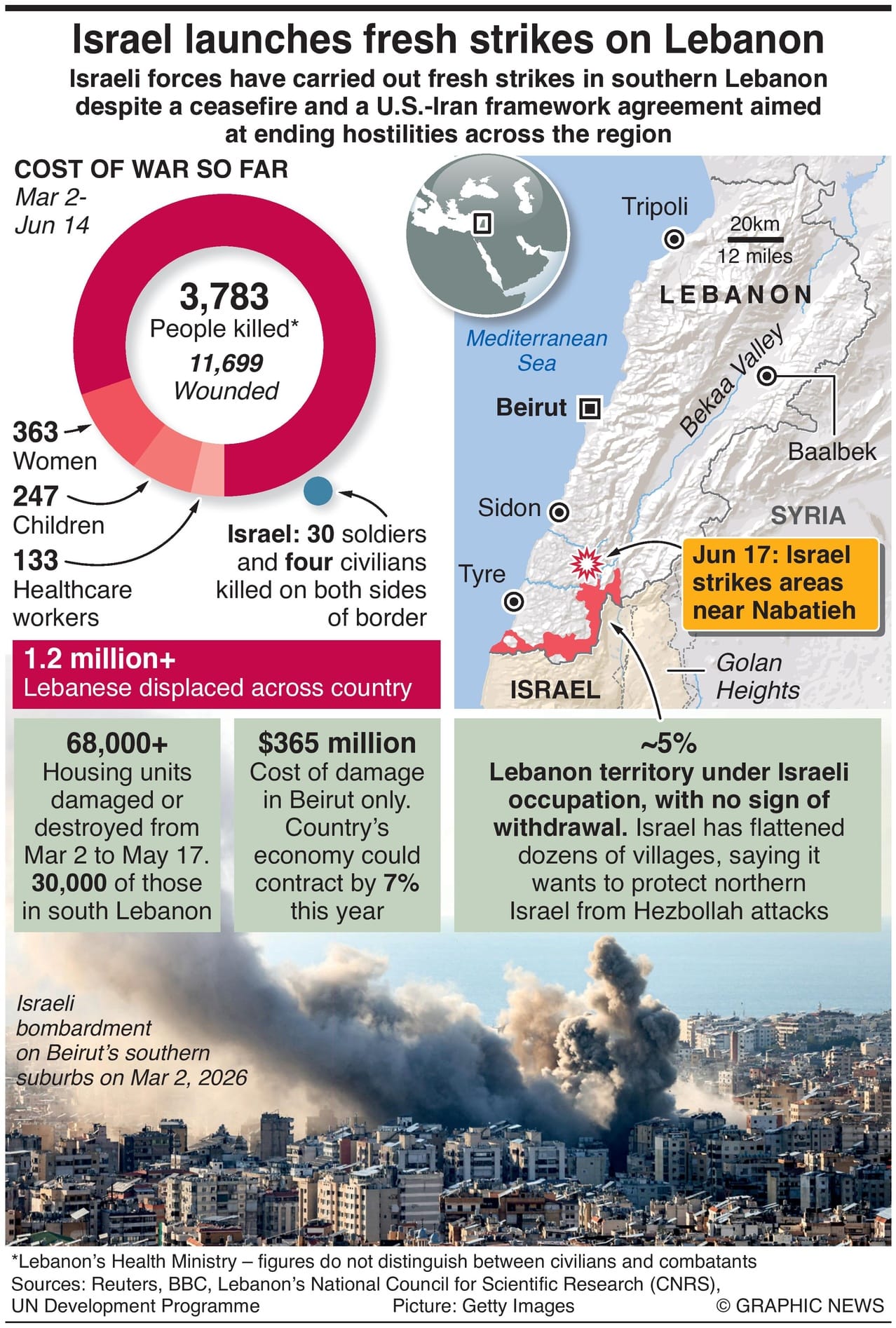
Israeli jets struck the Nabatieh area and the outskirts of neighbouring Kfar Tebnit, Lebanon's National News Agency (NNA) reported.
The text of the U.S.-Iran agreement has not been made public, but Pakistan, which acted as a mediator, said it envisages an immediate halt to military operations “on all fronts, including Lebanon”.
Lebanon has endured the deadliest spillover from the wider regional war triggered by U.S.-Israeli strikes on Iran more than three months ago.
According to figures covering the period from March 2 to June 14, released on the day the agreement was announced, at least 3,783 people were killed and 11,699 wounded in Lebanon.
Sources:
- Israel launches fresh strikes on Lebanon despite Trump criticism (BBC)
- Costs to Lebanon of latest Israel-Hezbollah war (Reuters)
- IDF and Hezbollah Attacks in Lebanon (ISW)
MEMORANDUM OF UNDERSTANDING
Between the United States of America and the Islamic Republic of Iran
Fourteen-Point Framework · June 17, 2026
Released by a senior U.S. administration official, the memorandum sets out fourteen provisions covering the ceasefire, sanctions relief, nuclear commitments, and the timeline toward a final agreement. The provisions read as follows:
1. The US and Iran declare the immediate and permanent end of military operations on every front, including in Lebanon, and commit to refraining from the threat or use of force against each other. The final deal will confirm the permanent termination of the war on all fronts and incorporate the other provisions of this paragraph.
2. The two countries agree to respect each other’s sovereignty and territorial integrity going forward. Both sides also commit to refraining from interfering in each other’s internal affairs.
3. The US and Iran commit to negotiating and concluding a final deal within a maximum of 60 days. That timeline can only be extended by mutual consent of both parties.
4. The US will begin removing its naval blockade and other impediments on Iran immediately upon signing, with a full lift within 30 days and vessel traffic progressively restored to pre-war levels. Washington also agrees to withdraw its forces from the proximity of Iran within 30 days of the final deal’s conclusion.
5. Iran will use its best efforts to ensure free passage for commercial vessels through the Strait of Hormuz for 60 days in both directions, with no fees charged, and commercial traffic is to resume immediately. Tehran is to complete demining and other technical and military measures within 30 days, and will hold talks with Oman and other Gulf states on the strait’s future administration and maritime services.
6. The US, in coordination with regional partners, will develop a definitive, mutually agreed reconstruction and economic development plan for Iran worth at least $300 billion. An implementation mechanism for the plan is to be finalized within 60 days, with the US granting all required licenses and waivers for the relevant financial transactions.
7. The US commits to terminating all sanctions on Iran, including UN Security Council resolutions, IAEA Board of Governors resolutions and US unilateral primary and secondary sanctions, according to a schedule to be set in the final deal. Both parties acknowledge the critical importance of the sanctions issue and intend to address it immediately in negotiations.
8. Iran reaffirms it will not procure or develop nuclear weapons. The two sides agree to resolve the disposition of Iran’s stockpiled enriched material through a mutually agreed mechanism, with on-site down-blending under IAEA supervision as the baseline method, and will discuss Iran’s enrichment activities within a framework to be agreed in the final deal.
9. Pending the final deal, both sides agree to maintain the status quo, with Iran keeping the current status of its nuclear program in place. The US, for its part, agrees not to impose any new sanctions or deploy additional forces in the region during this period.
10. The US Treasury will issue waivers immediately upon signing authorizing Iran to export crude oil, petroleum products and derivatives. Those waivers extend to associated services, including banking, insurance and transportation, and remain in effect until sanctions are terminated.
11. The US will make all frozen or restricted Iranian funds and assets fully available, with procedures for their release and use to be mutually agreed during negotiations. Those funds may be used for payments to any ultimate beneficiary designated by the Central Bank of Iran, with the US issuing all necessary licenses to that end.
12. Both sides agree to establish an executive mechanism to monitor implementation of the MOU. That same mechanism will also track future compliance with the final deal.
13. Once the ceasefire, naval withdrawal, Strait of Hormuz measures, oil waivers and asset release are underway, the two countries will begin negotiating the remaining elements of the final deal. That sequencing is tied specifically to the continued implementation of paragraphs 1, 4, 5, 10, and 11.
14. The final deal is to be endorsed by a binding UN Security Council resolution.
🌍 Global Affairs
The world's flashpoints, in motion.
🟦 Iran Deal Eases Shipping Threats In Strait Of Hormuz – TIPP News
🟦 Trump Warns U.S. Could Resume Strikes If Iran Deal Fails – TIPP News
🟦 Lebanese President Stresses Independent Path In Israel Talks – TIPP News
🟦 Russia Running Low On Key Air Defense Missiles, Report Says – TIPP News
🟦 IEA Cuts Oil Demand Forecast As Energy Markets Shift – TIPP News
🟦 DRC Faces Growing Ebola Crisis Amid Funding Shortfalls – TIPP News
🟦 Former Top Gear Host Jeremy Clarkson Says He Has Cancer – TIPP News
🏛️ National Affairs
The fights shaping America right now.
🟥 Mass Conspiracy To Attack White House UFC Event Results In Several Arrests – Al Perrotta, The Daily Signal
🟥 GOP Scrambles After Trump Delays Intelligence Nominee Push – TIPP News
🟥 What Is Holding Up Jay Clayton’s Confirmation – TIPP News
🟥 Does Either Party Have An Edge In 2026 Midterms And 2028 Presidential Election? I&I/TIPP Poll – TIPP News
🟥 Who Is Leading The Washington DC Mayoral Primary – TIPP News
📈 Economy
Prices, policy, and the pressure on your wallet.
🟩 The Fed Decides Today In Warsh’s First Test As Chair – Power & Capital Desk, TIPP Insights
🟩 Mortgage Rates Ease But Housing Market Remains Weak – TIPP News
🟩 Why Are Senate Democrats Opposing A West Coast Oil Reserve – TIPP News
💼 Markets & Business
The deals and tickers making moves.
🟧 SpaceX Rally Continues As Market Value Surpasses Amazon – TIPP News
🟧 How Are China’s Slowdown And The Iran War Hurting BMW – TIPP News
Letters to the editor email: editor-tippinsights@technometrica.com
Subscribe Today And Make A Difference. Consider supporting Independent Journalism by upgrading to a paid subscription or making a donation. Your support helps tippinsights thrive as a reader-supported publication. Contact us to discuss your research or polling needs.
Reach our audience. For sponsorship and advertising opportunities, visit our Partner With Us page.