By Todd G. Buchholz, Project Syndicate | April 20, 2026
By closing the Strait of Hormuz, Iran has handed the Trump administration a practice test. To pass—and preserve deterrence against a Chinese invasion or blockade of Taiwan—the United States must reopen the Strait decisively and visibly with escorts, minesweepers, and strikes on launch sites.
SAN DIEGO—Most schoolchildren learn that the Earth is roughly 25,000 miles around (40,000 kilometers). They do not learn that the global economy depends on just 100 of those miles.
Blocking two narrow waterways—the Strait of Hormuz and the Taiwan Strait—can send the economy back in time, if not to the Stone Age that US President Donald Trump has been threatening to bomb Iran back to, then at least to the mid-20th century, before the Rolling Stones first hit the airwaves.
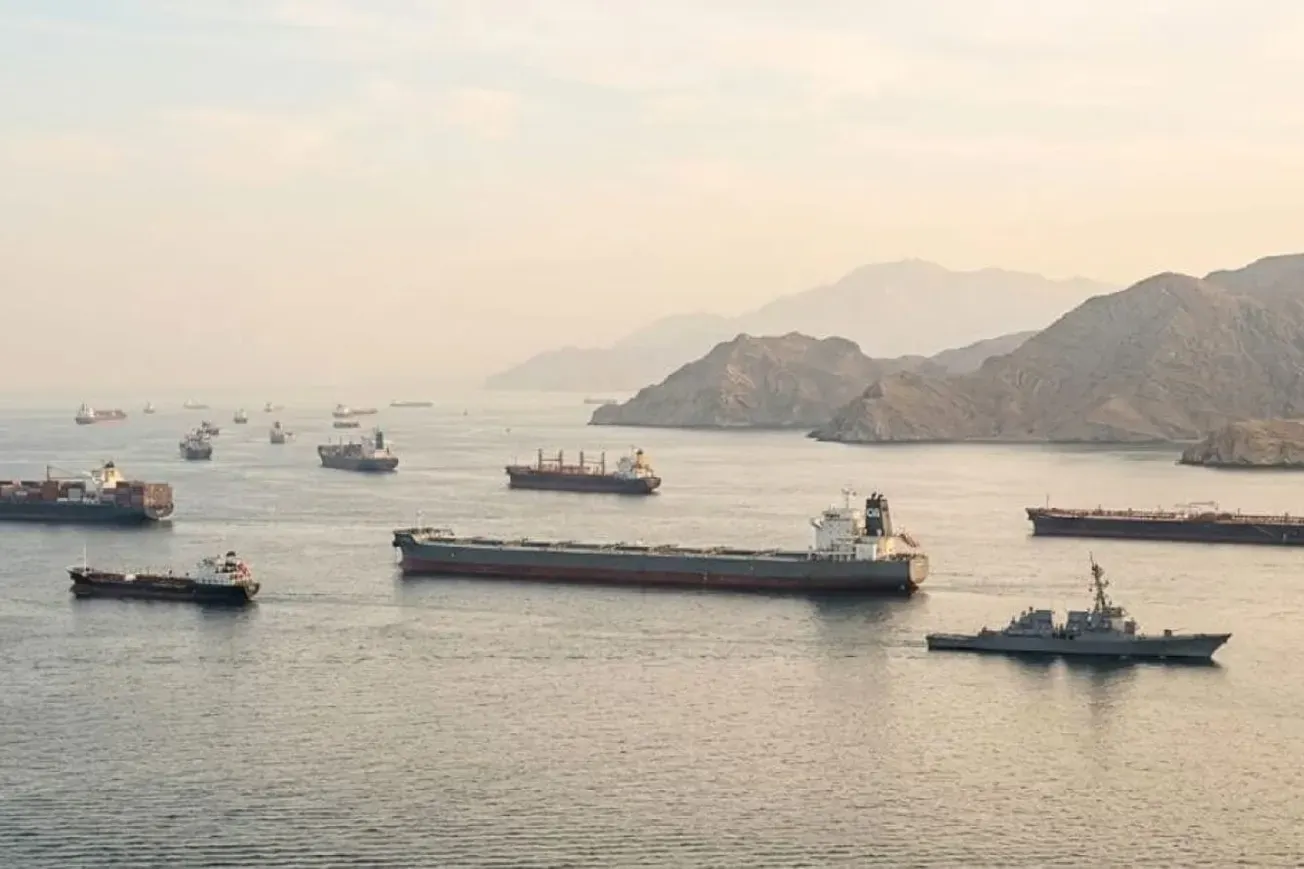
Over the past month and a half, Iran has turned the Strait of Hormuz, which is about 21 miles wide at its narrowest point, into a floating shooting gallery. Shipping traffic has plunged, with tankers loitering nervously while Iranian speedboats and drones play pirate. The standstill has throttled the world economy, as a large share of the world’s oil and liquefied natural gas transits through the Strait.
This is not just a Middle East quagmire. It’s a live-fire dress rehearsal for conflict in Asia, offering China a battle plan for Taiwan. The Taiwan Strait, which is about 81 miles wide at its narrowest point, is like the Persian chokepoint but for semiconductors. Taiwan’s TSMC fabricates more than 90% of the world’s most advanced chips—the “brains” of AI data centers, fighter jets, and smartphones.
The United States, alarmed at the national-security vulnerabilities posed by foreign chips, passed the 2022 CHIPS and Science Act to lure producers to build factories stateside. Despite plans for new fabrication facilities in Texas, Ohio, and New York, the US still depends heavily on chip imports—as do most other countries. Thus, a Chinese blockade or invasion of Taiwan would starve the 21st century’s technological nervous system. Global losses could hit $10 trillion. That is not a recession; it is a supply-chain cardiac arrest.
President Xi Jinping does not want to be remembered in China’s 4,000-year history as the guy who built better car batteries than Elon Musk. Tesla knockoffs are mere trinkets. Xi wants to achieve what Mao Zedong promised: one China, no asterisks, no renegade island thumbing its nose at the Communist leadership. He wants to break a 75-year stalemate by dragging Chiang Kai-shek’s heirs back into the fold.
Deterrence evaporates if Xi believes that America might hesitate, muddle through, or bargain following an attack on Taiwan. If the world’s mightiest navy cannot reliably escort tankers past a battered regional power, whose own fleet has been reduced to cigarette boats you would rent on a summer holiday in Nantucket, why would Xi conclude that the US will risk aircraft carriers, submarines, and thousands of American lives to break a Chinese blockade of Taiwan?
In such a case, Taiwan suddenly looks less like a fortress and more like a question mark. Game theorists call it a question of “credible commitment”—your opponent must believe that you will follow through, or the payoff matrix collapses.
History is a harsh tutor to the hesitant. When Mussolini tested the League of Nations over Ethiopia and found it toothless, Hitler took note. After Egyptian President Gamal Abdel Nasser seized the Suez Canal in 1956, Britain and France folded when Eisenhower arched a skeptical brow. More recently, Russian President Vladimir Putin goose-stepped into Crimea after President Obama blinked when Syrian President Bashar al-Assad used chemical weapons—allegedly a red line. Credibility, once squandered, cannot be easily restocked at the corner market.
The remedy is straightforward, painful, and overdue. America must reopen the Strait of Hormuz decisively and visibly: escorts, minesweepers, strikes on launch sites, and seizure or annihilation of Iran’s tollbooth islands, Abu Musa and the Greater and Lesser Tunbs. Once the Strait is secure, the US should send in the tall ships that grace New York Harbor every Fourth of July. Nothing says “open for business” like 18th-century sailboats cruising through the shipping lane past smoldering Iranian artillery nests.
In the longer term, the US must accelerate shipbuilding, replenish precision munitions, and support more pipelines in Saudi Arabia, the United Arab Emirates, and beyond. In 2020, Greece, Egypt, the Palestinian National Authority, and Israel—governments that rarely agree on anything—established the East Mediterranean Gas Forum with other regional powers to exploit newly discovered gas fields. Unfortunately, President Joe Biden’s administration withdrew US support for the proposed pipeline from Israel to Europe. But this is precisely the type of project that could reduce dependence on the Strait of Hormuz.
The choice is stark: reopen the Strait by force or watch Xi pencil in a Taiwan invasion date, all while European diplomats issue strongly worded epistles. By rebuffing Trump’s calls for backup, Europe has revealed itself as a free rider, loath to defend the global economy. And this despite America long serving as the world’s marine-traffic cop, keeping sea lanes open so that European and Asian countries—including China—could gorge on cheap energy and hawk their wares on any continent.
The good news is that the US still has the world’s most lethal navy and the economic muscle to outlast any rival. Iran handed the Trump administration the equivalent of a practice test. Taiwan is the final exam. Xi and his leadership team have been studying Trump’s steps before the Iran war and throughout. With the stakes so high, Trump’s mercurial mind and unpredictable moves may be less a flaw than a strategic asset.
Todd G. Buchholz, a former White House director of economic policy under President George H.W. Bush and managing director of the Tiger hedge fund, is the recipient of the Harvard Department of Economics’ Allyn Young Teaching Prize. He is the author of New Ideas from Dead Economists (Plume, 2021), The Price of Prosperity (Harper, 2016), and co-author of the musical Glory Ride.
Copyright Project Syndicate
ICYMI: Read our three-part Iran editorial series — "The Curse of Persia", "The Payroll", and "The Bluff"— on how Iran squandered its fortune, why the regime can't pay its bills, and what it means for the talks in Islamabad.
North Korea Tests High-Precision Ballistic Missiles
North Korea has successfully tested five high-precision ballistic missiles armed with cluster bombs and fragmentation mines amid reports that the U.S. is restricting intelligence sharing with South Korea.
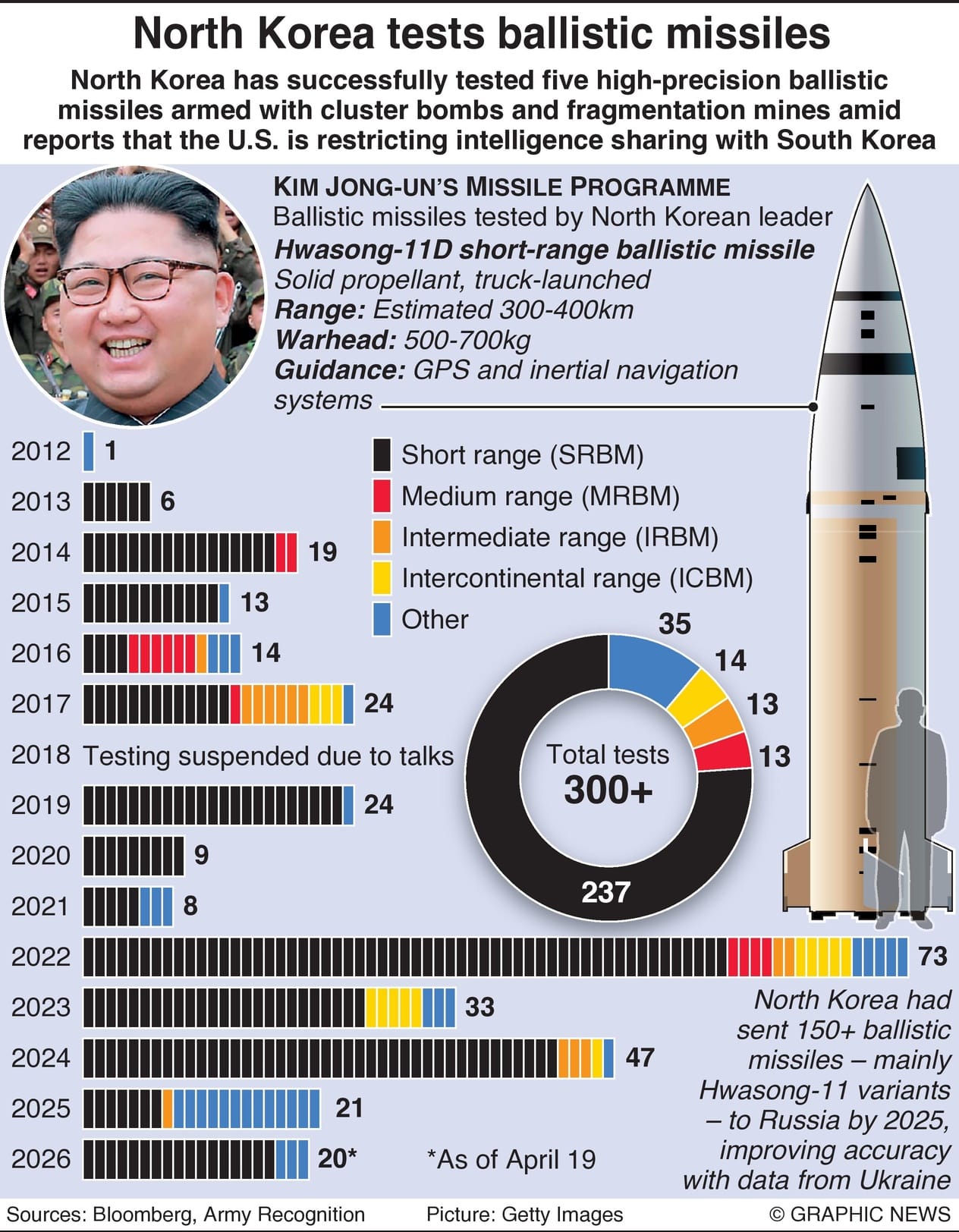
While North Korea has carried out over 300 ballistic missile tests under Kim Jong-Un, over 148 ballistic missiles had been supplied to Russia by early 2025, and accuracy has been honed with real-world data from the Ukraine war. There are growing concerns that since North Korea began contributing arms and troops to fight alongside Russia, the DPRK has gained valuable combat experience.
According to official reports, five Hwasong-11D tactical ballistic missiles were tested to “verify the characteristics and power of cluster bomb warhead and fragmentation mine warhead” and hit their target area about 136km away with “high precision”. In the last few weeks, North Korea has conducted tests with ballistic missiles, anti-warship cruise missiles, and cluster munitions.
In the Middle East conflict, Iran has used cluster munitions against Israel, while the U.S. is believed to have used them in Iran to deliver anti-tank mines.
Pressure Mounts On Starmer Over Mandelson Vetting
British Prime Minister Keir Starmer is facing growing calls to resign after it emerged that Peter Mandelson was appointed as U.S. ambassador despite failing a vetting process.
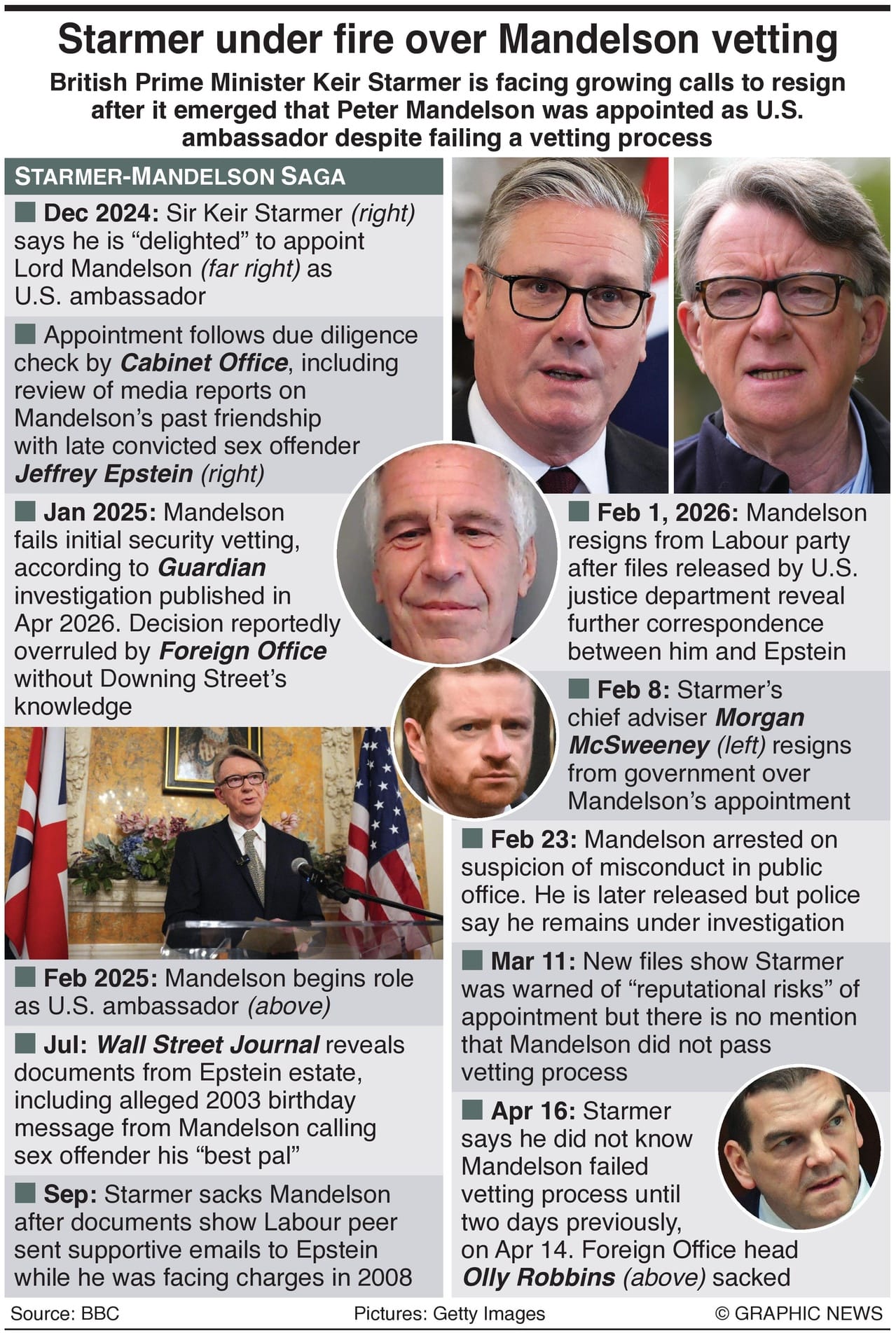
Sir Keir is set to face a packed Commons later on Monday, where he will address questions over Lord Mandelson’s vetting.
He repeatedly told MPs that "full due process” was followed when Lord Mandelson was appointed as U.S. ambassador in December 2024.
The prime minister said he was “staggered” to find out last week that civil servants in the Foreign Office withheld information from him about red flags in the initial vetting process.
1. Trump Rules Out Ceasefire Extension With Iran
2. Why Did The U.S. Board A Tanker In The Indian Ocean
3. Beijing Criticizes U.S. Policy, Warns Japan On Nukes
4. Joint US-Mexico Operation Ends In Fatal Accident
5. Why Is The UK Trying To Bring Expats Back From Dubai
6. Labor Chief Quits As Investigation Deepens
7. How Is The Iran Conflict Impacting Global Markets
8. Regulators Flag Risks In Anthropic’s Mythos AI
9. Apple's New CEO Signals AI Shift As Tim Cook Steps Down
10. Warsh Pledges Fed Independence Ahead Of Hearing
11. Retail Sales Hit 3-Year High Amid Iran War Impact
12. Fed Nominee Pushes Back On Political Influence Claims
editor-tippinsights@technometrica.com