Second in a three-part series on Xi Jinping's year of pressure on Japan. How Beijing tried to break Japan's new PM, why China, not Japan, is the one boxed in, and who the campaign was really performed for.
To reach the open Pacific, a Chinese warship leaving its eastern ports has only a few doors. The widest of them sit between Japanese islands, within range of Japanese missiles. Those are the doors China’s navy would have to force in a fight over Taiwan, to get behind the island and hold off the American fleet, and on that map, China is the trapped one.
Americans carry the opposite picture, a huge China and a small, exposed Japan beside it. Turn the map around, look from the open ocean back toward the mainland, and the geography inverts. By picking a year-long fight with Japan, Xi Jinping tightened the cage around his own navy.
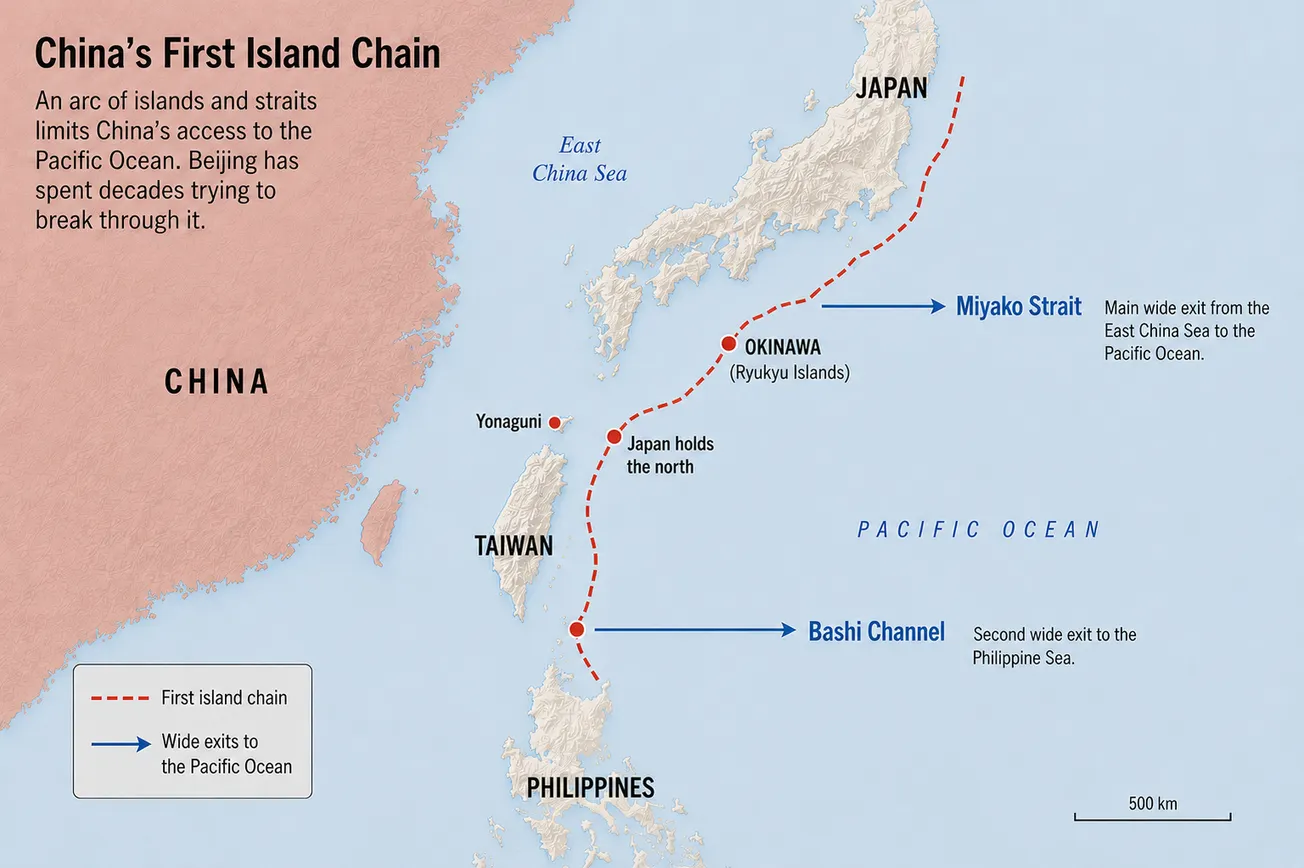
China’s coast is hemmed by what planners call the first island chain, an arc that runs from the Japanese home islands down through Okinawa and the Ryukyus to Taiwan and the Philippines. The term is American in origin, and China’s own admirals have spent forty years working out how to break through it. The chain offers only a few wide gaps to the deep ocean. The Miyako Strait, between Okinawa and the islands to its southwest, is the main one; a second, the Bashi Channel, lies between Taiwan and the Philippines. A navy bottled up behind the chain cannot break into the open Pacific to outflank Taiwan or protect the trade routes China depends on. In a war over Taiwan, that constraint would be decisive: China’s warships and submarines would have to thread the same few gaps to reach open water, exactly where Japanese and American missiles wait, and a navy stuck behind the chain cannot stop the US fleet from coming in.
The doors in the wall
- Yonaguni — Japan's westernmost island, about 110 km from Taiwan. Hold it and you watch the southern approach to a Taiwan war.
- Miyako Strait — the widest gap in the island chain. China's main route from the East China Sea to the open Pacific, and within range of missiles on Japanese soil.
- Bashi Channel — the second gap, between Taiwan and the Philippines. China's other way to deep water, and the other place its navy can be penned.
Japan owns the northern half of that wall. Its territory runs the length of the Nansei chain to Yonaguni, its westernmost island, about 110 km from Taiwan and visible from its shores on a clear day. For a decade, Japan has been turning these islands into a defensive line, fitting locks to the doors China’s navy needs, opening an anti-ship missile base on Ishigaki in 2023, and extending radar and air defenses down the chain.
The wall does not stop at Japan. To the south, the Philippines has opened more bases to American forces and is buying anti-ship missiles of its own, and Taiwan has its own along the strait. The United States ties the three together. Defense analysts now describe the result as a barrier running north to south across China’s Pacific approaches.
None of this began with Takaichi. The buildup has run since the mid-2010s on its own logic. What the past year did was speed it up and point it. Japan now has a longer-range Type-12 missile capable of reaching the Chinese mainland, has moved to host US anti-ship launchers that cover the Miyako Strait, and, in May, ran its first military exercise centered on the islands near Taiwan. Some of the north-south barrier across the Pacific approaches is built, and some are years off, and much of it is American rather than Japanese. When Japan’s defense minister visited Yonaguni in November, Beijing flew drones near the island, and Japan scrambled jets. Japan had planned to put air-defense missiles on the island since 2022, but set a hard 2031 deadline only in February, a day after Beijing imposed export curbs on 20 Japanese companies.
A year of pressure also revived an old question of whether Japan could build a bomb. Japan holds about 44 tons of separated plutonium, most of it stored in Britain and France, and has the skill to build a weapon within months if it chooses. An IAEA report has noted that this option is also leverage over Washington: if the US ever looked like a weaker protector, Japan could move toward a bomb, an outcome America wants to prevent. Japan has not crossed that line and is barred from doing so by its own three non-nuclear principles. The material is reactor-grade, short of the weapons-grade of a finished arsenal, and the 5,500 warheads that Chinese state media advertises is a theoretical maximum, not a plan. The capability is real all the same, and the standoff has made Japanese officials less shy about naming it.
Xi provoked the one country that holds the northern bars of his cage, and watched it harden them. The pressure pulled Japan closer to Washington and Taipei and put the nuclear question back in play. A power already boxed in by geography is now more boxed in, by its own hand.
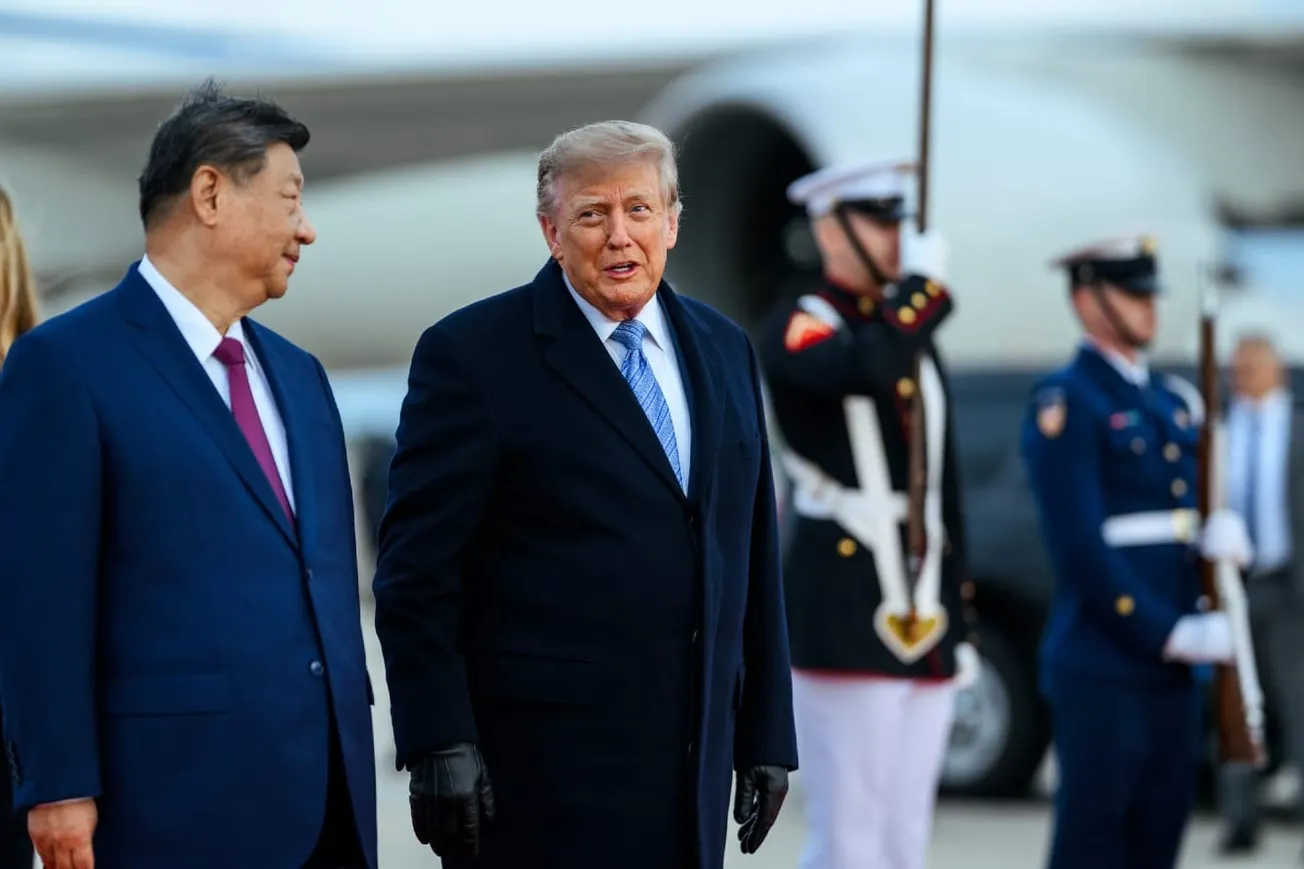
In May, Xi lectured Trump on the Thucydides trap, the theory that a rising power and a ruling one drift into war. He cast China as the rising power. Against Japan, he is the boxed-in one, and he tightened the box himself.
Next: who the year of pressure was really performed for, and why the audience was at home all along.
A three-part series: Xi's year of pressure on Japan
- The Backfire — how Beijing tried to break Japan's new prime minister, and ended up strengthening her.
- The Boxed-In Giant — why China, not Japan, is the one boxed in.
- The Audience Is at Home — who the campaign was really performed for.
The TIPP Off
What you should be reading right now
Global Affairs
Mr. President, Give The Iranian Regime Nothing – Editorial Board, Issues & Insights
Canada Shows The Gruesome Side Of Socialized Healthcare – Editorial Board, Issues & Insights
Putin Says No Point In Meeting Zelenskyy Over Peace Talks – TIPP News
Strait of Hormuz Tensions Rise After U.S. Intercepts Iranian Drones – TIPP News
What Did Zelensky Say In His Personal Letter To Putin – TIPP News
Iran Adviser Says Nuclear Talks Stalled Over $24 Billion Demand – TIPP News
Report Claims Nuclear Talks With Iran Stalled Over Release Of $24B In Frozen Assets – TIPP News
U.S. Expands Pressure Campaign Against Cuba With New Sanctions – TIPP News
CDC Warns Central Africa Ebola Outbreak Could Exceed 20,000 Cases – TIPP News
At Least 49 Die of Thirst After Vehicle Failure In Niger Desert – TIPP News
National Affairs
The Backfire – Editorial Board, TIPP Insights
Concerns Grow Over Trump’s Choice To Lead Intelligence Community – TIPP News
What Did Vance Say About The Henry Nowak Killing – TIPP News
DOJ Expands Election Review As California Ballot Count Continues – TIPP News
Lawmakers Introduce Draft Of Bill Preempting Some State AI Regulations For 3 Years – Elizabeth Troutman Mitchell, The Daily Signal
Democrat Xavier Becerra Moves On In High-Stakes Governor Contest – TIPP News
Judge Rules Against Immigration Policies Targeting Applicants From 39 Nations – TIPP News
ICE Drops Requirement To Report Post-Release Fatalities – TIPP News
What Is In The Senate’s New $70 Billion Immigration Bill – TIPP News
Why Did NASA Order ISS Astronauts Into Safe Haven Procedures – TIPP News
International Space Station Crew Told To Shelter In Spacecraft – TIPP News
Economy
Trump Pushes Arctic Drilling Expansion Through New Lease Sale – TIPP News
Strong Jobs Report Signals Labor Market Stability – TIPP News
What Is Included In The House Agriculture And FDA Funding Bill – TIPP News
Markets & Business
SpaceX IPO Faces S&P 500 Roadblock Despite Massive Valuation – TIPP News
Bitcoin Drops More Than 50% From 2025 Peak – TIPP News
Wall Street Slides As Strong Jobs Data Fuels Rate Hike Concerns – TIPP News
Why Is Trump’s Fannie Mae And Freddie Mac Plan Facing Delays – TIPP News
New York Enacts One-Year Data Center Moratorium – TIPP News
Amazon Expands Warehouse Automation With Next-Gen Proteus – TIPP News
Letters to the editor email: editor-tippinsights@technometrica.com
Subscribe Today And Make A Difference. Consider supporting Independent Journalism by upgrading to a paid subscription or making a donation. Your support helps tippinsights thrive as a reader-supported publication. Contact us to discuss your research or polling needs.
Reach our audience. For sponsorship and advertising opportunities, visit our Partner With Us page.