By Joschka Fischer, Project Syndicate
Until this month, a far-right, openly ethnonationalist party had never come so close to winning an absolute majority in an election in the Federal Republic of Germany. Now that it has, and with similarly pro-Russian forces on the rise in France, all Europeans must prepare for the worst.
BERLIN—On September 6, the far-right Alternative für Deutschland (AfD) won 43.8% of the vote in the German federal state of Saxony-Anhalt, falling just short of an absolute majority. For the first time since the founding of the Federal Republic, an openly ethnonationalist (indeed, racist) party, campaigning on a political platform that is ideologically adjacent to National Socialism, is close to gaining government power.
The fact that Saxony-Anhalt is a small state is hardly consolation. What happens there could happen elsewhere, and the stakes could not be higher. The AfD wants Germany to withdraw from NATO, the European Union, and the euro. It openly supports Russian President Vladimir Putin and seeks to shift the country’s foreign-policy alignment from the West toward the Kremlin.
The shock on election day was compounded by the poor showing—or rather, the outright collapse—of the center-right Christian Democratic Union (CDU), which had been Saxony-Anhalt’s governing party. Its share of the vote was effectively halved, despite substantially higher voter turnout. The governing coalition in Berlin, and Chancellor Friedrich Merz in particular, was widely assigned much of the blame for the result—and not without justification.
The CDU’s disintegration has become a realistic possibility nationwide, auguring a coalition and governing crisis in Berlin. After all, Germany is struggling with persistently weak growth and a failure to push through urgently needed reforms to the tax system and major social-security programs, including pensions, health care, and long-term care.
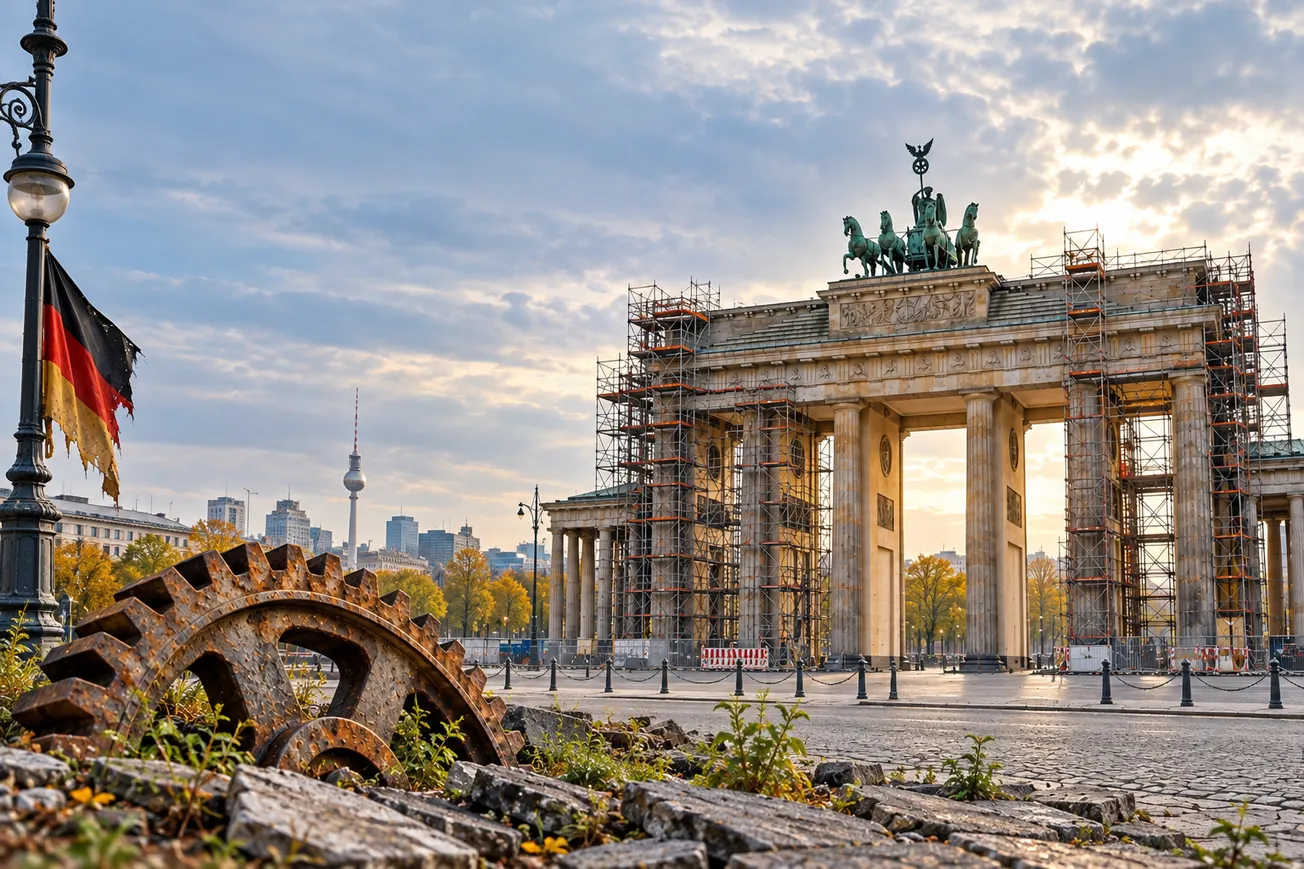
Political stability and predictability have always been important pillars of Germany’s postwar democracy, both before and after reunification in 1990. It was the Federal Republic’s strong rule of law, strategic anchoring in the West, and staunch commitment to the project of European integration that enabled it to build trust with its neighbors and former wartime adversaries. It was these commitments that made reunification possible.
Is all that about to come to an end? Are the pillars crumbling? If so, the rest of Europe would once again be confronted by the “German Question.” For the first time in many decades, Europeans would have to wonder which way the largest, most powerful country in their midst is leaning. They would no longer be sure if Germany is firmly anchored in Europe and NATO, or once again pursuing a national course of its own.
Nothing has yet been decided, of course. But the danger is real, and when combined with the looming political crisis in France—where the far right is also ascendant—the consequences for the European Union could be disastrous. The rest of Europe now must account for the fact that both France and Germany—the EU’s two largest, indispensable member states—are operating from a position of domestic weakness, with each threatened from within by its own version of the new nationalism.
The makings of a European nightmare scenario are already visible. Consider what it would mean if the political and economic crises afflicting the Franco-German partnership were to converge. On the western side of the Rhine would be a government lacking a parliamentary majority and struggling with weak growth and exorbitantly high public debt; and on the eastern side would be a country also struggling with weak growth, foreseeable political instability at the federal level, and a manifest identity crisis.
In this scenario, the EU’s irreplaceable Franco-German engine would grind to a halt. If the two largest, most important member states were to succumb to political renationalization, it is difficult to imagine that the EU and the euro could survive.
Worse, this looming existential crisis for the EU is unfolding against the backdrop of the continuing war in Ukraine, a persistent Russian threat to the continent, and America’s military withdrawal from Europe. The coming weeks and months could prove decisive for Europe. The new nationalism represents an open betrayal of the postwar European project, and a vote in favor of Russia. Whether European sovereignty, values, and freedom can survive this year and 2027 has become an open question.
Joschka Fischer, Germany’s foreign minister and vice chancellor from 1998 to 2005, was a leader of the German Green Party for almost 20 years.
Loved it, hated it, or somewhere in between — tell us. Grade this article here and help shape what lands in your inbox next.
🔗 Further Reading
Deeper on what you just read.
🟨 Germany’s Moment Of Reckoning – Ulrike Malmendier, Project Syndicate
🟨 The Political Earthquake From Germany’s China Shock – Dalia Marin, Project Syndicate
🟨 German Chancellor’s Attack On Free Speech Reveals Europe’s Growing Fear Of Dissent – Jarrett Stepman, The Daily Signal
🟨 Germany’s Political Firewall Is Crumbling – Michael Bröning, Project Syndicate
🟨 From Industrial Power To Military Keynesianism: Germany’s Engineered Collapse – Gerry Nolan, Ron Paul Institute for Peace and Prosperity
🟨 Friedrich Merz Are You Nuts? – William Dunkerley, Ron Paul Institute for Peace and Prosperity
🧭 Power & Capital · September 28, 2026
Where state power meets the boardroom.
🔷 China, US Lower Tariffs On Agriculture, Appliances And Consumer Goods – Power & Capital Desk, TIPP Insights
🔷 Trump Says US Diesel Export Ban Is Under Serious Consideration – Power & Capital Desk, TIPP Insights
🔷 What Is Trump’s $15 Billion Plan For The Largest US Steel Plant – Power & Capital Desk, TIPP Insights
🔷 Watch: Trump Brushes Off AI Safety Alarms Ahead Of Meeting With Anthropic Chief – TIPP Video
🌍 Global Affairs
The world's flashpoints, in motion.
🟥 UK Police Arrest Five Over Suspected Attack On Air Base Used By US – TIPP News
🟥 Watch: Bangkok Faces Persistent Flooding Following Days Of Heavy Rains – TIPP Video
🟥 Watch: Mexican Fishing Villages Prepare For Hurricane Polo Amid Rising Flood Concerns – TIPP Video
🏛️ National Affairs
The fights shaping America right now.
🟫 Americans Grow More Concerned About Food Safety Amid Outbreaks – TIPP News
🟫 California’s New Tire Rule Will Result In Higher Costs And More Highway Deaths – TIPP News
📈 Economy
Prices, policy, and the pressure on your wallet.
🟩 Oil Jumps As Trump Turns Down Iran’s Strait Of Hormuz Deal – TIPP News
🟩 Is The GOP Failing To Sell Trump’s Economic Gains? I&I/TIPP Poll – Terry Jones, TIPP Insights
🟩 AI Infra Spending Raises Fresh Inflation Concerns – TIPP News
🟩 What Democratic Socialists Don’t Want You To Know About Monopoly – Rudolph Kohn, Mises Wire
💼 Markets & Business
The deals and tickers making moves.
🟧 SpaceX Starship Reaches Orbit In Major Test Flight – TIPP News
🟧 Nvidia Builds New Guardrails For Autonomous AI Agents – TIPP News
Letters to the editor email: editor-tippinsights@technometrica.com
Subscribe Today And Make A Difference. Consider supporting Independent Journalism by upgrading to a paid subscription or making a donation. Your support helps tippinsights thrive as a reader-supported publication. Contact us to discuss your research or polling needs.
Reach our audience. For sponsorship and advertising opportunities, visit our Partner With Us page.