
By Michael Bröning, Project Syndicate
The upcoming election in Saxony-Anhalt could give the far-right Alternative für Deutschland control of a state government for the first time in Germany’s postwar history. Its rise offers a crucial lesson for democracies elsewhere: closing ranks against extremist parties is no substitute for effective governance.
NEW YORK—On May 8, 1654, the mayor of Magdeburg appeared before the Imperial Diet at Regensburg with two hollow copper hemispheres and 30 horses. Nothing joined the metal halves, yet the horses could not pull them apart. The hemispheres were held together by the vacuum within and the weight of the atmosphere around them. Only when a valve was opened and air rushed in did the spheres fall apart.
Another vacuum in Magdeburg is set to be filled when the eastern German state of Saxony-Anhalt—of which Magdeburg is the capital—heads to the polls on September 6. The result is expected to shake the German body politic and hold a crucial lesson for democratic movements beyond Germany: simply closing ranks against the far right becomes a dangerous tactic when it is mistaken for a strategy.
In recent surveys, the far-right Alternative für Deutschland (AfD) has polled as high as 43%, comfortably ahead of Chancellor Friedrich Merz’s Christian Democratic Union (CDU), which stands at 23%. This gives the AfD a real chance to lead a state government—a first in Germany’s postwar history. The election could be a watershed moment, marking the end of the political firewall (Brandmauer) erected by the country’s mainstream parties to keep the far right out of power.
The AfD in Saxony-Anhalt, led by Ulrich Siegmund, a charismatic 35-year-old entrepreneur with one of the largest social media followings of any state-level politician, is classified as an extremist party by the state’s domestic intelligence service. Ironically, constitutional rules designed to prevent such parties from gaining power may prove instrumental in their rise. Germany’s 5% threshold for entering federal and state parliaments, which dates back to the founding of the Federal Republic, was introduced to prevent political fragmentation—a key lesson from the failure of the Weimar Republic. Now it may shut out the Social Democrats, the Greens, the Liberals, and the left-nationalist BSW, all of which hover around the crucial mark in Saxony-Anhalt. If enough of them fall short, the AfD could convert roughly two-fifths of the vote into an absolute majority.
But even if these smaller parties do make it into parliament, an AfD-led government in Saxony-Anhalt might be blocked only by a minority government or an ideologically incoherent coalition bringing together the CDU and the anti-capitalist Linke. Such an arrangement risks feeding the far-right narrative that a cartel of mainstream forces is conspiring to keep it from power and would also almost certainly produce a government founded on little more than opposition to a shared adversary.
The AfD’s rise has been fueled by a combination of widespread concerns about immigration and related security issues, rising energy costs, and a backlash against perceived progressive cultural causes, from gender to language. In Saxony-Anhalt, the party’s platform minces no words. It warns of the “aging and extinction of the German people” and calls for banning the rainbow flag from school buildings, imposing a moratorium on wind-energy expansion, and establishing volunteer citizen patrols. Siegmund frequently invokes “remigration” and has made the abolition of public broadcasting one of his signature issues. Compulsory schooling is a problem, he claims, while Vladimir Putin’s Russia is a potential partner.
And Saxony-Anhalt could be only the beginning. At around 28% support, the AfD is currently the strongest party in national polls. Membership numbers are soaring, and nearly half of Germans now say they are not afraid of the party. Just two weeks after the vote in Saxony-Anhalt, the AfD is expected to come out on top in the state election in Mecklenburg-Vorpommern and to make a strong showing in Berlin.
For Germany’s mainstream parties, shutting out up to a third of the electorate is not a viable solution. But nor is alarmism. A recent cover story in Der Spiegel, Germany’s most influential weekly, featured a mugshot of Siegmund under the headline “Germany’s most dangerous man.” Siegmund, apparently delighted, has been handing out signed copies, turning the cover into a campaign prop.
Almost 400 years ago, the Magdeburg hemisphere experiment demonstrated the extraordinary force created by a vacuum. The Brandmauer operates on a similar principle, seeking to contain an oppositional force by keeping it out of government. But exclusion cannot substitute for effective governance, and vacuums are quickly filled when valves are opened.
The same is true for other European countries. In France, mainstream parties joined forces to hold the country’s far right at bay in the 2024 legislative election but failed to produce a stable government. Belgium’s political cordon sanitaire, meanwhile, has not stopped the nationalist Vlaams Belang party’s growth. And in the Netherlands and Sweden, years of shunning the far right did not prevent its voter base from expanding.
What liberal democracy needs now is not firmer walls against political insurgents but a state that delivers on its core promises: an immigration policy that is neither performatively cruel nor an exercise in wishful thinking; an energy policy that enables rather than undermines industrial production; and reforms that build economic momentum instead of regulating it away.
In 1654, two copper shells and 30 horses showed the assembled princes of the Holy Roman Empire the power of atmospheric pressure. This month, Magdeburg may once more reveal the power of atmospheric pressure. The question is no longer whether the vacuum will be filled, but whether it will be filled by anger and resentment or by competence, responsiveness, and decency.
Michael Bröning is the author, most recently, of Die Hetzer sind immer die Anderen (Verlag am Park, 2024) and serves on the Basic Values commission of Germany’s Social Democratic Party.
Loved it, hated it, or somewhere in between — tell us. Grade this article here and help shape what lands in your inbox next.
Far-Right Eyes Breakthrough In Germany’s State Election
Elections in three German states are set to test the credibility of the Alternative for Germany (AfD) and gauge its chances of winning an outright majority – a breakthrough that would mark the first time a far-right party has achieved such a result in postwar Germany.
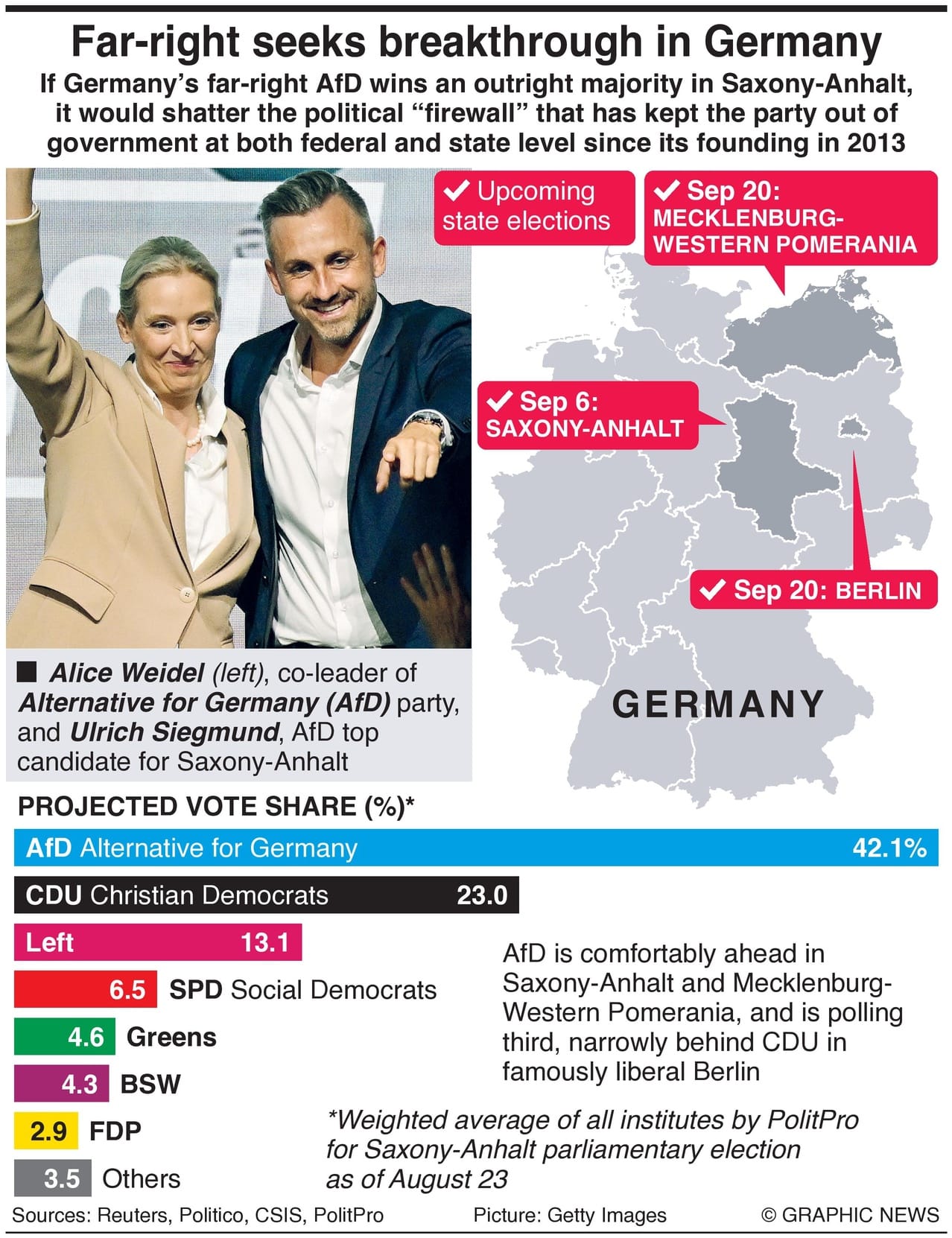
A majority in Saxony-Anhalt would shatter the political “firewall” that has kept the AfD out of government at both federal and state level since its founding in 2013.
The AfD is polling as high as 42% in Saxony-Anhalt. The party has faced criticism over Nazi imagery and rhetoric, its distinctions between “biological” and “passport” Germans, and policies seen as more extreme than those of many other European far-right parties.
AfD co-leader Alice Weidel has reiterated calls for tougher immigration rules and for Germany to leave the Schengen passport-free travel area to strengthen border controls.
The AfD is also comfortably ahead in Mecklenburg-Western Pomerania, while it is polling third in liberal Berlin, narrowly behind the CDU. Elections in both states are set for September 20.
🧭 Power & Capital · September 2, 2026
Where state power meets the boardroom.
🔷 Carney Picked A Trade War With Trump—But Why? – Victor Davis Hanson, The Daily Signal
🔷 Trump Suggests He Won’t Try To Talk Warsh Out Of Rate Hike – Elizabeth Troutman Mitchell, The Daily Signal
🔷 Watch: Gave Canadian PM A Verbal Beatdown, Says Scott Bessent – TIPP Video
🔷 Why Has The Prediction Markets Battle Reached The Supreme Court – Power & Capital Desk, TIPP Insights
🌍 Global Affairs
The world's flashpoints, in motion.
🟥 Iran Says U.S. Strike Hit Wedding Party, Killing Four – TIPP News
🟥 Watch: Iran Releases Video Claiming Missile Launches Aimed At Jordan – TIPP Video
🟥 How Is Russia Helping Iran Build Faster, More Advanced Missiles – TIPP News
🟥 ‘Trump Strait’: US President Proposes Renaming Strait Of Hormuz – TIPP News
🟥 Zelenskyy Says Russian Skies Becoming Unsafe For Airlines – TIPP News
🟥 US Aircraft Carrier Abraham Lincoln Arrives In Thailand After Historic Deployment – TIPP News
🟥 Watch: Tracing The Aftermath Of Nepal’s Fatal Flash Floods In Nuwakot – TIPP Video
🏛️ National Affairs
The fights shaping America right now.
🟫 Pentagon Faces Leadership Shake-Up As Iran War Strains Forces – TIPP News
🟫 Trump’s Approval Stays Strong With GOP, But Weakens Among Indie Voters: I&I/TIPP Poll – Terry Jones, TIPP Insights
🟫 What Does The New Poll Say About Trump’s Canada Trade War – TIPP News
🟫 JD Vance Says Abdul El-Sayed Represents An Evil Plaguing America – Virginia Grace McKinnon, The Daily Signal
🟫 DeSantis Deals Blow To Controversial Flock Cameras – Elizabeth Troutman Mitchell, The Daily Signal
🟫 Voter Registration Battle Taking Place In Ohio Ahead Of Midterms – Elizabeth Troutman Mitchell, The Daily Signal
🟫 Whom Do Democratic Socialists Of America Politicians Represent? – Michael Freund, The Daily Signal
🟫 Trump $1 Coin Hits The Market As America Marks 250 Years – TIPP News
🟫 Golf Star Tiger Woods To Appear In Court Over DUI Charge – TIPP News
💼 Markets & Business
The deals and tickers making moves.
🟧 Nike Forgot Its Customers. Now They Are Walking Away. – Tom Carter, The Daily Signal
🟧 American Airlines Upgrades Boeing 777 With Luxury Flagship Suites – TIPP News
Letters to the editor email: editor-tippinsights@technometrica.com
Subscribe Today And Make A Difference. Consider supporting Independent Journalism by upgrading to a paid subscription or making a donation. Your support helps tippinsights thrive as a reader-supported publication. Contact us to discuss your research or polling needs.
Reach our audience. For sponsorship and advertising opportunities, visit our Partner With Us page.