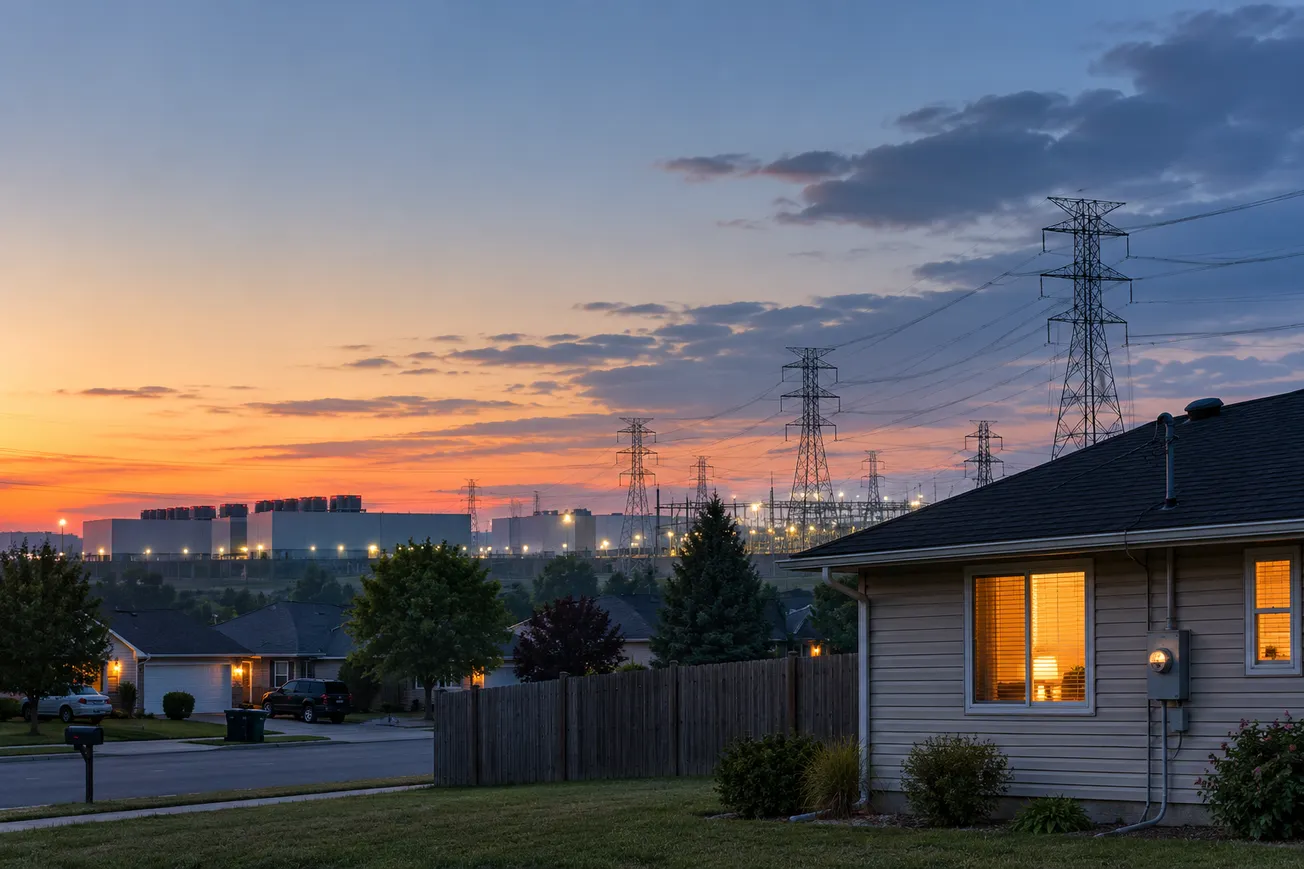
Americans are clearly torn over artificial intelligence and the electricity-hungry data centers now being built around the country that make it all possible. As the latest I&I/TIPP Poll shows, voters are at best ambivalent about the giant AI high-tech transformation, and worry about its impact on energy costs and their household budgets.
In its latest survey, the national online I&I/TIPP Poll began by asking 1,463 voters: “How concerned are you that your household’s electricity bills will increase over the next 12 months?”
In something of a landslide, a hefty 75% majority overall responded that they would be either “very” concerned (41%) or “somewhat” concerned (34%), while just 20% said they would either be “not very” concerned (14%) or “not concerned at all” (7%).
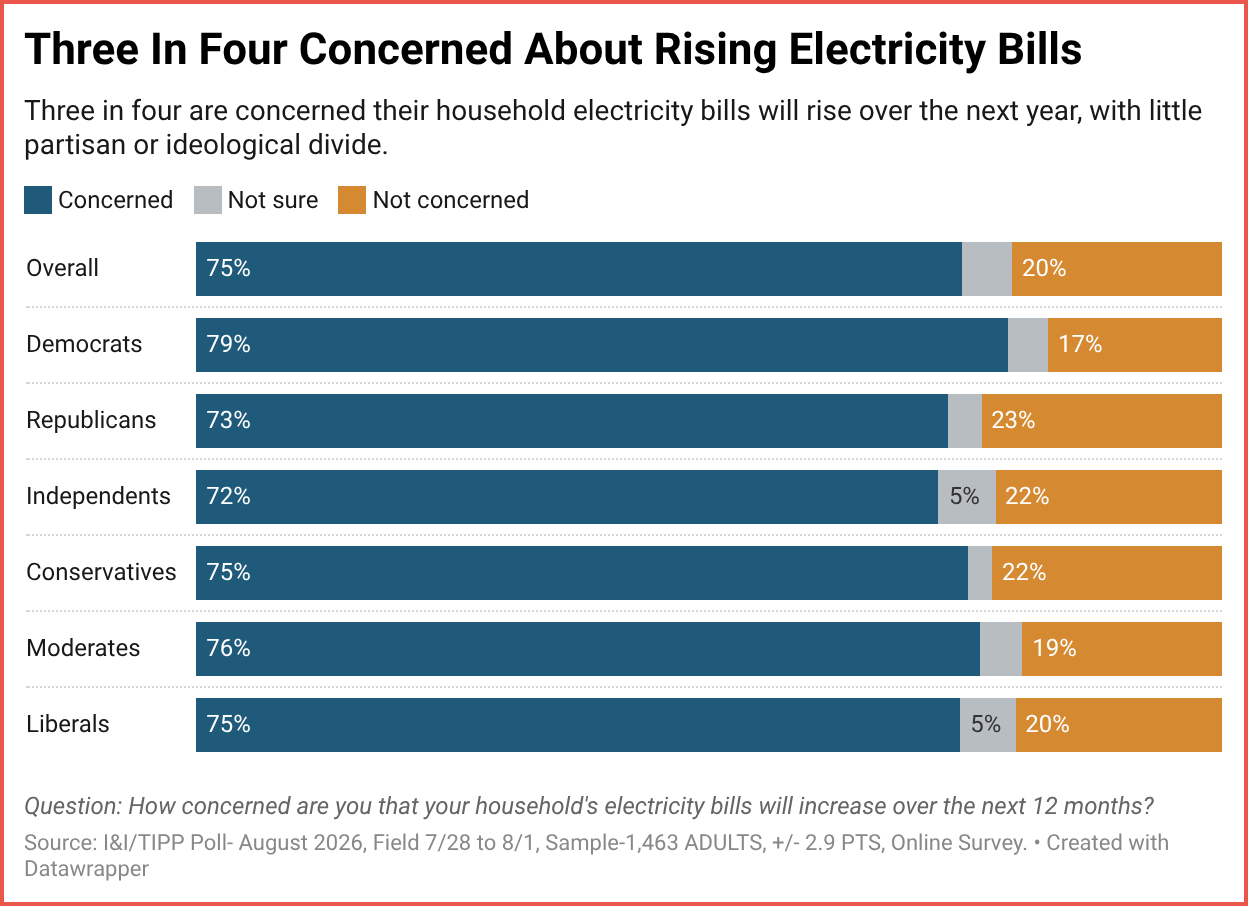
The August I&I/TIPP Poll was taken from July 28 through Aug. 1 and has a margin of error of +/- 2.9 percentage points.
Among Democrats (79% concerned), Republicans (73% concerned) and independents (72% concerned), there was extremely high agreement. Indeed, not one of the 36 demographic groups I&I/TIPP tracks were below 70% “concerned.” Those “not concerned” formed only a small minority in all groups.
A follow-on question queried: “If a large data center were built near your community, which potential impact would concern you the most?”
On this question, six responses were possible.
Among those, 37% answered “higher electricity costs,” while another 21% went with “greater demand on the electrical grid” as their answer. Just 13% worried over “increased water use,” while a slightly larger 14% cited “noise and environmental impacts,” and only 7% said they had “few or no environmental concerns.
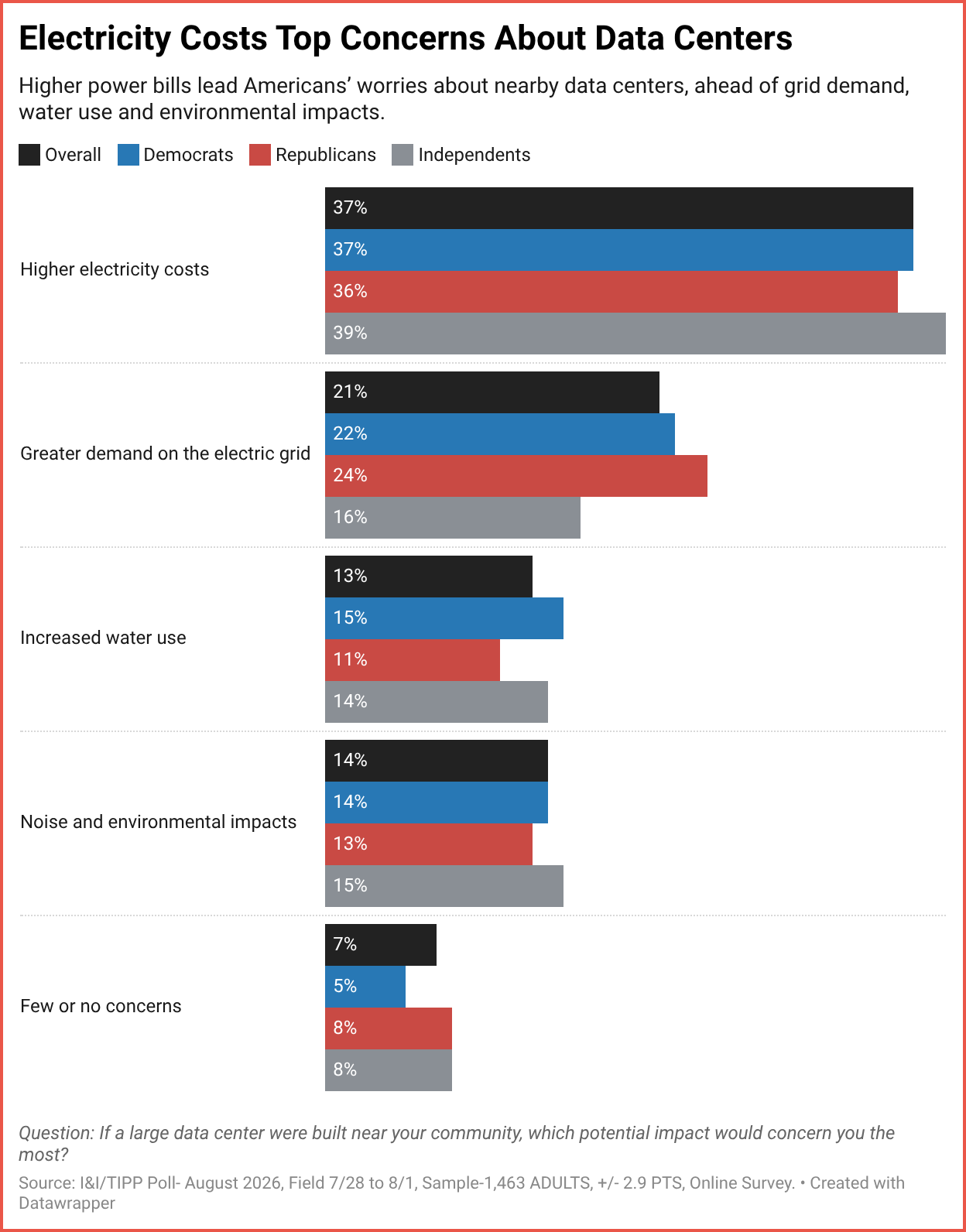
Once again, political persuasion mattered little: Though numbers weren’t identical, they were bunched closely together. And the two responses about America’s ability to continue producing low-cost electricity without straining the national grid accounted for 58%. It’s very much on all Americans’ minds now.
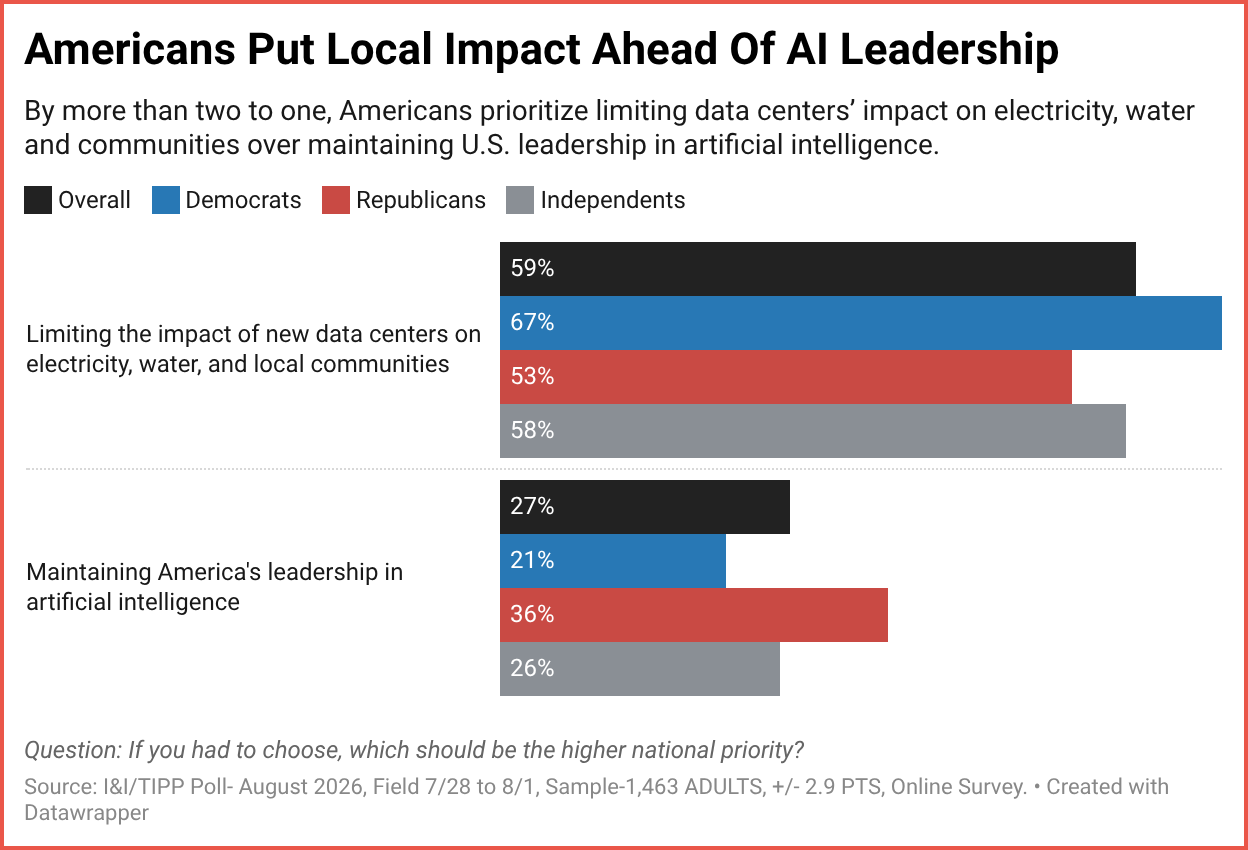
As a third question, participants were asked: “If you had to choose, which should be the higher national priority?”
This question provided three possible answers, with 27% selecting “Maintaining America’s leadership in artificial intelligence,” but a 59% majority favoring “Limiting the impact of new data centers on electricity, water, and local communities.” Another 14% said they were not sure.
As noted, the AI/data center controversy is one of a small handful of issues on which a majority each of the three major political groupings — Democrats, Republicans, independents — agree.
Among Democrats, only 21% thought “maintaining America’s leadership” in AI should be a priority, while 67% wanted to “limit the impact” of data centers, and 12% weren’t sure. For independents, a slightly higher 26% wanted to back U.S. AI leadership, but 58% wanted to limit data center impacts and 16% were not sure.
And Republicans largely agreed, with 36% wanting to maintain U.S. AI leadership, but a majority of 53% in favor of limiting local impacts. Just 11% were not sure.
A fourth question asked respondents the best ways to meet growing electricity demand: “As demand for electricity from data centers grows, what should America do first?”
The number one answer at 26%: “Improve energy efficiency to reduce demand.”
“Expand renewable electricity generation” and “Slow construction of new data centers until the electric grid catches up” were in a statistical tie, each at 24%.
The least popular response? “Build more electricity generation,” with just 13% support. That 13% was also the same percentage who said “not sure.”
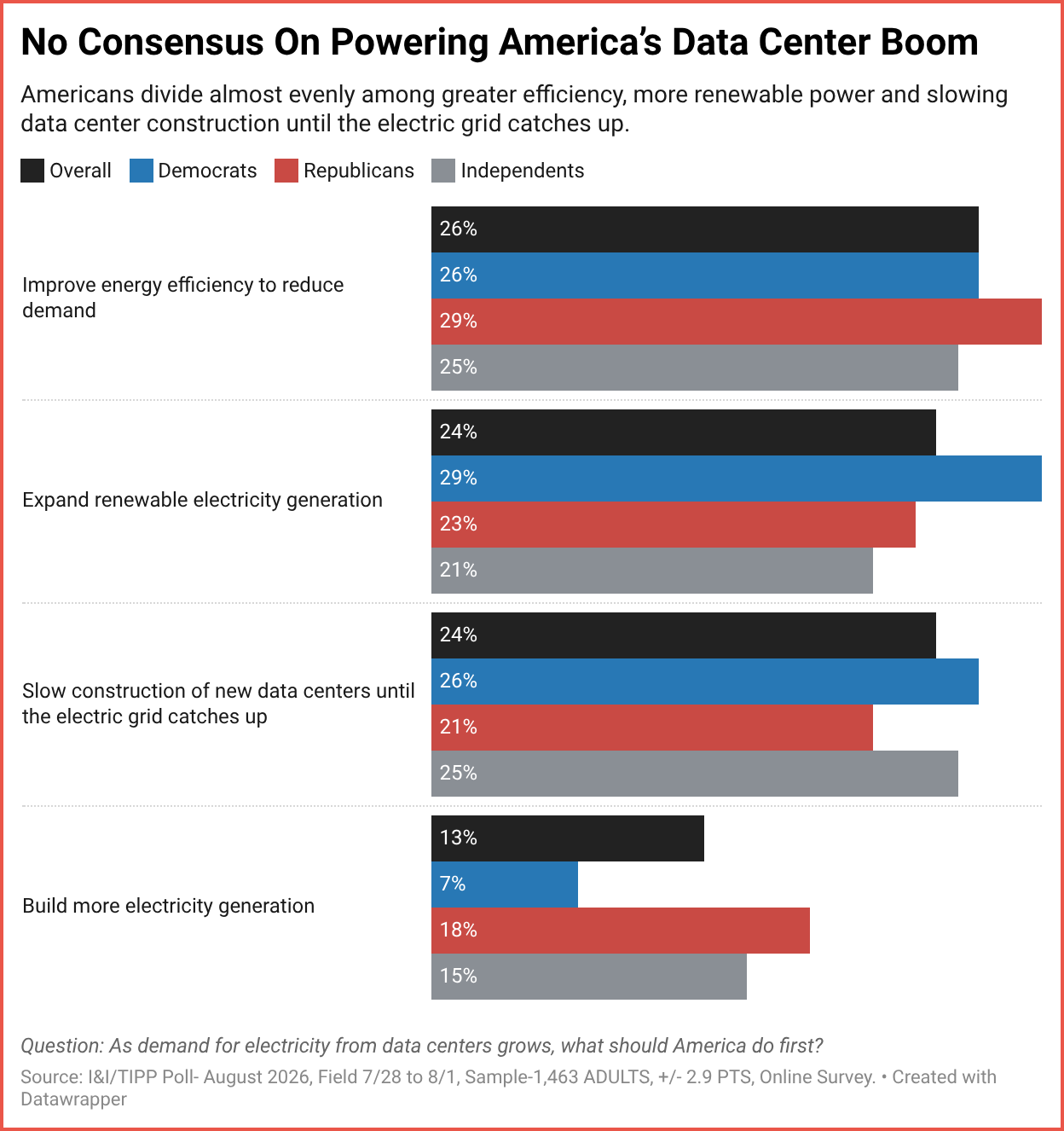
Democrats, Republicans and independents were not far apart in their responses, though there were some differences. Among Republicans, 29% favored “improve energy efficiency,” while Dems (26%) and indie voters (25%) were slightly lower.
Using more renewables was most popular with Democrats (29%), less so with Republicans (23%) and independents (21%). That pattern held, too, for “slow construction of new data centers,” which received support from 26% of Democrats, 25% of independents, and 21% of Republicans.
“Build more” power plants got strongest backing from Republicans at 18%, but found just 7% with Democrats and 15% with independents. Among the policy options, it is the least popular.
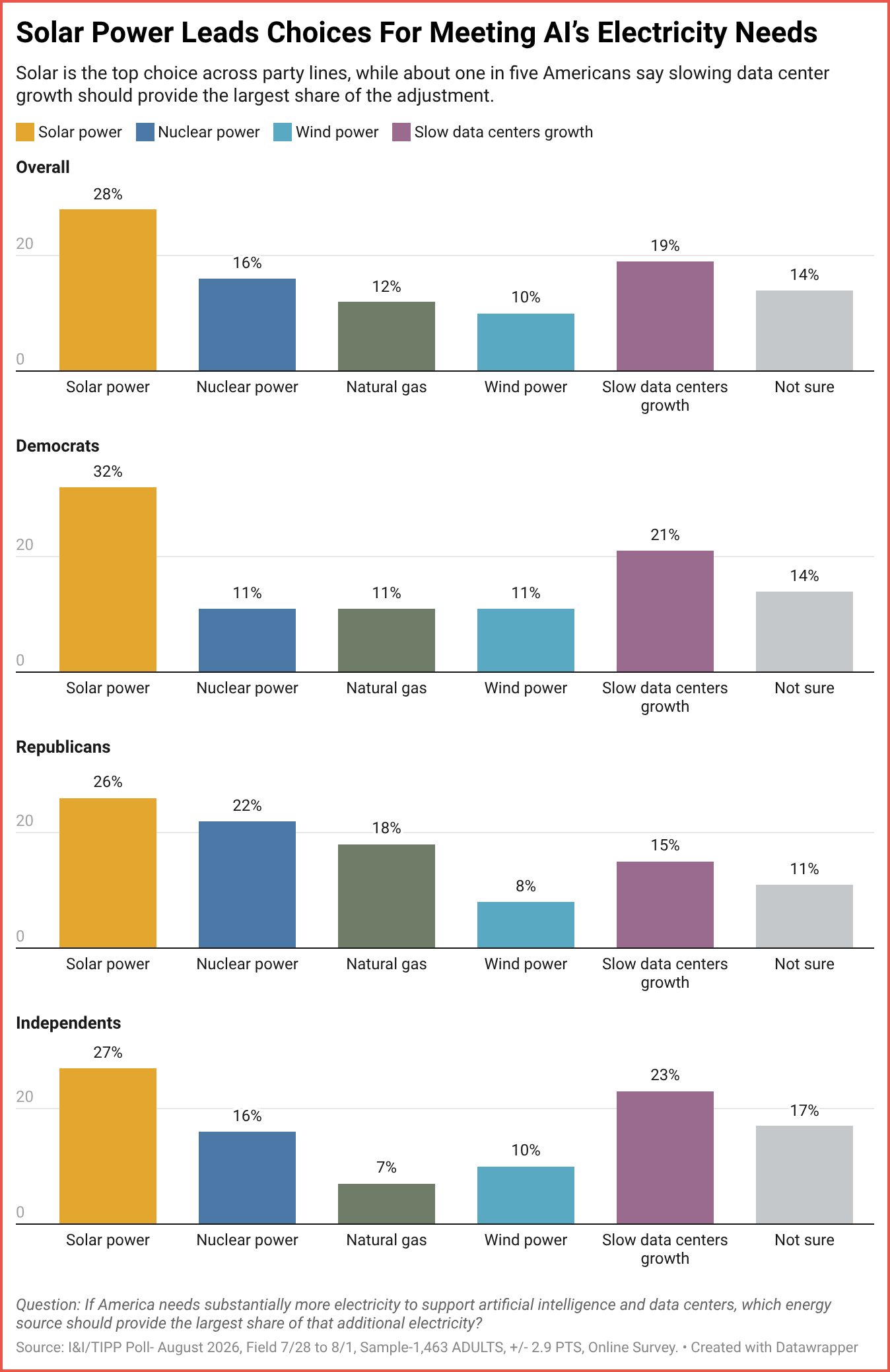
A final poll question asks: “If America needs substantially more electricity to support artificial intelligence and data centers, which energy source should provide the largest share of that additional electricity?”
The big winner? Solar power, with 28% support, followed by nuclear power (16%), natural gas (12%), and wind power (10%). But No. 2 response, with 19% backing, wasn’t any kind of energy at all, but rather: “America should slow the growth of data centers instead.”
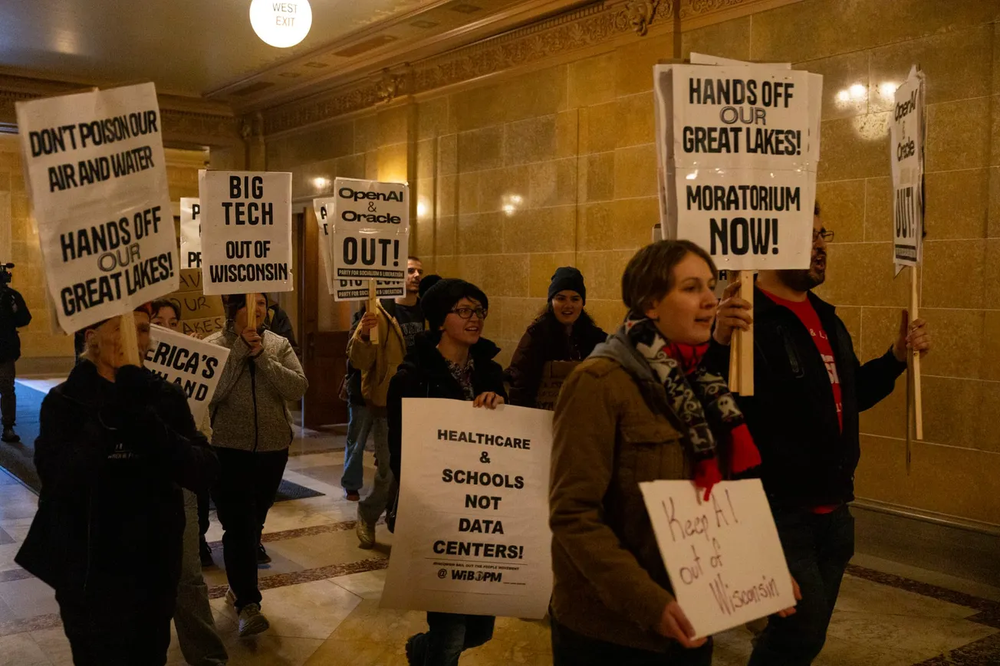
No question about it: Americans are very wary of artificial intelligence and the data centers being built to make AI possible. The same thing happened in the 1980s, when personal computers first emerged and initially cost jobs in some areas, but soon boosted employment overall.
Data centers have been vilified by politicians on the far left, including Vermont’s socialist Sen. Bernie Sanders, who claims data centers and AI will have a “catastrophic impact” on average Americans, while New York Democratic Socialist Rep. Rep. Alexandria Ocasio-Cortez charges they are a source of “existential harm” to working people.
And, as the I&I/TIPP Poll clearly shows, the nearly non-stop anti-AI/data center campaign by the Democratic Party, has had a negative impact on how its viewed by average Americans. What Americans don’t know is that much of that opposition is funded in part by foreign governments, including China. These groups have “delayed, blocked, or scaled back approximately $23.6 billion in proposed U.S. AI data center investment,” the Bitcoin Institute study shows.
Even so, Americans fear that data centers will consume vast amounts of electricity, driving up energy costs to consumers, while ruining local economies.
But do people really understand data centers? Maybe not. They might not know it, but they’re already heavily dependent on data centers and AI. There’s no going back, unless we want to cede leadership to China, India and a growing number of others seeking to control AI’s destiny, for good or for ill.
Data centers are already a big part of our economy. And the data center industry is growing rapidly.
A 2026 report by global accounting and consulting firm PwC (PricewaterhouseCoopers) found that data centers already employ more than a million people (and it’s growing fast). And each one of those jobs supports 4.5 jobs elsewhere. In just two years — 2023 and 2024 — they boosted GDP by $1.7 trillion and added $369 billion to federal, state and local taxes.
“Without data centers, this country’s roughly 315 million smart phones would be — well, dumb phones,” adds IndustryWeek Magazine. “Data centers are, effectively, the backbone of our digital economy, supporting cloud storage, streaming media, modern communications, and online game servers. And with the rise of AI, they will become even more essential.”
Newer data centers are being built with their own power supplies, just like Elon Musk’s. And new data centers also don’t waste water: They recycle all the water they use. It is, of course, proper to ensure that new data centers don’t damage local communities, that they pay for or supply their own energy, and that they mitigate noise pollution.
As the August I&I/TIPP Poll clearly shows, many Americans believe that the AI and data center industries are a problem. Indeed, like all new growth industries, they pose challenges for local communities. But as recent studies also strongly suggest, Americans’ lives will likely be far better, not worse, thanks to the beneficial impact that AI and data centers will have on the overall economy.
I&I/TIPP publishes timely, unique, and informative data each month on topics of public interest. TIPP’s reputation for polling excellence comes from being the most accurate pollster for the past six presidential elections.
Terry Jones is an editor of Issues & Insights. His four decades of journalism experience include serving as national issues editor, economics editor, and editorial page editor for Investor’s Business Daily.
Loved it, hated it, or somewhere in between — tell us. Grade this article here and help shape what lands in your inbox next.
🔗 Further Reading
Deeper on what you just read.
🟨 Data Center Backlash Brings Thousands Of Projects To A Screeching Halt – Sean Moran, Daily Caller News Foundation
🟨 Data Centers, Polling, November Elections, And The Way Forward – Steve Cortes, The Daily Signal
🟨 Data Center Boom Forces US Grid To Ration Electricity – Power & Capital Desk, TIPP Insights
🟨 Rising Majority Say AI Is A Job Killer That Will Lead To Higher Energy Costs: I&I/TIPP Poll – Terry Jones, TIPP Insights
🟨 How Are Data Centers Reshaping The 2026 Midterm Elections – TIPP News
🟨 How Will Data Centers Affect Ohio's Elections? – Rebecca Downs, The Daily Signal
🟨 Trump Defends Data Centers As Backlash Grows Ahead Of Midterms – TIPP News
🟨 Data Center Critics Have Water On The Brain – Editorial Board, Issues & Insights
🧭 Power & Capital · August 26, 2026
Where state power meets the boardroom.
🔷 Canada Hits US Goods With Retaliatory Tariffs As Trade Tensions Escalate – Power & Capital Desk, TIPP Insights
🔷 SCOOP: Billionaire Abortion Doula Gives Thousands To Influence This Senate Race – Virginia Grace McKinnon, The Daily Signal
🔷 Central Banking: The Scourge Of Civilization – George Ford Smith, Mises Wire
🌍 Global Affairs
The world's flashpoints, in motion.
🟥 CIA Director John Ratcliffe Visits Moscow For Undisclosed Meetings – TIPP News
🏛️ National Affairs
The fights shaping America right now.
🟫 Records Reveal Planned Parenthood’s 14-Point Post-Dobbs Strategy For State AGs To Target Pro-Lifers – Fred Lucas, The Daily Signal
🟫 ICE Reports Nearly 50,000 Arrests In July As Immigration Enforcement Expands – TIPP News
🟫 Far-Left Streamer Hasan Piker Says He’s More Respectful Of Charlie Kirk Than Kirk’s Widow – Tyler O’Neil, The Daily Signal
🟫 He Can’t Vote For Congress. The Census Still Gives Him A Seat. – Jay Rogers, The Daily Signal
🟫 Republican Ranchers In Congress Urge Trump To Put American Ranchers First – Virginia Grace McKinnon, The Daily Signal
🟫 US Army Apache Helicopters Face Historically High Crash Rate – TIPP News
🟫 USS Abraham Lincoln Set To Make First Port Call In Months In Thailand – TIPP News
🟫 FBI Sets $25,000 Minimum Reward For Unsolved Indian Country Cases – TIPP News
🟫 Plano ISD Sued By Mothers Over Alleged Takeover Of Choir Booster Club – Emily Medeiros, The Daily Signal
🟫 Virginia Navigates Changing NCAA, Federal Policies – Rich Tucker, The Daily Signal
🟫 440,000 Floridians Drop Obamacare Plans As Healthcare Costs Surge – TIPP News
🟫 Two Measles-Related Deaths Reported In Pennsylvania Amid Outbreak – TIPP News
🟫 US Marijuana Smoking Matches Record High As Cigarette Smoking Hits Low – TIPP News
🟫 Country Music Legend Dolly Parton Dies At 80 – TIPP News
💼 Markets & Business
The deals and tickers making moves.
🟧 SpaceX Plans New Starship Rocket Complex In Louisiana – TIPP News
📊 Market Mood · August 26, 2026
How the trading day is setting up.
🟩 Markets are relatively steady as oil prices fall sharply, with Brent near $86 a barrel after Iran and Oman resumed talks over managing traffic through the Strait of Hormuz. The decline is providing some relief to inflation and bond-market concerns.
🟦 Nvidia takes center stage today. Its earnings after the bell are arguably the biggest test yet for the AI trade, with investors looking for confirmation that extraordinary spending on chips and data centers continues to translate into growth.
🟧 Inflation and interest rates remain the other major focus. PCE data arrives this morning, while markets continue to grapple with elevated long-term Treasury yields ahead of Fed Chair Kevin Warsh's Jackson Hole speech on Friday.
🟨 With PCE, revised GDP and Nvidia earnings all arriving today, investors have several potential market-moving catalysts before attention shifts fully to Jackson Hole.
🗓️ Key Economic Events
On today's U.S. data calendar.
🟧 8:30 a.m. ET — PCE Price Index (July)
Forecast: +0.1% m/m | 3.6% y/y
Previous: −0.1% m/m | 3.7% y/y
The Fed's preferred inflation gauge is today's most important economic release.
🟧 8:30 a.m. ET — Core PCE Price Index (July)
Forecast: +0.2% m/m | 3.3% y/y
Previous: +0.1% m/m | 3.3% y/y
The underlying inflation reading will be closely watched for clues on whether price pressures are easing enough to keep the Fed on hold.
🟧 8:30 a.m. ET — Q2 GDP, Second Estimate
Forecast: +1.5% | Previous estimate: +1.5%
The revision will show whether the economy's second-quarter growth picture has changed materially.
🟧 8:30 a.m. ET — Durable Goods Orders (July)
Forecast: +0.5% | Previous: +0.3%
A key gauge of manufacturing demand and business investment.
Letters to the editor email: editor-tippinsights@technometrica.com
Subscribe Today And Make A Difference. Consider supporting Independent Journalism by upgrading to a paid subscription or making a donation. Your support helps tippinsights thrive as a reader-supported publication. Contact us to discuss your research or polling needs.
Reach our audience. For sponsorship and advertising opportunities, visit our Partner With Us page.