
How much do Americans know about some of the most important events and ideas of the last century?
The latest TIPP Poll suggests the answer is not much.
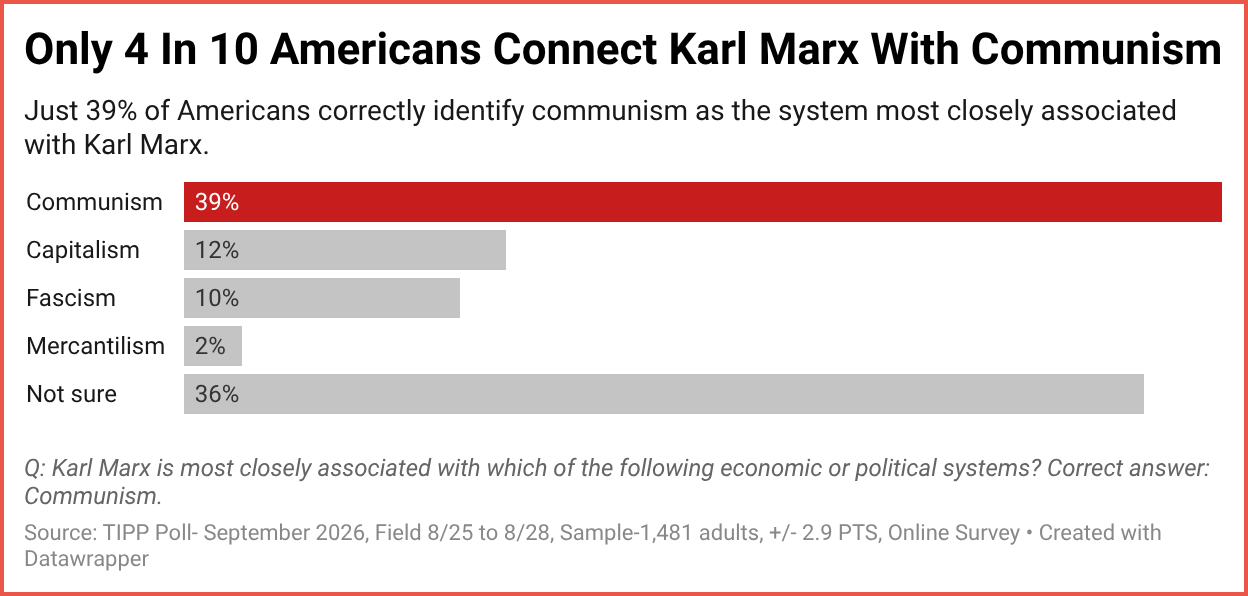
We asked Americans a straightforward question: Karl Marx is most closely associated with which economic or political system?
Only 39% correctly answered communism. Nearly as many, 36%, said they were not sure. Another 12% chose capitalism, and 10% picked fascism.
We did not ask about Marxist theory, Das Kapital, or the finer points of Marx's economic arguments. We asked only for the system most closely associated with his name.
Six in ten did not name it.
Two caveats are worth noting. Marx's major work is a study of capitalism, so some of the 12% may have had that in mind. And among Americans who picked an answer rather than “not sure,” about six in ten got it right. Neither changes the basic picture.
The age breakdown is even more striking.
Among Americans 65 and older, 59% correctly identified communism. No younger group came close. The figure was 35% among those aged 45 to 64, 32% among those aged 25 to 44, and 29% among adults aged 18 to 24. Those three numbers are close enough together that we would not read much into the order.
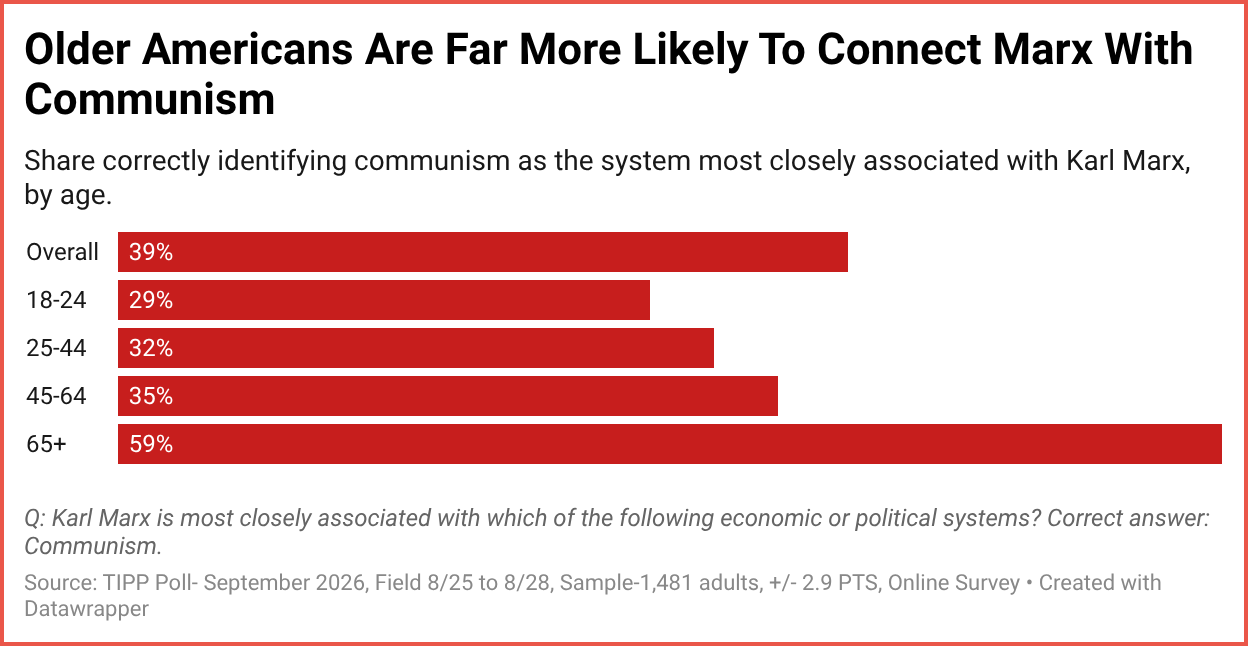
Americans 65 and older came of age when Marx's name was in the news and the Soviet Union was the adversary. Everyone younger has to be taught both.
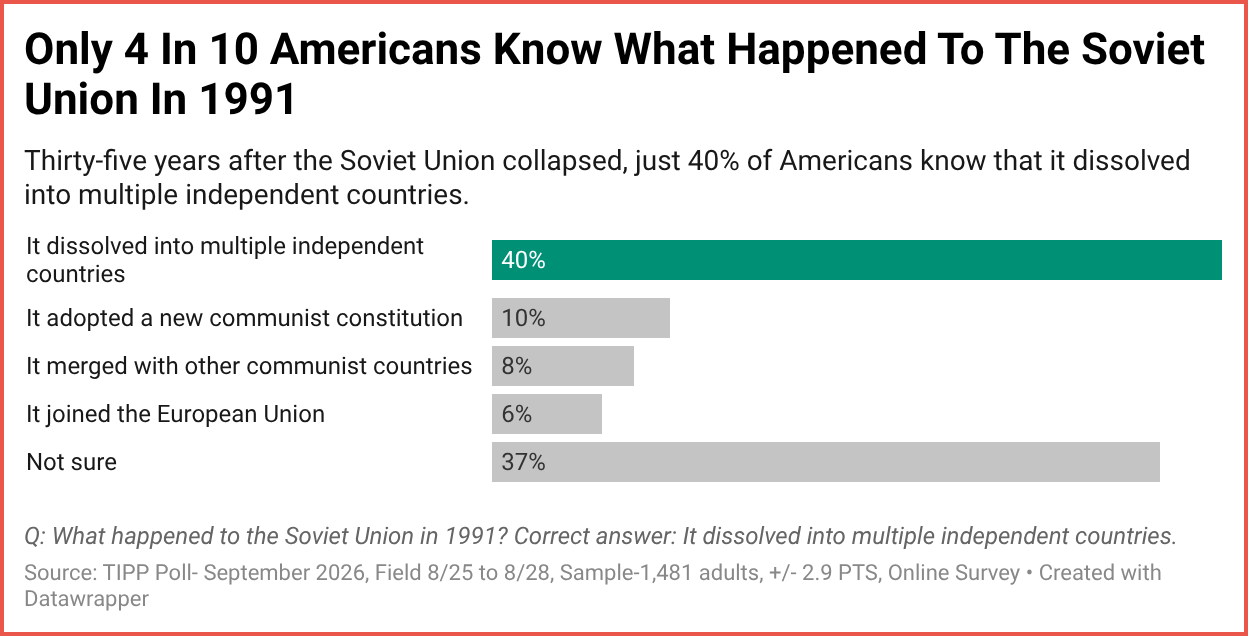
We also asked a basic history question: What happened to the Soviet Union in 1991?
Only 40% knew that it dissolved into multiple independent countries. Another 37% were not sure.
Ten percent thought the Soviet Union adopted a new communist constitution, 8% thought it merged with other communist countries, and 6% thought it joined the European Union.
The Soviet Union collapsed only 35 years ago. Many Americans remember watching it come apart, and the Soviet flag lowered over the Kremlin.
These findings raise a basic question about how well Americans know recent history.
There will be plenty of debate about capitalism, socialism and communism in the years ahead. Americans will have different views about each of them. That's to be expected.
But an informed debate requires some understanding of history.
We don't have to agree on what history means. We should at least know what happened.
Loved it, hated it, or somewhere in between — tell us. Grade this article here and help shape what lands in your inbox next.
🧭 Power & Capital · September 1, 2026
Where state power meets the boardroom.
🔷 FTC Sues Amazon Over Alleged Manipulation Of Online Ad Prices
🔷 Trump Administration Announces New Drug Pricing Deals With 9 Pharma Companies
🌍 Global Affairs
The world's flashpoints, in motion.
🟥 Trump Must Not Let Washington’s Korea Hawks Intimidate Him Again – Ted Galen Carpenter, Ron Paul Institute for Peace and Prosperity
🟥 Marcus Licinius Trump – Derek Wheeler, Ron Paul Institute for Peace and Prosperity
🟥 Welcome Home Stalin – Eric Margolis, Ron Paul Institute for Peace and Prosperity
🟥 Three Reasons Why The French Revolution Was So Different From The American Revolution – Ryan McMaken, Mises Wire
🟥 The Arday Tragedy: A Story Of Institutional Failure, Not A Witch Hunt – Lipton Matthews, Mises Wire
🏛️ National Affairs
The fights shaping America right now.
🟫 Supreme Court Lets Trump Ballroom Project Proceed For Now – TIPP News
🟫 ‘The Court Has No Choice’: Judge Torpedoes Maryland Gerrymandering Amendment From Ballot – Fred Lucas, The Daily Signal
🟫 17-Year-Old Charged With Murder In San Diego Mosque Shooting – TIPP News
🟫 Lindsay Clancy Jury Ends Third Day Of Deliberations Without Verdict – TIPP News
🟫 The Bunker State: The Government Will Survive, But Will The Constitution? – John W. & Nisha Whitehead, Ron Paul Institute for Peace and Prosperity
🟫 How Much Trump Raised For National Parks By Making Foreigners Pay Extra – Elizabeth Troutman Mitchell, The Daily Signal
📈 Economy
Prices, policy, and the pressure on your wallet.
🟩 The Life And Times Of Murray N. Rothbard – David Gordon, Mises Wire
🟩 The Telephone, Political Entrepreneurship, And Theodore M. Vail – Joshua Mawhorter, Mises Wire
🟩 The Two Lineages Of Liberty – Philippe Lemieux, Mises Wire
🟩 Nationality: You Belong To The State – Ulrich Fromy, Mises Wire
🔬 Science & Tech
What's being discovered, built, and launched.
🟪 Why Xylitol May Be Linked To Higher Heart Attack And Stroke Risk – TIPP News
🟪 Spanish-Led Team Confirms New Planet In Habitable Zone – TIPP News
💼 Markets & Business
The deals and tickers making moves.
🟧 Sony, Warner Music File Copyright Lawsuit Against Anthropic – TIPP News
🟧 OpenAI Receives $5.5 Billion In SB Energy Warrants Ahead Of IPO – TIPP News
🟧 Instagram Cracks Down On AI Profiles That Pretend To Be Real People – TIPP News
📊 Market Mood · September 1, 2026
How the trading day is setting up.
🟥 Bond markets are under renewed pressure, with the 10-year Treasury yield around 4.78%, its highest since early 2025, as investors confront stubborn inflation, rising government debt and expectations for tighter monetary policy.
🟧 Oil is adding to the inflation problem. Brent is above $92 as renewed U.S.-Iran fighting raises fresh concerns about Gulf supplies and the Strait of Hormuz.
🟨 Stocks are starting September defensively, with Asian markets lower and U.S. futures under pressure as higher yields and geopolitical tensions weigh on risk appetite.
🟦 Attention now turns to the U.S. economy, with ISM manufacturing and JOLTS today beginning a busy week that culminates in Friday's jobs report, a key test of whether the Fed will need to tighten again.
🗓️ Key Economic Events
On today's U.S. data calendar.
🟧 10:00 a.m. ET — ISM Manufacturing PMI (August)
Forecast: 55.3 | Previous: 55.6
A strong reading would reinforce the economy's resilience, but could also add to pressure on the Fed to keep rates higher.
🟧 10:00 a.m. ET — JOLTS Job Openings (July)
Forecast: 7.3M | Previous: 7.4M
The first major labor-market reading of the week will show whether demand for workers continues to cool ahead of Friday's employment report.
🟧 10:00 a.m. ET — Construction Spending (July)
Forecast: 0.0% | Previous: -0.1%
Spending is expected to be flat, providing another read on the strength of domestic investment as borrowing costs remain elevated.
Letters to the editor email: editor-tippinsights@technometrica.com
Subscribe Today And Make A Difference. Consider supporting Independent Journalism by upgrading to a paid subscription or making a donation. Your support helps tippinsights thrive as a reader-supported publication. Contact us to discuss your research or polling needs.
Reach our audience. For sponsorship and advertising opportunities, visit our Partner With Us page.