
Third in the China in Decline series, a running examination of the structural strains beneath China's slowing economy. Part One, "The Pig Doesn't Lie," and Part Two, "Xi's Lost Decade," traced the same loss of confidence through collapsing pork prices and the property bust.
In March, Beijing approved its new five-year plan, the document that sets China’s economic course through 2030. For the first time, it includes a full chapter on the country’s shrinking population under a slogan the leadership now repeats: “invest in people.” Xi Jinping has finally acknowledged that China is running out of children. But he has not put money behind the rhetoric, and the plan he signed will not reverse the decline.
The figures behind that chapter are the worst in the history of the People’s Republic. This past January, China’s National Bureau of Statistics reported 7.92 million births for 2025, fewer than half the 17.9 million born in 2016, when Beijing lifted the one-child limit, and the lowest since the republic was founded in 1949. The population fell for the fourth year running, down by more than three million in a single year, the steepest drop since the famine of the early 1960s. Deaths are rising as the country ages, and they will rise faster. By 2050, according to projections by RAND researchers, there will be fewer than two working-age adults to support each person over sixty-five, whereas today there are about five. The Rhodium Group, a New York research firm, expects China to lose close to sixty million people over the coming decade, roughly the present population of France.
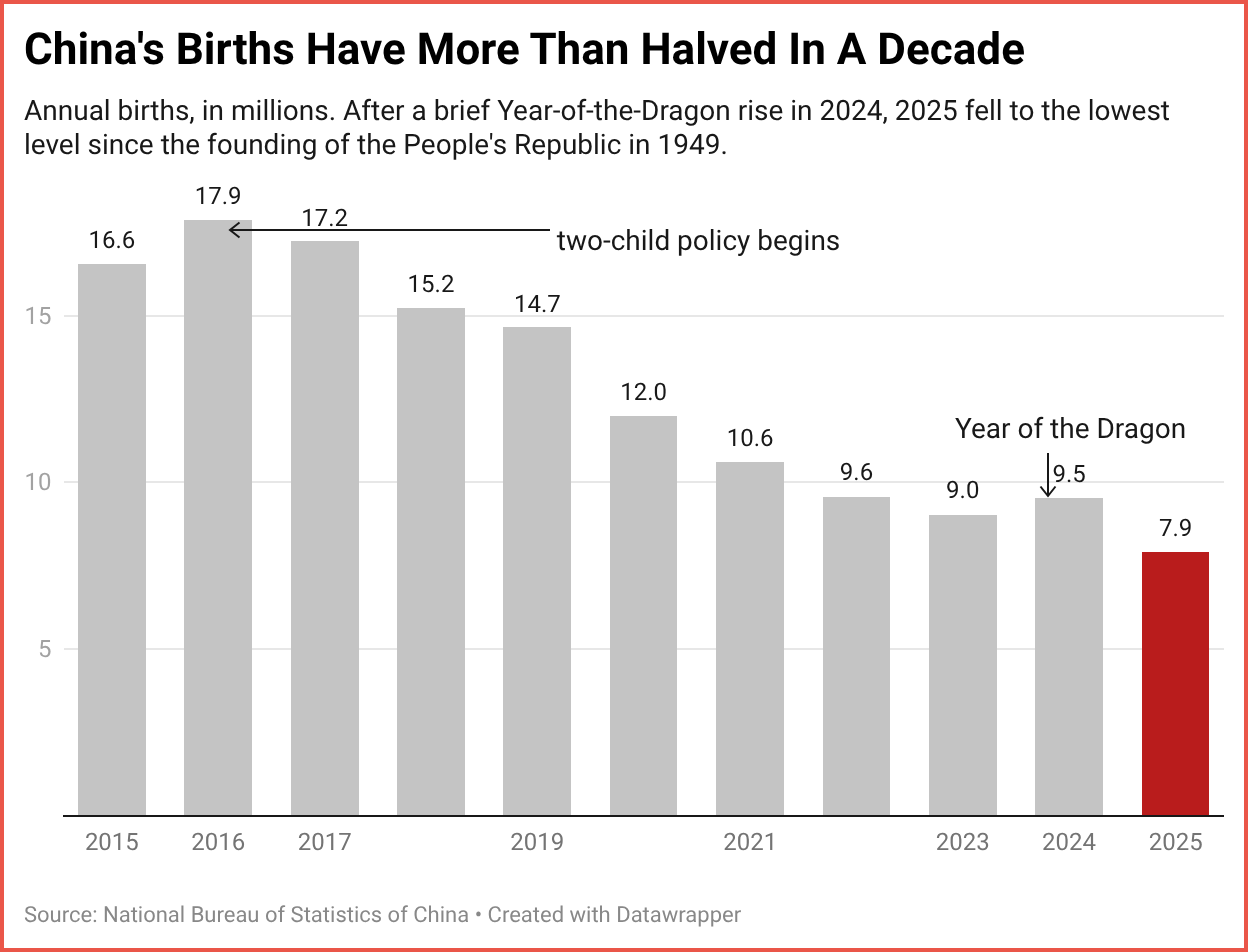
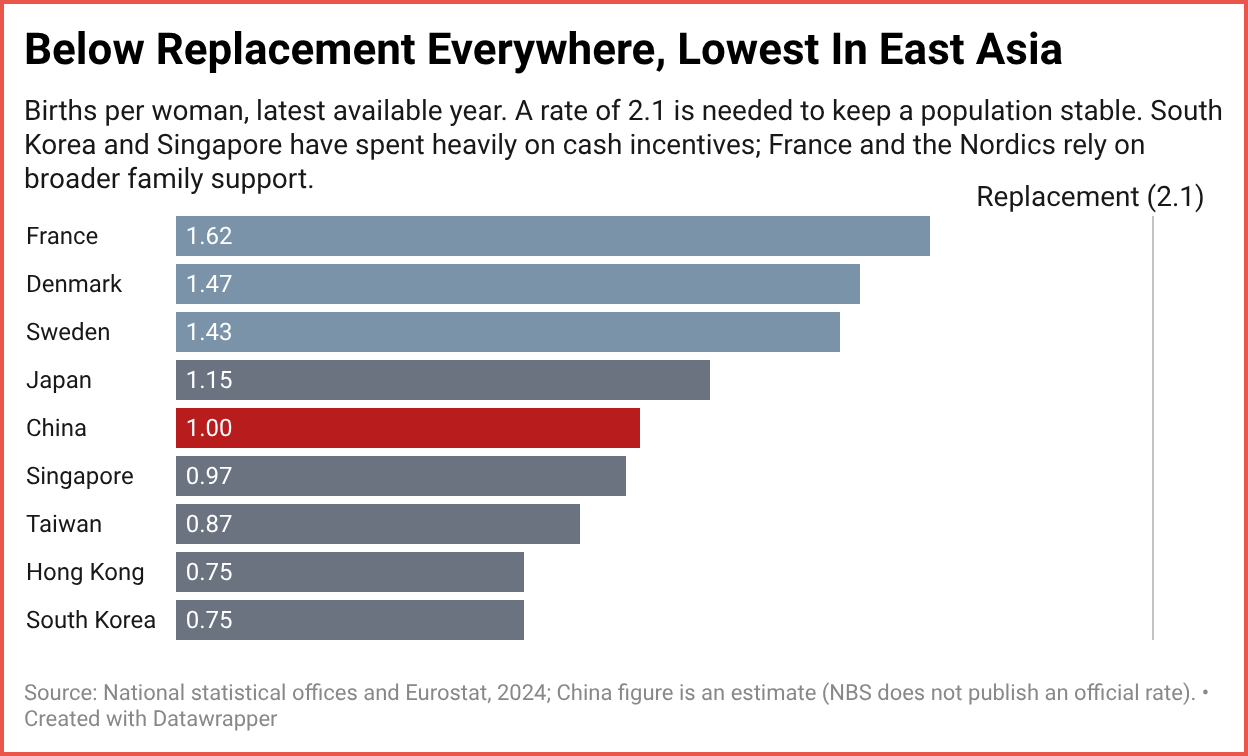
The demographic collapse cannot be laid entirely at Xi Jinping’s feet. The richest and freest societies in East Asia face the same problem, and several have fared even worse. South Korea, a democracy that has spent more than $200 billion trying to reverse its falling birth rate, has seen its fertility rate fall to about 0.7, the lowest ever recorded. Taiwan, Singapore, Hong Kong, and Japan also remain well below the level needed to sustain their populations.
Across the affluent world, raising children has become more expensive, careers more demanding, and family support less reliable. Women with greater educational and career opportunities are also choosing to have fewer children, or none at all. Add the delayed effects of China’s one-child policy, and demographic decline was coming regardless of who governed the country.
The case against Xi concerns what came afterward. He cannot order a demographic recovery, and he refuses the one approach that might produce one. His government is built to command supply. When it wants a city built or a railway laid, resources move, and the work gets done. Having a child is different. It is a decision households make about their own future, and they make it only when they feel secure.
The economy Xi has built gives them every reason to be cautious. Housing is unaffordable, the social safety net remains thin, the job market for young graduates is weak, and educating even one child can consume a large share of a family’s income. As Wang Feng, a sociologist at the University of California, Irvine, observes, government policy has little influence over whether young adults start families because they are trapped in an economy where living costs keep rising while incomes stagnate. It is the same loss of confidence that froze China’s housing market, as an earlier part of this series showed.
China’s own experience shows the limits of state power over family life. In 1980, Beijing imposed the one-child policy and demonstrated that an authoritarian government could drive births sharply lower. It worked. Thirty-five years later, the same government reversed course, ending the policy and urging couples to have more children. The response was muted, and births continued to fall.
Governments can coerce people into having fewer children, but they can never compel them to have more, and the only force that lifts births again is money, spent in a particular way. Starting a family depends on confidence in the future, not official slogans. That confidence returns only with direct support for households: affordable housing, reliable childcare, stronger social protections, and financial help that brings down the cost of raising a child.
That is where Xi has drawn the line. As with the property crisis, he has refused to put money directly into the hands of ordinary families. Doing so would mean trusting households to make their own decisions instead of directing the economy from above.
Xi has responded with modest incentives and public campaigns. In 2025, his government introduced a cash allowance of about $500 a year for each child under three and continued state campaigns urging young people to marry. On January 1 this year, it went further by imposing a tax on condoms. The centerpiece is the new chapter in the five-year plan under the slogan “invest in people.”
Yet the plan shifts much of the burden onto businesses, households, and local governments, many of which remain financially crippled by the property crash. The central government, which has the fiscal capacity to act, has largely kept its own budget on the sidelines. Even on one of the highest-return reforms available, granting migrant workers pensions and urban residency rights so they can settle down and raise families, analysts at Rhodium Group find no sign of significant new central funding.
Several countries have slowed, though not reversed, similar demographic declines. France, Sweden, and Denmark have birth rates well above China’s because they have invested in policies that make raising children more affordable, slowing the decline to a survivable glide rather than a free fall. They provide dependable childcare, generous paid parental leave shared by mothers and fathers, and flexible working conditions that allow parents to keep both their careers and their incomes.
The well-understood remedy is costly, time-consuming, and requires a government willing to put money directly into households and to trust families to decide how best to use it. That is the one requirement Xi’s system cannot meet.
Faced with a shrinking workforce, Xi plans to invest heavily in automation, artificial intelligence, and robotics, betting that machines can replace the workers a shrinking generation will never supply. Rather than asking why young people have stopped having children, he is trying to re-engineer the labor supply.
The high-technology economy Xi is building creates fewer jobs than the factories it replaces, adding to the economic insecurity that has already discouraged young people from starting families. His answer does nothing for the birth rate and worsens the insecurity beneath it.
The pattern throughout this series has been consistent. People who feel poorer spend less, and the same loss of confidence that emptied the butchers’ counters and froze the housing market has now reached the most personal decision of all: whether to have a child.
Xi did not cause China’s demographic decline, but he has ensured that it will persist. The one proven remedy is the one step he refuses to take. A generation has looked at the future he offers and quietly decided not to bring children into it.
Loved it, hated it, or somewhere in between — tell us. Grade this article here and help shape what lands in your inbox next.
📉 THE CHINA FILES · June 27, 2026
Xi's China is contracting at home and overreaching abroad. The TIPP editorial board tracks the decline, one front at a time.
THE SUMMIT THEATER
🔹 Mr. President, Don't Go to China: Beijing is funding a regime that is killing American troops. A state visit now rewards the patron.
🔹 The Handshake in Beijing: The summit is just a photograph, unless Trump forces Xi to move on Iran.
🔹 The 25th Visit: The price column is still blank.
🔹 To Be Continued: Trump asked Xi for the only thing that mattered. Xi said no.
🔹 Xi's Reelection Theater: Every concession since Busan was for one photograph. The photograph was for his fourth term.
BANKROLLING THE AXIS
🔹 The Quartermaster: The drone that downed an American helicopter is Iranian. Its supply chain is not.
🔹 The Denuclearization Surrender: China's demand that North Korea disarm was also its leverage. Xi gave up both, just as Kim turns to confront Washington.
TAIWAN AND A HOLLOW ARMY
🔹 The Boxed-In Giant: On the map that decides a war over Taiwan, China is the trapped one, and Xi tightened the trap himself.
🔹 Xi's Question: Taiwan?
🔹 Ambiguity Top and Bottom: Xi asked whether America would defend Taiwan. The President preserves the ambiguity by design; the public, by indecision.
🔹 The Death Sentence: Xi is purging the men he handpicked. The army he is left with cannot fight the war he keeps threatening.
🔹 One Child, One Soldier: The demographic curse haunting Xi.
THE JAPAN MISFIRE
🔹 The Home Front: Xi staged a year of pressure on Japan for an audience at home, and lost the one abroad.
🔹 The Backfire: A year of Chinese pressure left Japan's new prime minister stronger than it found her.
THE PENETRATION OF AMERICA
🔹 The American Kill Line: The viral Chinese meme that explains everything wrong with Beijing's reading of America.
🔹 Inside the Wire: Americans want China out of the land, the supply chain, and the phone. The agreement is broad, and it is defensive.
CHINA IN DECLINE
🔹 The Pig Doesn't Lie: The pig the Party once promised would stay cheap now costs more to raise than it sells for.
🔹 Xi’s Lost Decade: A real estate bust the size of Japan’s, not yet halfway through. Xi holds the one tool that could break the spiral, and won’t use it..
👉 The full China dossier, with new dispatches as the story breaks. Subscribe to TIPP Insights →
Letters to the editor email: editor-tippinsights@technometrica.com
Subscribe Today And Make A Difference. Consider supporting Independent Journalism by upgrading to a paid subscription or making a donation. Your support helps tippinsights thrive as a reader-supported publication. Contact us to discuss your research or polling needs.
Reach our audience. For sponsorship and advertising opportunities, visit our Partner With Us page.