By Sergei Guriev, Project Syndicate | June 25, 2026
With Ukraine reclaiming territory, mounting drone strikes deep in Russian territory, and draining Russia’s coffers, Vladimir Putin would do well to seek a negotiated freeze to the conflict. But there is no guarantee that he will, not least because he might not grasp the situation Russia is in.
LONDON—Russian President Vladimir Putin has had a tough few months. While the Ukraine war never unfolded according to plan, Putin believed, until recently, that time was on his side. Russia managed to increase its share of occupied Ukrainian territory in 2025—albeit only slightly, from 18.5% to 19.3%. More important, US President Donald Trump appeared eager to pressure Ukrainian President Volodymyr Zelensky into a “peace agreement” that handed even more Ukrainian territory to Russia.
But the picture is very different this year. Trump has been so preoccupied by the crisis in the Middle East that Ukraine has largely fallen off his radar, saying at the G7 summit this month that the US has “nothing to do” with a war that is “thousands of miles away.” And there is little reason to think that the Trump administration will be more inclined to help Putin secure a favorable outcome after the midterm congressional election in November.
At the same time, Russia’s military is no longer making progress on the battlefield. If anything, it is losing ground to Ukrainian forces. As of June 2026, Russia occupies 19.4% of Ukrainian territory—a negligibly higher share than in January, and lower than in May. Ukraine owes this shift to its breakthroughs in drone technology and massive increase in drone production, which have helped to stabilize the front line and neutralize Russia’s manpower advantage.
Ukraine’s drone superiority has also enabled it to overcome Russia’s air defenses and strike deep into Russian territory, including Moscow and Saint Petersburg. The strikes, especially on energy infrastructure, have delivered a powerful message to Russians: this war can no longer be dismissed as some distant drama. It is coming to the heart of Russia.
The Kremlin is shaken. That much was apparent at last month’s Victory Day parade in Moscow, which was much smaller than usual and lacked the typical ostentatious displays of heavy military hardware. Russia’s leaders surely fear targeted attacks, including on personnel, especially after watching the United States and Israel assassinate Iran’s leaders in their own country.
Desperate to impede Ukraine’s drone capabilities, Putin has interrupted access to mobile internet across Russia, including in Moscow, fueling popular frustration. But the attacks continue, including on supply lines to Crimea, a crucial staging ground for Russian forces. While there is a chance that Russia could develop drone capabilities on par with Ukraine or strengthen its air defense in the coming weeks and months, time no longer appears to be on Putin’s side.
This is all the more true, because the bills are piling up. To be sure, the Iran war briefly improved Russia’s fiscal outlook. According to Russia’s government, buyers were paying $95 per barrel for Russian oil in April and $86 in May—double the average of the first two months of 2026 ($43) and much higher than the price assumed in the Russian government budget ($59). Citing higher oil prices, the International Monetary Fund in April raised its forecast for Russia’s 2026 GDP growth by 0.3%, bringing it to 1.1%.
But this boost was only temporary, and it could not offset the war’s massive drain on Russia’s coffers. Putin has already been forced to raise taxes, compounding the pressure on Russia’s ailing economy. GDP declined by 0.2% year on year in the first quarter of 2026. With Russia planning austerity measures, its economic performance is set to deteriorate further. Russia’s own government expects GDP to grow by only 0.4% this year. This will hardly improve morale.
Against this backdrop, it would be in Putin’s best interest to return to the negotiating table, in an effort to freeze the conflict. But there is no guarantee that he will, not least because he might not fully grasp the situation Russia is in. After all, the country has no independent press, and Putin’s advisers surely avoid delivering bad news to him. When Putin insists that Ukraine is on the brink of defeat—as he has done many times since the war began—he is probably trying to manipulate the public, but he might also believe it, at least partly.
This is the classic autocrats’ trap. When power is centralized, and dissent is stifled, the gap between the dictator’s perception of reality and the situation on the ground widens. This leads to unpredictable and often disastrous decisions—like sustaining a war that you can neither win nor afford.
Sergei Guriev, Dean and Professor of Economics at London Business School, is a former provost of Sciences Po and a former chief economist of the European Bank for Reconstruction and Development.
The Boom Years Are Very Much Over For China
China – the “Workshop of the World” – is facing an economic decline brought about by multiple factors, such as a collapsing housing market, depressed consumer spending (leading to deflation) and a cooling job market.
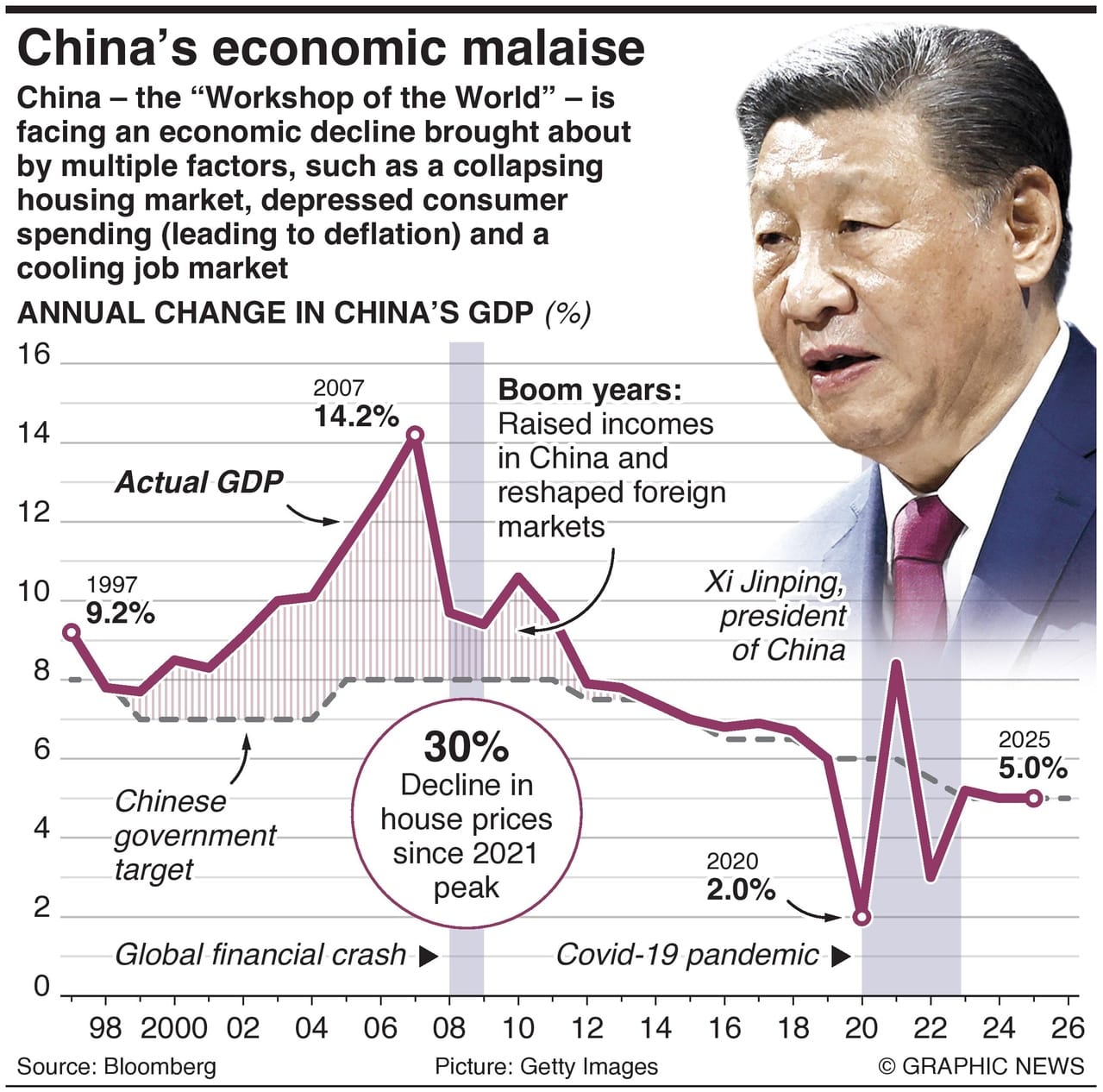
China’s rapid economic rise, which transformed living standards at home and markets worldwide, once seemed unstoppable.
That assumption is now being challenged after the government cut its 2026 growth target to 4.5–5% earlier this year, its lowest since 1991 and far below the double-digit growth rates of previous decades.
Although growth strengthened early this year, long-term pressures – including weak consumer spending, a prolonged property downturn, and a shrinking workforce – are slowing the world’s second-largest economy.
China Claims World’s Fastest Supercomputer
A Chinese supercomputer now tops the rankings ahead of its U.S. counterparts as the world’s most powerful for the first time since 2017. LineShine can make up to 2.198 quintillion calculations per second
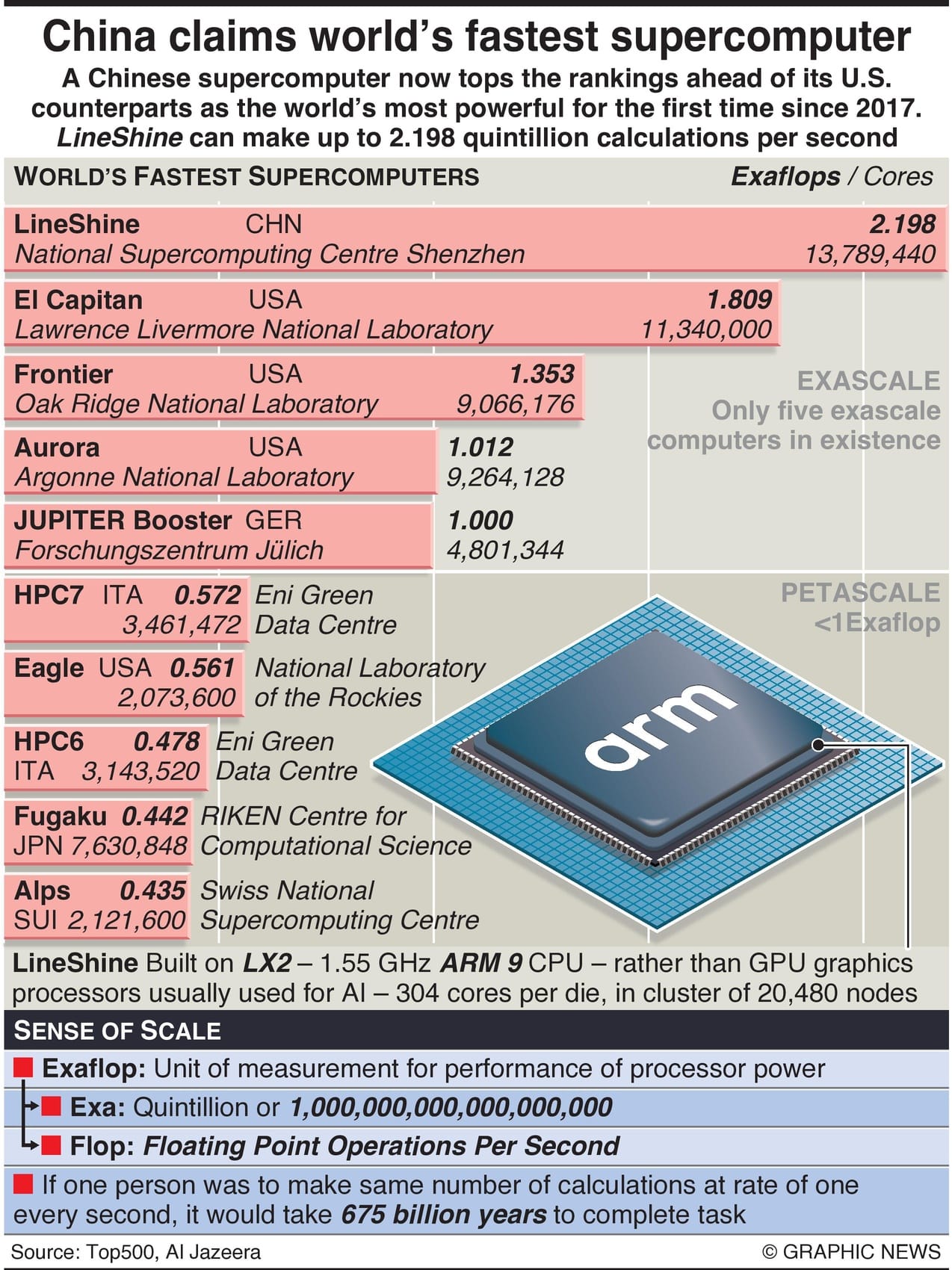
The LineShine supercomputer at the National Supercomputing Center in Shenzhen displaced El Capitan at the Lawrence Livermore National Laboratory, which had held the top-ranked position since November 2024, outperforming it by around 20%.
LineShine is based around the LX2 CPU, a 1.55 GHz ARMv9 processor, rather than the GPU graphics processors usually used for artificial intelligence. Each processor has 304 cores per die, and the system is configured as a cluster of 20,480 nodes, for a total of 13,789,440 cores.
🌍 Global Affairs
The world's flashpoints, in motion.
🟦 Devastating Earthquakes Deepen Venezuela’s Economic Crisis – TIPP News
🟦 Iraq Calls For Higher Oil Quotas As OPEC Tensions Grow – TIPP News
🟦 Can the Manchester Model Save Britain? – Diane Coyle, Project Syndicate
🏛️ National Affairs
The fights shaping America right now.
🟥 More Than 500 Migrant Children Face Potential Deportation Under Trump Plan – TIPP News
🟥 Supreme Court Backs Gun Owners In Hawaii Concealed Carry Case – TIPP News
🟥 Supreme Court Rules Federal Law Shields Roundup Label – TIPP News
📈 Economy
Prices, policy, and the pressure on your wallet.
🟩 What Drove America’s Inflation To A Three-Year High – TIPP News
🟩 Tanker Traffic Through Hormuz Pushes Oil Prices Lower – TIPP News
🟩 Why Does Chevron CFO Say Gas Prices Will Take Time To Fall – TIPP News
💼 Markets & Business
The deals and tickers making moves.
🟧 Micron Stock Rallies On Strong Earnings And Optimistic Outlook – TIPP News
🟧 How Will Amazon’s $48 Billion Bet Transform India’s AI Sector – TIPP News
🟧 What Sparked The Recovery In AI Chip Stocks – TIPP News
🟧 Memory Chip Shortage Drives Apple Device Price Hikes – TIPP News
📉 THE CHINA FILES · June 25, 2026
Xi's China is contracting at home and overreaching abroad. The TIPP editorial board tracks the decline, one front at a time.
THE SUMMIT THEATER
🔹 Mr. President, Don't Go to China: Beijing is funding a regime that is killing American troops. A state visit now rewards the patron.
🔹 The Handshake in Beijing: The summit is just a photograph, unless Trump forces Xi to move on Iran.
🔹 The 25th Visit: The price column is still blank.
🔹 To Be Continued: Trump asked Xi for the only thing that mattered. Xi said no.
🔹 Xi's Reelection Theater: Every concession since Busan was for one photograph. The photograph was for his fourth term.
BANKROLLING THE AXIS
🔹 The Quartermaster: The drone that downed an American helicopter is Iranian. Its supply chain is not.
🔹 The Denuclearization Surrender: China's demand that North Korea disarm was also its leverage. Xi gave up both, just as Kim turns to confront Washington.
TAIWAN AND A HOLLOW ARMY
🔹 The Boxed-In Giant: On the map that decides a war over Taiwan, China is the trapped one, and Xi tightened the trap himself.
🔹 Xi's Question: Taiwan?
🔹 Ambiguity Top and Bottom: Xi asked whether America would defend Taiwan. The President preserves the ambiguity by design; the public, by indecision.
🔹 The Death Sentence: Xi is purging the men he handpicked. The army he is left with cannot fight the war he keeps threatening.
🔹 One Child, One Soldier: The demographic curse haunting Xi.
THE JAPAN MISFIRE
🔹 The Home Front: Xi staged a year of pressure on Japan for an audience at home, and lost the one abroad.
🔹 The Backfire: A year of Chinese pressure left Japan's new prime minister stronger than it found her.
THE PENETRATION OF AMERICA
🔹 The American Kill Line: The viral Chinese meme that explains everything wrong with Beijing's reading of America.
🔹 Inside the Wire: Americans want China out of the land, the supply chain, and the phone. The agreement is broad, and it is defensive.
CHINA IN DECLINE
🔹 The Pig Doesn't Lie: The pig the Party once promised would stay cheap now costs more to raise than it sells for.
🔹 Xi’s Lost Decade: A real estate bust the size of Japan’s, not yet halfway through. Xi holds the one tool that could break the spiral, and won’t use it..
👉 The full China dossier, with new dispatches as the story breaks. Subscribe to TIPP Insights →
Letters to the editor email: editor-tippinsights@technometrica.com
Subscribe Today And Make A Difference. Consider supporting Independent Journalism by upgrading to a paid subscription or making a donation. Your support helps tippinsights thrive as a reader-supported publication. Contact us to discuss your research or polling needs.
Reach our audience. For sponsorship and advertising opportunities, visit our Partner With Us page.